Feeds:
Posts
Comments

Archive for March, 2012

I liked a story in the January 25 Boston Globe. It’s about a gourmet chef taking a job at a homeless shelter and helping to train residents with the marketable skills he knows best.

“Frank Van Overbeeke used to prepare foie gras and filet mignon for the French brasserie crowd as executive chef at Bouchee on Newbury Street,” writes Katie Johnston. “Now he makes cheeseburger meatloaf for the residents at the Pine Street Inn.

“In the shelter’s kitchen, he also oversees the preparation of jerk chicken with pineapple rice pilaf for the Boston Foundation, chicken tikka masala for Simmons College, and baked ziti for doctors at Boston Medical Center.

“Van Overbeeke’s move two years ago from haute cuisine to homeless shelter was a key step in Pine Street Inn’s efforts to develop a corporate catering business to increase revenues to support its food service job-training program.” Read more.

Another job-training program in the culinary arts has been going since 1983 at a prisoner pre-release facility in Concord.

Betsy Levinson writes in a March 29 Globe article, “Four days a week, diners pay $3.21 to enter one of the drab gray buildings at the Concord rotary, drop off their licenses at security, and line up for a seat at one of nine tables in the cafe known as the Fife and Drum.

“Inmates serve as waiters, cooks, and busboys, all trained by chef Kim Luketich. Those who complete the 10-month culinary arts program get a Serve Safe food-handler certificate, making them eligible for work in restaurants.

“ ‘I love it,’ said Jacqueline Friedman, an Acton resident arriving for lunch. ‘It’s an experience. The guys are so nice and are trying so hard.’ …

“ ‘This is a premier program,’ said the superintendent. ‘No other facility has this kind of program that allows the community to come in and eat. We have some elderly who have come daily for years. It’s a great setting, a great atmosphere.’

“ ‘They learn quality skills,’ said Luketich. … “‘They learn social skills. The whole idea is that they will go back into society. That is what we focus on.’ ’’

Read more. As the article says, food service is one of the areas where there actually are jobs today, and it can be a way to get acclimated to dealing with the public.

Photograph: Bill Greene/Globe Staff

Read Full Post »

I went to Manchester, New Hampshire, today for an event designed to bring bankers together with community and economic development people.

The panelists were pretty interesting. A woman from the NH Small Business Development Center talked about what it takes to put together a financing package and what sorts of entrepreneurs are a good investment. For example, people like Richard Tango-Lowy, who do their homework.

Tango-Lowy kept his IT job while he researched everything about fine chocolate, traveling extensively in France and Italy. Almost as soon as he opened Dancing Lion Chocolate, he was successful. He got a great review in the Boston Globe. He has no cash-flow problems. His only problem is keeping up with demand.

“The entrepreneur’s Mayan-style drinking chocolate, made with milk or water, is served in large painted bowls,” writes Kathleen Pierce in the Globe. “This driven chocolatier and Manchester resident is more than a little obsessed with cacao. He works with chocolate maker Alan McClure of Patric Chocolate in Columbia, Mo., to create a house-blend derived from Madagascar beans.

“Like a vintner, Tango-Lowy selects the chocolates that go into his tasting squares, bars, and candies, paying close attention to flavor profiles and how a particular bean enhances the moment. ‘I think about how long will it linger in your mouth. There are ones that hit the fragrant front and each piece evolves as you eat it,’ he says.

“When you discover that Tango-Lowy is a physicist, his approach to chocolate begins to make sense.” Read more.

Read Full Post »

In Slate magazine, Katie Roiphe wonders whether good children’s book writers need to be childlike themselves.

“Is it possible that the most inspired children’s book writers never grow up? By that I don’t mean that they understand or have special affection or affinity toward children, but that they don’t understand adulthood, and I mean that in the best possible sense. It may be that they haven’t moved responsibly out of childhood the way most of us have, into busy, functional, settled adult life.” Read more.

Roiphe may be right about certain children’s writers, but I think she misses an important aspect of Margaret Wise Brown and Goodnight Moon. The book is based on research conducted at the Bank Street School in New York. Educators there observed that very young children like to hear about common things that they see around them and know about. And they like repetition. Watching toddlers react to Goodnight Moon is proof of the theory.

Some people known for their children’s books were indeed Peter Pans who never grew up. Hans Christian Anderson comes to mind. Roiphe mentions Lewis Carroll. But surely the most important thing, whether you are a childlike children’s author or an adultlike children’s author, is to see things the way children do. Ed Emberley, the subject of my March 24 post, is an example. Mister Rogers, too, for that matter. I became an instant convert to Mister Rogers when I saw how my 3-year-old responded to him.

Would love to hear your take on this.

Read Full Post »

Mice find Verdi and Mozart more healing than Enya. Tom Jacobs at Miller-McCune (now called Pacific Standard) explains.

“Writing in the Journal of Cardiothoracic Surgery,” he says, “a team of Japanese researchers led by Dr. Masanori Nimi describe an experiment in which a group of 8- to 12-week-old mice underwent heart transplants. The rodents were randomly assigned to one of five groups: those exposed to opera (a recording of Verdi’s La Traviata, conducted by Sir Georg Solti); instrumental music by Mozart; New Age music (The Best of Enya); no music; or ‘one of six different sound frequencies.’

“After one week, the mice whose personal soundtrack featured Enya, one of the sound frequencies, or no music at all ‘rejected their grafts acutely,’ the researchers report. …

“In contrast, those exposed to Verdi or Mozart ‘had significantly prolonged survival.’ …

“In explaining the results, the researchers point to the immune system. They report exposure to classical music generated regulatory cells, which suppress immune responses and are thus vital to preventing rejection of a transplanted organ. …

“In any event, this provides more evidence that classical music has a health-inducing impact on the body.” Read more.

Hmmm. You want to suppress your immune system when you have a transplant because you don’t want your body to reject an organ from a donor. But suppose you want a strong immune system for some other reason? Would classical music be bad for you (or a mouse) in that case? Hard to get my head around that one.

Read Full Post »

I was interested in an article in today’s NY Times about a school that gives chronically failing students another chance. It succeeds against all odds, but success is a slow process. New York’s mayor is not a fan, because many kids take six years to graduate.

Aniah McAllister, once a lost and wandering soul, has one of the happier stories. Reporter Michael Powell writes that she seems amazed to have earned 46 credits and to be headed to college.

“ ‘This school made realize,’ she says, ‘that I am much better than I thought I was.’

“That’s a pretty fair bottom line for any school,” writes Powell, “although in the up-is-down world of public education in New York, it might just be an epitaph for this small marvel of a high school. Known as a transfer high school, Bushwick Community admits only those teenagers who have failed elsewhere. Most students enter at age 17 or 18, and most have fewer than 10 credits.

“You can muck around quite a bit trying to find someone who has walked the school’s corridors, talked to its students and faculty, and come away unmoved. Most sound like Kathleen M. Cashin, a member of the State Board of Regents and a former superintendent. ‘They care for the neediest with love and rigor,’ she said. ‘They are a tribute to public education.’ ”

Read the article. I’m hoping it will have an influence on the policymakers and let an initiative that sounds so positive keep going.

Aniah McAllister, left, Justin Soto and Kassandra Barrientos attend Bushwick Community High School. Photograph: Kirsten Luce, NY Times

Read Full Post »

Back in December, Asakiyume and her daughter and I went to see a graphic art exhibit in Fitchburg. We were all quite taken with a dark, wordless story that Lynd Ward carved nearly a century ago. So I thought I would mention that, according to the New York Times, a documentary about Ward will be shown in Maine next Saturday.

Scroll down in a column by Eve Kahn, here, to the subhead “An Illustrator’s Life.”

“The prolific illustrator Lynd Ward had fans as diverse as superhero-comic-book collectors, the poet Allen Ginsberg and the graphic novelist Art Spiegelman. In the 1920s and ’30s Ward carved woodblocks for wordless books about capitalism’s oppressive side effects. …

” In later years Ward mainly illustrated stories by other authors, but his compassion for the underdog still came through, especially in his 1942 watercolors for Hildegarde H. Swift’s ‘Little Red Lighthouse and the Great Gray Bridge.’ “

The Times reporter interviews filmmaker Michael Maglaras, who “has devoted much of the past two years to a new movie, ‘O Brother Man: The Art and Life of Lynd Ward,’ which will have its premiere on March 31 at the Maine Festival of the Book in Portland.

“Mr. Maglaras and the producer Terri Templeton based the film partly on archives that the family preserved after Ward’s death in 1985, and they extensively interviewed Ward’s younger daughter, Robin Ward Savage.”

Now, that is a movie I would like to see. Here’s a clip.

Read Full Post »

Summer Stages Dance, an unusual summer program at Concord Academy, had a fundraiser today, a Dance Feast. From noon to five, people of all ages and abilities could take classes with top choreographers and try ballet, modern dance, hip hop, Indian dance, Isadora Duncan dance, Irish dance, yoga, rope performance, Ghanaian dance, taiko drumming, and more.

At 5 p.m., the choreographers and their companies presented short performances in the gym. The program was characterized not only by inventive movement but by intellect, emotion, and humor.

I was particularly moved by Catherine Gallant’s second selection from the work of Isadora Duncan. The first selection was lovely and what you might expect of Isadora Duncan, sort of woodland nymphs. The second was fierce, angry, passionate. I was amazed.

Also powerful was David Dorfman‘s on-the-spot creation, a dance with words.

Amy Spencer and Richard Colton are the married dance team behind Summer Stages. They teach at Concord Academy. Their summer program gives professional choreographers a time to create while also teaching some classes and performing. It has been going 15 years and is considered quite unique in the country.

David Parker, son of the late mystery writer Robert B. Parker, is a regular participant. I’m including a sample of his work. He brings a lot of humor to his choreography. Today he did the Velcro dance, Slap-Stuck.  Search on YouTube for “Sisters and Misters” or “Nut-Cracked,” Parker’s version of the traditional Christmas favorite.

Read Full Post »

I went to the Concord Library today to hear children’s book author and illustrator Ed Emberley give a charming talk to a crew of little kids sitting on a rug.

Emberley used an easel and colored chalks to demonstrate simple ways to create pictures. It was clear that he was used to talking to young children and loved making them laugh. The kids responded gleefully. Grownups did, too.

Several fans asked him — and his wife and collaborator, Barbara — to sign books they had brought along. One woman told me that her kids, now grown, still knew all the words to the Emberleys’ book Drummer Hoff, winner of the 1968 Caldecott Award for  illustration.

I took home a worksheet with Emberley’s drawing tips so I can do more-interesting doodles in long meetings at work.

Read Full Post »

Last night I went to a jazz benefit for the nonprofit Kids4Peace Boston, which sponsors a summer camp and other events for children of three faiths — Christian, Muslim, and Jewish. The children are from both the United States and Jerusalem and are 11 to 12. Read more about the program here.

The fundraising event was held in the Grand Circle Gallery in Boston, which features magnificent travel posters and travel photography from the 1930s and 1940s. The entertainment was provided by Indian vocalist Annette Philip and her jazz quartet. Very impressive.

Read Full Post »

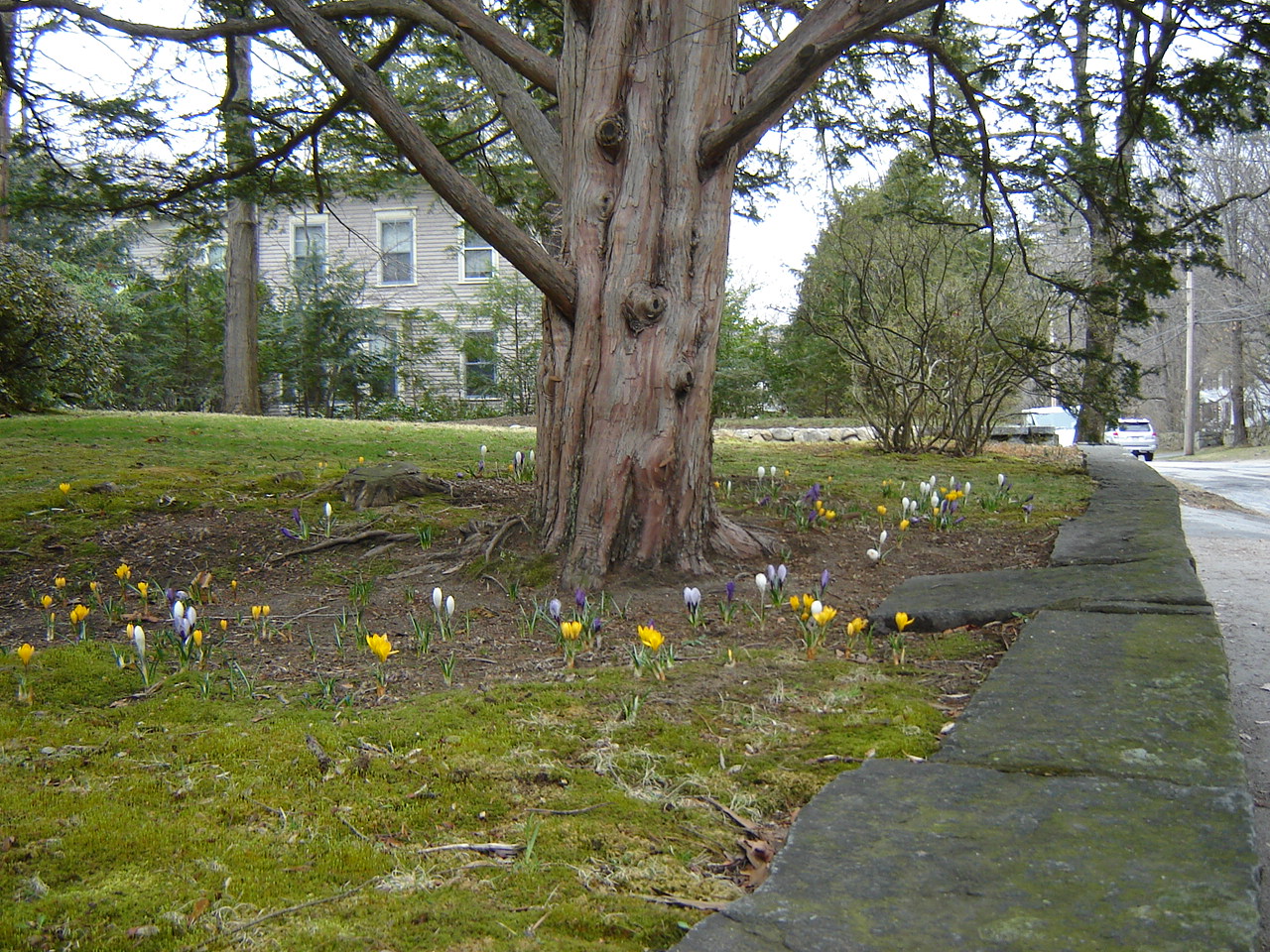
Who would have imagined it would be 80 degrees in March! I certainly enjoyed being able to take a walk I usually take in the summer and check out the flowers and art.

Search this blog on “Greenway” for more pictures and posts about the lovely Rose Fitzgerald Kennedy Greenway in Boston. Here’s what it looked like today.


Read Full Post »

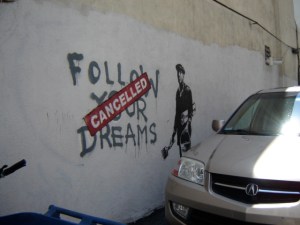
I am intrigued by street art, and have blogged a few times about the British street artist Banksy. For example, here.

So I wanted to share Nicholas Barber’s article “The Full Banksy Experience” at More Intelligent Life.

“Last week I was driving home along an unlovely stretch of main road in east London,” writes Barber, “when I saw what looked like a billboard on the side of a building. It had a friendly message printed in neat black letters: ‘Sorry! The lifestyle you ordered is currently out of stock.’

“It took a few seconds to process. It was definitely pithy, and definitely cheered me up at the end of a boring drive, but what was it? An advert? Did it have The Economist’s red logo at the bottom? Or was it … could it be … a Banksy?

“A few days later, an item in the local paper confirmed that it was indeed a Bansky, and a photo was on the artist’s website. I felt as if I’d lucked into a new artistic experience.

“The pleasure you get from a Banksy comes from the whole process: the chancing upon on an artwork in the unlikeliest of places, the speculation over how it got there, the uncertainty over whether it’s his or not, the subsequent authentication, and then the knowledge that it might have been rubbed out by the time you return.”

That is similar to my own reaction, except for the fact that I knew what I was looking for. And to this day, it has not been “authenticated.” Do you think it looks like a Banksy?

Read Full Post »

Language is Funny

Language can be funny.


I like thinking about all the ways that the sign in a local shop window — “Craft Butchery” — could be read. Maybe the term is familiar to you, but it struck me funny. “We butcher arts and crafts”?

I guess it all depends on the meaning of “craft.” Small craft, as in small craft warning? “Hurricane predicted. Ignore this small craft advisory and invite craft butchery.”

If I saw the sign in Salem, I might conclude it was short for witchcraft butchery, but I still wouldn’t know if it was butchery by witchcraft or butchery of witchcraft.

Well, as you likely assumed straight off, the store sells cuts of meat. And the butcher is an artisan in his field.

Read Full Post »

Living on Earth, a national radio program produced in Somerville, Massachusetts, has interviewed an interesting guy who makes audio recordings of nature.

He may record, for example, what a woodland sounds like before a logging company comes in and what it sounds like after clear cutting. He may record the sounds of insects in trees. He says it is nearly impossible to get away from man-made sounds when recording nature.

Listening to his recordings early this morning resulted in my listening for the birds more on the walk I took later. (And I turned to see a very jubilant cardinal.)

“Few have heard the world as Bernie Krause has. Originally trained as a musician, he spent years recording the most famous musicians of the 1960s and 70s. Then he left the studio to explore the origins of music in nature. Krause has recorded wild sounds in places few have ever been or even dreamed of. Living on Earth’s Ike Sriskandarajah listens in.” Listen here or read transcript.

Krause calls his field of study soundscape ecology. Here is his new book, The Great Animal Orchestra.

Read Full Post »

in Just-
spring          when the world is mud-
luscious the little
lame balloonman
whistles          far          and wee
and eddieandbill come
running from marbles and
piracies and it’s
spring …
– from e.e. cummings

Read Full Post »

Older Posts »

Follow

Get every new post delivered to your Inbox.

Join 253 other followers