Feeds:
Posts
Comments

Archive for January, 2013

At work we have partnered with an urban high school for 35 years. Tomorrow a group of 15-year-olds from the school will come into the office for Job Shadow Day.

The students fill out a form in advance to let their assigned mentor know something about them — favorite subject, least favorite, hobbies, career ambitions.

My student has an unusual ambition for a 15-year-old. She wants to be a philanthropist.

Perhaps I will tell her what I read recently about how many of today’s top philanthropists are active in their causes. They don’t just give money.

“The global face of philanthropy is changing,” writes the Christian Science Monitor. “Donors no longer just open their wallets. They’re actively involved in causes, use savvy business practices, and leverage what they give to achieve more good.”

One such philanthropist is F.K. Day. Read how his work has benefited people in Zambia and beyond.

“Life in rural Zambia has improved dramatically for dairy farmer Cecil Hankambe. He has doubled his milk sales, purchased a farm, and earned enough money to send his children to school. He still milks the same cow and travels the same rugged roads to the local dairy co-op. The only difference now: Instead of lugging a heavy jug on foot, he pedals a bicycle.

“Mr. Hankambe rides a Buffalo, a bike so sturdy and basic that its steel frame can carry up to 220 pounds and be repaired with a rock. Instead of delivering only seven to 10 liters of milk a day, Hankambe can now transport 15 to 20 liters to a chilling station before it spoils, boosting his profit.

” ‘A reliable bike can create reliability in a dairy farmer’s income,’ says F.K. Day, founder of World Bicycle Relief, a foundation based in Chicago that produces the Buffalo and provides two-wheeled aid to people in developing nations. ‘You forget how important transportation is.’ ”

Day started young, as young as the girl who will visit me at work tomorrow.

“As a teenager, he flew – on his own initiative – from Chicago to Brazil to knock on the door of Irish priests who were building schools in São Paulo‘s poorest neighborhoods. They hadn’t responded to his letters. But when he showed up on their doorstep, they had no choice but to put him to work.

“That experience laid the groundwork for what followed three decades later. On Dec. 26, 2004, horrific images of tsunami-swept Southeast Asia flickered on TV screens in the United States. Day, now a successful cofounder of SRAM, an elite bicycle-parts manufacturer, wanted to do more than just fund relief efforts. …

“So he and his wife, Leah, boarded a plane to Sri Lanka. Within weeks, Day had partnered with World Vision; he eventually oversaw the distribution of 24,000 bicycles that gave thousands of people affected by the tsunami the ability to reach their jobs, schools, and health-care centers.” His bikes are now in many countries were transportation needs are great.

” ‘If you can enter something new, open and honestly with beginner’s eyes, something good is bound to happen,’ says Day.”

How does one come by that core impulse to help? Probably it shows itself at a very young age. Even at 15.

Read about seven additional innovative philanthropists in the Monitor.

Photograph: Leah Missbach Day
F.K. Day, President of World Bicycle Relief & Executive Vice President of SRAM Corporation, pictured in downtown Chicago.

other innovative philanthropists

Read Full Post »

I can’t think how many times I have heard someone say that people should harness the energy from workouts on treadmills, biking, or running. Finally, a couple of college students did just that.

Nicholas Nehamas, Latitude News, writes about the students’ innovative idea.

“The company, Uncharted Play, has designed a fully functional soccer ball called the SOCCKET which can power an LED light. One minute of kicking around this portable generator produces around six minutes of light. Children in developing countries without reliable sources of electricity can play their favorite game and then plug in the light to read, do homework, and help illuminate their homes. …

“More than a billion families around the world use kerosene lamps as their primary source of light because electricity is either unavailable or too expensive. But as well as being a serious fire risk, kerosene lamps also endanger the health of those who breathe their fumes. …

“The SOCCKET is one innovative alternative to kerosene. [Jessica Matthews, CEO and co-founder of Uncharted Play], explains that the ball contains a pendulum, or gyroscope-like device, inside it.

“ ‘As the ball rolls, the mechanism also rolls, harnessing kinetic energy and
and then storing it inside a simple battery,’ she says. …

“ ‘We weren’t trying to change the world,’ says Matthews. ‘By no means were we trying to do anything beyond not failing the class.’ ”

More.

Read Full Post »

Photograph: Melanie Stetson Freeman/Christian Science Monitor
Eric Schwarz, chief executive of Citizen Schools, advocates ideas such as an extended day, hands-on learning, and adult mentors in classrooms.

At work, we have a relationship with an after-school enrichment organization called Citizen Schools. One day a teacher brought in a Citizen Schools group for a special event that my friend Lillian and I attended.

At the end of the program I said to Lillian, “Do you see that girl second from left? Don’t we know her?” And then we both realized the sixth grader had the previous year been in a reading-enrichment program where we volunteer.

It makes you think. There are young people in urban public schools who understand the importance of education and will grab every opportunity they can get.

But about Citizen Schools: “Eric Schwarz is remaking public education in the United States using a simple formula: Extend the school day, give kids adult mentors, and let them get their hands dirty,” writes Gregory Lamb at the Christian Science Monitor.

“The program, called Citizen Schools, has succeeded so well that Mr. Schwarz has been invited to the White House to explain how it works ..

“Now at work in 14 US inner-city school districts and on one Indian reservation, Citizen Schools is seen as a model for making dramatic improvements at low-performing schools. To do that it partners not only with AmeriCorps, the quasi-governmental service organization, but with some of the biggest names in US business …

“The idea is to level the playing field for students who grow up in low-income households.

” ‘In this country we have a growing achievement gap based on family income. It’s actually a bigger gap than it was 50 years ago,’ Schwarz says in an interview at the Citizen Schools headquarters in a renovated brick building on Boston’s waterfront, just one pier away from the replica of the historical Boston Tea Party ship. ‘The reason, I think, is not that poor kids are learning less, but that rich kids are learning more because their families are giving them all these opportunities to get violin lessons, go to robotics camp, get extra coaching and tutoring, and have lots of chances to be [around] successful adults.

” ‘Those opportunities are incredibly unequally provided in our society, and Citizen Schools changes that.’ ”

More.

Read Full Post »

Erik’s mother saw yesterday’s post on poetry slams and sent this.

“I do not know if you are aware of a competition held in England in April for young people 14-18 years old who recite poems by heart. You can read about it on www.poetrybyheart.org.uk. I found out about it when I read a Swedish newspaper where they suggested it would be good if they had this type of competition in Swedish schools too.”

When I was in school, we were obliged to memorize both poetry and Bible verses. I still remember poems and verses going back decades, even some lines in French. The trend away from any sort of “rote learning” has an unfortunate side.

Having beautiful words and cadences in your head can help you so much with your writing. (It also helps when you are standing in a long line with nothing interesting to think about.) Educators threw out the baby with the bathwater when they decided kids should understand, not just memorize, historical facts, science, and math. Understanding is good, and sometimes it comes from memorization.

I’m going to reuse a funny little poetry recitation that I posted once before. Jim Clark, Poetry Reincarnations, copyrighted the animation and explains it on YouTube.

Read Full Post »

I think I first heard about poetry slams from Patricia Smith when she was a columnist at the Boston Globe. I went with Kristina to hear her slam some poetry at Cambridge Adult Ed once. It was fun.

Patricia Smith had too much imagination to be a Globe columnist, but I still remember one of her stories that, if it wasn’t real in the usual sense was real on a level that has meaning for me. She has developed her poetry side since then and has won the awards she deserves.

Today my husband pointed me to an article on another poetry slam guru, Jack McCarthy.

Bryan Marquard writes in an obit in the Globe, “At some 200 lines, Jack ­McCarthy’s first published ­poem appeared in the Boston Sunday Globe in October 1976. Filling a page, ‘South Boston Sunday’ describes a family stroll through the neighborhood of his youth

“He thought the poem would launch his writing career, but that didn’t happen until another October, in 1993, when Mr. McCarthy took his youngest daughter to a poetry slam at the Cantab Lounge in Cambridge. He got up to read and the positive response brought an epiphany: The poet’s voice and the audience’s ears were inseparable.

“ ‘For me, the live audience is really the only audience I ever think about,’ he said by phone when he knew his death was near. “When I put something down on paper and publish it, my highest hope is that someone somewhere will pick it up and read it to a third party. My sense of audience does not stop with the person who reads the poem. I hope the poem goes on to another life.’ …

“ ‘The only ambition he seems to have is to tell the truth as best he can in poems,’ the poet Thomas Lux once wrote of Mr. McCarthy.”

Stephen Dobyns, a respected poet and one of my favorite mystery writers, called him “one of the wonders of contemporary poetry. He writes — and often performs — dazzling narratives full of wit and humor, sadness and hard thinking. He should be cloned.”

Read more about McCarthy here, about Patricia Smith here, about poetry slams here.

Photograph: Peter Vicinanza/file 2007/Boston Globe
Mr. McCarthy became well known after he in the 1998 documentary “SlamNation.”

Read Full Post »

Panera Bread has set up a foundation to fund Panera Cares, a pay-what-you-can opportunity for buying baked goods, sandwiches, and meals.

“The concept was born during the tough days of the recession. [Panera co-chief executive Ron] Shaich saw a television story about a cafe in Colorado that fed everyone at whatever price they could afford, which he said inspired him to find ways for Panera to address ‘food insecurity.’ …

“By May 2010, the first Panera Cares had opened in Clayton, Mo., a suburb of St. Louis. For the first one and others since then in Dearborn, Mich., Portland, Ore., and Chicago, Panera Cares sought locations that are easily accessible by public transportation and that attract economically diverse customers. …

“Panera’s vendors contributed to the [Boston] effort, giving about $80,000 worth of free furniture and lighting, along with cameras and and coffee. The rest of the money needed to open the store, an estimated $1 million, is being absorbed by Panera Bread’s corporate operations.

“ ‘It is a community cafe of shared responsibility,’ [Kate Antonacci, project manager of Panera Cares] said. ‘One of the goals of this charitable program is to help ensure that everyone who needs a meal gets one and to raise the level of awareness about food insecurity in the country.”

The Boston Globe’s Jenn Abelson has more here, with a follow-up on the successful first week in Boston, here. See the Christian Science Monitor‘s take, here.

Will you go? Will you pay full price or a bit more for others?

Photograph: John Tlumacki / Globe Staff
The Panera Cares Community Cafe opened in Center Plaza on January 24 with a pay-as-you-can approach.

Read Full Post »

From the Jules Verne classic 20,00 Leagues Under the Sea came a film with Kirk Douglas and a memorable Giant Squid. (Disney will probably sue if I embed a pirated trailer. See the official one here. It has the Giant Squid in it.)

Until very recently, no one could prove that such a thing as a Giant Squid even existed. I have seen renderings of what sailors might really have seen when they described a Giant Squid: for example, a whale with an octopus wrapped around it. And I just learned that the mythological Kraken may be the result of people seeing a Giant Squid and thinking it was a supernatural monster. (Oh, surely not the gentle Kraken of The Island of the Aunts!)

Here’s what made my day: the wonder and delight in the voice of the woman videotaping the first Giant Squid ever caught on camera, a creature that hangs out in the deep sea off Chichi island, Japan, where expeditions going down 3,000 feet have sought him for years.

You can hear Tom Ashbrook’s guests talk about this triumph at WBUR’s OnPoint program.

They are Richard Ellis, author of “The Search For The Giant Squid: The Biology and Mythology of the World’s Most Elusive Sea Creature,” and Edie Widder, the president and senior scientist at the Ocean Research and Conservation Association who filmed the Giant Squid.

“For thousands of years, sailors have told stories of giant squids. In myth and cinema, the kraken was the most terrible of sea monsters. Now, it’s been captured — on a soon-to-be-seen video.

From National Public Radio: “Even after decades of searching, giant squids had only been seen in still photographs. Finally, in last July, scientists filmed the first video of a live giant squid swimming some 2,000 feet below the surface of the Pacific Ocean.

“Edie Widder is the ocean researcher who shot the footage, which is slated to be released in a Discovery Channel documentary later this month.

“She told Jacki Lyden, host of weekends on All Things Considered, the elusive creature could have been as much as 30 feet long” More.

(I am spatially challenged and embarrassed to admit how many decades it took me to figure out that Captain Nemo traveled in his Nautilus 20,000 leagues horizontally, not straight down.)

Photograph: Edie Widder/Discovery Channel
A giant squid stars in this still image taken from the first-ever video of giant squids.

Read Full Post »

John sent me a good New Yorker story about “the Arslanköy Women’s Theatre Group, an all-female theatre group, based in rural Turkey, which is writing and performing plays.

“Ümmiye Koçak, who is now in her mid-fifties, was a forty-four-year-old farmworker with a primary-school education when she caught the theatre bug from a school play that a local school principal, Hüseyin Arslanköylü, had staged the previous year,” writes Elif Batuman.

“Ümmiye had never seen a play before, and it seeped into her thoughts. For a long time, she had been puzzling over the situation of village women and the many roles they had to play. In the fields, they worked like men; in villas, they became housekeepers; at home, they were wives and mothers.

“In 2000, with other women from her village, Arslanköy, she formed the Arslanköy Women’s Theatre Group. The group met every night at the school, after the women had worked ten- or twelve-hour days on farms. Their first production, a contemporary Turkish play called ‘Stone Almonds,’ sold out a theatre in the provincial capital of Mersin, and was written up in the national press.” Continued here.

Still more at the New Yorker blog, here.

I’m wondering about the mysterious figure at the left here. Hamlet’s father? But he doesn’t show up after people die, or does he? It was always a somewhat confusing play. As my father used to say, quoting I know not who: “The king dies, the queen dies, Ham dies — I calls it a helluva play!”

Photograph: New Yorker magazine
“Hamlet” performed in a mountain location near Arslanköy at dawn.

Read Full Post »

It’s a good day to think about someplace warm.

I was standing around chatting with friends while waiting for the train tonight. We were all complaining about the weather. When I said we should count ourselves lucky because it’s 35 degrees F below zero in Minnesota, a woman standing near me piped up saying that she was from Alaska and it’s 60 below there.

So this is about balmy Curacao.

Santiago Ortega writes at AlertNet (a “free humanitarian news site”) about Curacao’s plan to turn seawater to energy.

“A Dutch company called Bluerise B.V. and the company that owns Curacao’s airport  – Curacao Airport Holding N.V. – are exploring building a small 100-kilowatt marine power plant that will use the temperature of the seawater as a power source.

“In the tropics” — ah, the tropics! — “the sun heats the ocean surface and keeps it warm all year long. But at a depth of one kilometre (0.6 miles), sunlight can’t reach and warm colder waters, circulated from the Arctic.

“Ocean Thermal Energy Conversion (OTEC) works by deploying a pipeline in the ocean to pump cold, deep water to the surface and take advantage of the difference in its temperature with the warm surface water.

“Cold and warm waters are used in a process to condense and evaporate ammonia, causing it to move inside a closed-pipe circuit. Evaporated ammonia powers a turbine that generates electricity, and then is condensed to continue the cycle.

“The downside of the process is that the difference in temperatures is not very large, so the efficiency of the process – and thus the power production – is low when compared to conventional power plants. The bright side is that the energy resource is as abundant as the ocean itself.” More.

Photograph:  R. Norman Matheny/Christian Science Monitor
Costumed dancers perform a folk dance for tourists in Curacao, a Caribbean island nation that is considering using seawater to generate electricity.

Read Full Post »

Thank you, Gwarlingo, for tweeting this. Looks like there’s hope for us all.

“All your excuses are invalid,” says Dustin Kurtz in an article at the Melville House site about “the seventy-five year old winner of a prize for emerging writers.

“The semiannual Akutagawa prize was awarded in Japan this past Wednesday, and this season’s winner was Natsuko Kuroda. The Akutagawa prize, begun in 1935, is awarded for stories published in newspapers or magazines by new or emerging authors. Kuroda is seventy-five years old.

“Her story, ‘ab Sango’ (it can be previewed and purchased here) is unusual in that it uses no pronouns for its young principle characters, and is written horizontally across the page from left to right, rather than the standard top to bottom. The result is strange and beautiful, and hints at a genealogy of Popper-esque fairy tale formulae, of mathematics or of sociology, and all of which is given subtle cultural freight by Kuroda’s horizontal lines. But again — because it bears repeating — this intriguing emerging writer is seventy-five years old.

“Kuroda is in fact the oldest writer ever to be given the Akutagawa prize, and she is nearly as old as the prize itself. Ryunosuke Akutagawa, the award’s namesake and perhaps Japan’s most celebrated story writer, famously killed himself when he was less than half her current age.

“Upon receiving the prize, Kuroda said, ‘Thank you for discovering me while I am still alive.’ ” More.

Photograph: Melville House, an independent book publisher in Brooklyn, NY.

Read Full Post »

I’m going to repost the Poem-a-Day that Poets.org sent this morning. Readers who are into poetry may like it because it is Walt Whitman. (Even when Whitman writes prose, it sounds like poetry.) Readers who are into history may like it because it is Lincoln.

Specimen Days [The Inauguration]
by Walt Whitman

“March 4th.–The President very quietly rode down to the Capitol in his own carriage, by himself, on a sharp trot, about noon, either because he wish’d to be on hand to sign bills, or to get rid of marching in line with the absurd procession, the muslin temple of liberty and pasteboard monitor. I saw him on his return, at three o’clock, after the performance was over. He was in his plain two-horse barouche, and look’d very much worn and tired; the lines, indeed, of vast responsibilities, intricate questions, and demands of life and death, cut deeper than ever upon his dark brown face; yet all the old goodness, tenderness, sadness, and canny shrewdness, underneath the furrows. (I never see that man without feeling that he is one to become personally attach’d to, for his combination of purest, heartiest tenderness, and native Western form of manliness.) By his side sat his little boy, of ten years. There were no soldiers, only a lot of civilians on horseback, with huge yellow scarfs over their shoulders, riding around the carriage. (At the inauguration four years ago, he rode down and back again surrounded by a dense mass of arm’d cavalrymen eight deep, with drawn sabres; and there were sharpshooters station’d at every corner on the route.) I ought to make mention of the closing levee of Saturday night last. Never before was such a compact jam in front of the White House–all the grounds fill’d, and away out to the spacious sidewalks. I was there, as I took a notion to go–was in the rush inside with the crowd–surged along the passage-ways, the blue and other rooms, and through the great east room. Crowds of country people, some very funny. Fine music from the Marine Band, off in a side place. I saw Mr. Lincoln, drest all in black, with white kid gloves and a claw-hammer coat, receiving, as in duty bound, shaking hands, looking very disconsolate, and as if he would give anything to be somewhere else.”

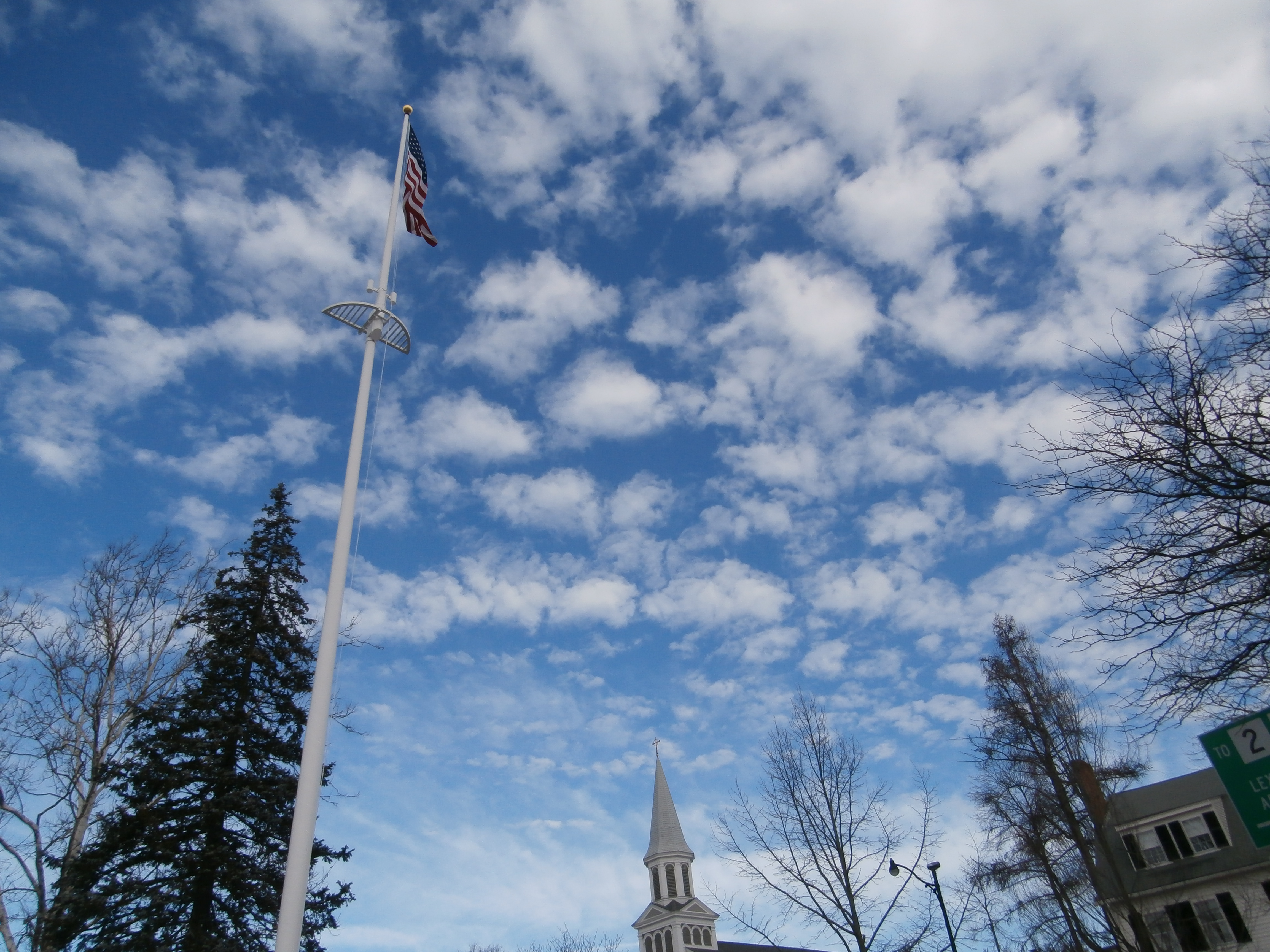
January sky

Read Full Post »

I have written a few times about the crowdfunding site Kickstarter (for example, in this post about a great documentary I saw).

I even participated in one campaign because Liz told me about a Pomona College professor who wanted to raise a small amount to publish a book on the artist Ben Shahn.

Sometimes there is a little sweetener (I was offered Ben Shahn note cards). Sometimes donors just want to see the thing get off the ground. If you don’t meet your goal in the allotted time, no one pays.

My impression is that Kickstarter is most suited to products that are ready to roll. Lisa Kocian wrote in the Boston Globe recently about a product I would definitely like to buy.

 “U-Turn Audio, founded by three Lexington High grads, is a few steps closer to bringing its affordable, sound-obsessed vinyl turntable to the mass market.

“In March, the trio won a $2,500 Prototype Fund grant from Northeastern University’s Center for Research Innovation. Seven or eight prototypes later, the three friends are trying to raise the $60,000 needed to start manufacturing their Orbit turntable, which will retail for about $150, according to Bob Hertig, one of the company’s cofounders.” More.

Tonight, with 28 hours left in U-Turn’s Kickstarter campaign, the team has raised more than 300% of their goal. (Note that different levels of funding are associated with different rewards, here.)

Read Full Post »

Photograph: http://americanflatbread.com/lareau-farm. Lareau Farm is home to American Flatbread in Waitsfield, Vermont.

@@@

A few of my readers will see “Waitsfield, Vermont” and think “skiing.” That’s because they were skiing there a couple weeks ago.

But this post is about the man who launched American Flatbread in Waitsfield in 1985, franchising his restaurant concept in other states and using his business success as a platform to advocate for the environment and other causes.

“In the fall of 1979,” writes Mike Ives for the Christian Science Monitor, “George Schenk stuffed all his worldly possessions into his pickup truck and moved from upstate New York to central Vermont. After settling in the sleepy ski town of Waitsfield, he began working as a dishwasher, freelance photographer, and live-in baby sitter.

“He also apprenticed at local restaurants and learned from chefs who were cooking in ways that emphasized local and regional ingredients. By 1985, Mr. Schenk was selling his own ‘flatbread,’ a variation on the brick oven-style pizza he’d eaten as a teenager, topped with Vermont produce.

“Serving nutritious food, he realized, was a good way to promote the kind of community values he’d absorbed in his Connecticut childhood and the ecological principles he’d embraced in his previous careers as a farmer and forester. …

” ‘I felt as though the environmental dimension of food needed a voice,’ Schenk recalls.

“Today, American Flatbread operates three popular Vermont locations, exports frozen pizzas nationwide, and is franchising its restaurant concept in other states.

“But profit isn’t Schenk’s only priority: For more than two decades he has donated thousands of his flatbreads to the poor and sick. He’s also held an average of eight benefit bakes each year to raise money for those in need.”

Although his political views and “civil disobedience” actions have often raised hackles, the people who know him best defend him.

“They insist his commitment to his employees and community is sincere and unwavering,” writes Ives. ” ‘I don’t always agree with George, but I always appreciate him,’ says Amy Shollenberger, former executive director of Rural Vermont, a nonprofit farm advocacy group. ‘He loves everybody, wears his heart on his sleeve — and walks his talk.’ ”

Read more.

Brian Mohr/EmberPhoto
George Schenk founded American Flatbread pizza as a way to showcase local produce and advocate for both community and global causes.

Read Full Post »

Global Envision is part of an effort at the nonprofit Mercy Corps “to foster a richer conversation about global poverty.”

Last fall, Global Envision’s Erin Butler set off to investigate technologies that help schools in impoverished parts of of the world.

“For some students, hopping on the school bus is hopping into the classroom. Four communities are using solar-powered mobile classrooms to overcome inaccessibility to the power grid.

“Last week,” writes Butler, “we looked at a bus in Chitradurga, India, that brought modern computer technology to students in energy-poor rural schools through solar power. SELCO, a private energy company, engineered the bus with 400 watts of solar modules, 10 laptops, fans, and lights.

“Circumventing the area’s erratic power supply with its solar panels, this bus provides much-needed modern computer education and exposure to the advantages of solar energy. Motoring through rural villages in Chitradurga since January 2012, the bus has reached ’60 schools and 2,081 children,’ the New Indian Express reported in early September. …

“Where there’s more water than land, boats replace buses, and with rising sea levels, low-income Bangladeshi students have difficulty getting to school altogether.

“Pushed to inaccessible riverside settlements that lack basic infrastructure, students often can’t get to school due to monsoon flooding. Shidhulai Swanirvar Sangstha, a nonprofit organization started by Mohammed Rezwan, rides the rising tides with his solar-powered floating schools.

“Trained as an architect and personally experienced with soggy school disruptions in Bangladesh, Rezwan rode a brainwave that led him to floating schools. Combining the best of traditional boat design and modern sustainable practices, the organization’s 54 boats have been operating since 2002 and have served over 90,000 families.”

Read about the other solar-powered schools here.

Photograph: Jayanta Shaw/Reuters/File
Students in Kolkata, India, check out their solar sunglasses as they prepare to watch the transit of Venus across the sun. The sun is being harnessed in India and Africa to power mobile solar classrooms for students.

Read Full Post »

In 1972, an idealistic young man graduated from Duke University and returned to St. Louis.

There Joe Edwards became both a successful entrepreneur and “a powerful force for civic good,” writes Marjorie Kehe in the Christian Science Monitor.  …

“Casting about for a career, he decided to bank on his love of music and opened Blueberry Hill, a small restaurant and bar that featured live performances. For his venture he chose a storefront on Delmar Boulevard, a retail area that locals call The Loop (named for the trolley that once used to turn around there).

“Back in the 1920s and ’30s The Loop was an elegant shopping street, and up through the ’50s it remained a major draw for young St. Louisans …

“But by the early 1970s the street had become a ghost town. About half The Loop’s storefronts were vacant or boarded up, and crime was rampant. Edwards remembers sweeping up debris and broken glass in front of Blueberry Hill each morning and feeling despair.

” ‘Within a week of opening Blueberry Hill I realized that I wouldn’t make it if the neighborhood didn’t make it,’ he says.

“And so began his campaign of gentle persuasion. ‘I talked to other residents, to city hall, to the police,’ Edwards says. He reminded them of what many seemed to have forgotten – that The Loop was a valuable asset, graced with appealing architecture and a rich history. He formed The Loop Special Business District and served on committees that worked on issues from lighting to sanitation to flower planters to security.

“But Edwards’s best move was to become a success. ‘The business establishment has been willing to listen to him because he’s been so successful,’ says Bill McClellan, a columnist at the St. Louis Post-Dispatch newspaper. ‘He’s an unusual combination – a hippie-visionary-business type.’ ”

Read more about how one person made a big difference in a city he loved.

Photograph: Ann Hermes/Christian Science Monitor
Joe Edwards sits in the display window of his restaurant Blueberry Hill on Delmar Boulevard in St. Louis.


Read Full Post »

Older Posts »