Feeds:
Posts
Comments

Archive for March, 2013

Planetizen’s Brent Toderian wrote a while back that he attended a book party in Vancouver where Simon Fraser University City Program Director Gordon Price asked “each member of the crowd to state an urban design decision that ‘they loved.’ …

“When it came to my turn, my answer took a big picture and perhaps surprising approach, depending on your definition of urban design. In Vancouver, a city often referred to as ‘a city by design,’ the most important urban design decision we ever made, the decision I loved most, is actually usually referred to as a transportation decision.

“In 1997, the city approved its first influential Transportation Plan.

“It was a game-changer for our city-making model in many ways, most notably in its decision to prioritize the ways we get around, rather than balance them. The active, healthy and green ways of getting around were ranked highest – first walking, our top priority, then biking, and then transit, in that order. The prioritization then went on to goods movement for the purposes of business support and economic development, and lastly, the private vehicle. …

“If you’re a driver who is worried about a ‘war on the car,’ remember this — our model of city building understands the ‘Law of Congestion’ and proves that when you build a multimodal city, it makes getting around better and easier for every mode of transportation, including the car. It makes our city work better in every way.”

Read Toderian’s whole Planetizen post, here.

Photo: Vancouver.ca

Read Full Post »

Back in first-grade, we learned to read from books featuring invariably blond, blue-eyed children. Today, primers have more variety, but multicultural pleasure reading, where it exists, is not always available to poor children.

Leslie Kaufman wrote recently at the NY Times that a  “nonprofit called First Book, which promotes literacy among children in low-income communities, announced the Stories for All project, a program intended to prod publishers to print more multicultural books. …

“In a 2012 study, the Cooperative Children’s Book Center at the University of Wisconsin-Madison evaluated some 3,600 books, looking for multicultural content. Of the books examined, 3.3 percent were found to be about African-Americans, 2.1 percent were about Asian-Pacific Americans, 1.5 percent were about Latinos and 0.6 percent were about American Indians.” More.

First Book picked two winning publishers in its first Stories for All competition — HarperCollins and Lee & Low Books — and purchased $500,000-worth of books from them. The books “will be available beginning in May through the First Book Marketplace, a website offering deeply discounted books and educational materials exclusively to schools and programs serving kids in need.”

Among the books are:  “Shooter”, Walter Dean Myers (HarperCollins); “Tofu Quilt”, Ching Yueng (Lee & Low Books); “In the Year of the Boar and Jackie Robinson”, Bette Bao Lord (HarperCollins); “The Storyteller’s Candle: La Velita de Los Cuentos”, Lucia Gonzalez (Lee & Low Books); “El Bronx Remembered: A Novella and Stories”, Nicholasa Mohr (HarperCollins); and “Passage to Freedom: The Sugihara Story”, Ken Mochizuki (Lee & Low Books).

More information at FirstBook.org.

Photograph: Strategies for Children

kids--teacher

Read Full Post »

Photo of Patricia McCarthy: Agenda

The editor of a small poetry journal in England was desperate for money to keep the magazine going, so she entered a poem of her own in a contest — and won.

The poem came straight from her mother’s memories of World War I. WW I poems — mostly written by young men in service who never came home — are some of the saddest ever composed.

At the Guardian, Alison Flood has the story on Agenda editor Patricia McCarthy’s win.

“McCarthy, who has published several poetry collections of her own, beat 13,040 other entries to win the anonymously-judged prize. Her winning poem, ‘Clothes that escaped the Great War,’ tells of the plodding carthorse who would take boys away to war, and then return, later, with just their clothes. ‘These were the most scary, my mother recalled: clothes / piled high on the wobbly cart, their wearers gone,’ writes McCarthy. …

“McCarthy said winning the £5,000 prize was ‘just extraordinary.’ “I’ve never even won a raffle. I don’t go in for competitions – the only other time I did was decades back, when I got runner-up,’ she said. ‘But I’m really down on my finances – I edit Agenda, and was really struggling, and thought this was probably better than a gamble on the horses.’ ”

More.

Read Full Post »

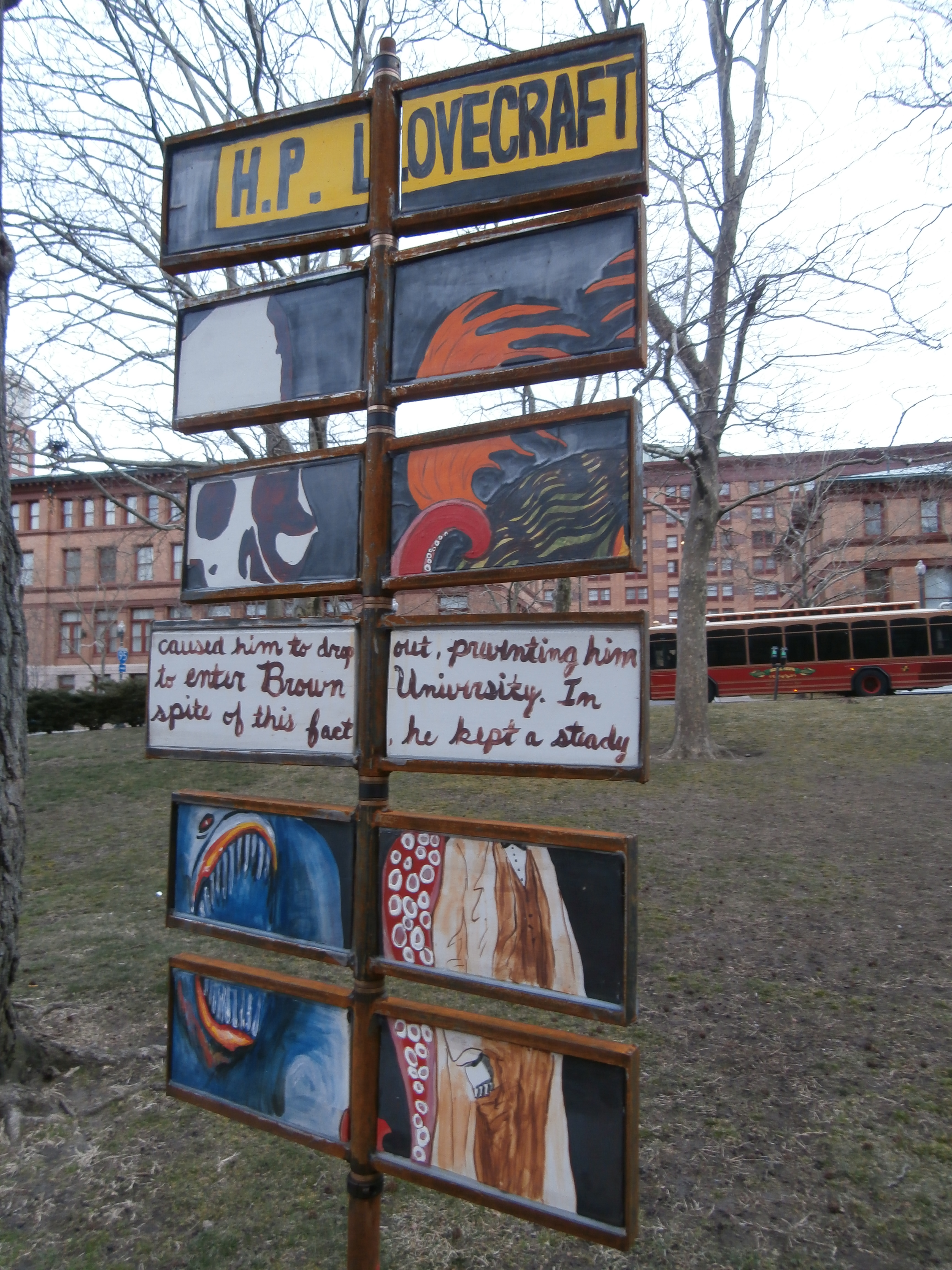
I was in Providence for a work event this morning, setting out early to miss the traffic.

I got to walk around a bit, and I’m going to show you my photos. If you are wondering why I took the first one, it’s because it reminds me of a song in Guys and Dolls, one of my favorite shows. Do you know the “Fugue for Tinhorns,” in which harmonic gamblers bemoan the lack of a location for “the oldest established permanent floating crap game in New York”?

It goes: “So the Biltmore garage is the spot. / But the one thousand bucks we ain’t got.”

biltmore garage

providence signpost

providence author lovecraft

water fire festival sign

tiles near riverwalk


tiles from children


Read Full Post »

I liked this National Public Radio story on a Jewish South American composer creating a St. Mark’s Passion that uses many ethnic styles and has enthusiastic urban kids in the chorus.

Anastasia Tsioulcas writes, “Salsa rhythms, Brazilian martial arts and a Jewish prayer of mourning: It’s not exactly what you would expect from a classical composer’s setting of the Gospel according to St. Mark. But that’s exactly what Argentine Jewish composer Osvaldo Golijov, a MacArthur ‘genius,’ did when he was asked to write a choral work based on one of the gospels, in a hugely acclaimed piece that’s been presented around the globe …

” ‘I never expected a Passion to have this funk and Spanish and everything inside it. I never thought I would be able to sing them,’ says Andrew Farella, a 16-year-old bass in the chorus. He and his friend Jerry Ortiz, another 16-year-old bass, say they’re thrilled to hear all these different kinds of music within Golijov’s work — ones they know well from their own lives.

” ‘I’m actually very excited to do this piece, me being from the Latin culture,’ says Ortiz, who is Dominican and Puerto Rican. ‘Everything that’s in here is based on my culture, my background. So I can feel the music when we sing it. I was kind of surprised to hear African and also Indian stuff. But he talked about how in Latin America we come from three places. There’s our white side, our Native American side and there’s our African side. And that’s basically what La Pasión is — coming from those three to combine into one, the Holy Trinity.’ ”

Follow this link to read more and hear the music.

Something different for Easter.

Photo: Chris Lee/Carnegie Hall
A coach and high school students work on Osvaldo Golijov’s Passion According to St. Mark with the composer (right) in November 2012.

Read Full Post »

Longtime readers may recall I took a playwriting class a couple years ago. One of the assignments — which I blogged about here — was to listen in on a conversation in a public place and write it down word for word. Very awkward, but a good lesson in the random way people really talk.

Now the artist/cabby Daniel J. Wilson has taken the concept to an extreme, recording customers’ conversations and using them in his art.

Matt Flegenheimer writes at the NY Times that while driving a taxi in New York, Wilson “secretly recorded the conversations of his passengers, assembled the highlights into an audio collage of the back-seat musings and installed the final product in his taxi, playing the clips for his riders …

“ ‘It’s this world where people act like you don’t exist, even though you’re three feet away,’ Mr. Wilson, 35, said from the front seat of his cab recently. ‘You get this fragment of a person.’ ” More.

Much has been done with the invisibility theme in literature: Ralph Ellison’s Invisible Man, the powerful Mammy in The Sound and the Fury, the murderer disguised as an “invisible” waiter in an Agatha Christie novel — you can probably come up with more.

The Times article discusses the invasion of privacy. I think invasion of privacy might be the penalty for treating humans as invisible.

Photo: Hiroko Masuike/The New York Times
Victoria Reis, left, called Daniel J. Wilson’s audio collage “the least pretentious and most experimental” work she had seen all week, and tipped him.

Read Full Post »

Portland, Maine, has a reputation for being welcoming to immigrants and refugees. As a result, newcomers have been giving back, taking seriously their training in how to start a business, for example, hiring people, and boosting the city’s economy.

In this story by Jess Bidgood at the NY Times, we learn about Portland’s “class intended to help immigrants from warm countries cope with the cold.”

Bidgood writes about newcomers “squeezed into a plain conference room at the city’s center for refugee services … to be schooled in a central piece of Portland’s cultural curriculum for its growing population of new arrivals, many of whom are asylum-seekers from Central Africa: the art of handling a Maine winter.

“The instructor, Simeon Alloding, a human services counselor here, sat at the front of the room, ticking off winter’s many perils as clip art images of a penguin and an elephant decked out for cold weather hovered in a PowerPoint presentation behind him. ‘Everyone here has fallen, right?’ Mr. Alloding asked as he began a discussion on how to navigate the city’s icy sidewalks. ‘You don’t walk too fast, you don’t take long steps.’ …

“On this slushy morning, there were more attendees than could possibly find seating, and late arrivals clustered around the entrances to the room, many still wrapped in winter coats and hats despite the stifling heat of the room.”

The refugees help each other with translation, but some questions are hard to answer, like how to know what tomorrow’s weather might be.

“Miguel Chimukeno, from Angola, rose to ask a question in Portuguese, which another student translated to French, which the French interpreter, Eric Ndayizi, posed to Mr. Alloding.

“ ‘He’s low income — zero income — and you said they should watch TV and know some information. How does he get TV?’ Mr. Ndayizi asked.

“ ‘There’s nobody that’s going to issue out TV’s,’ Mr. Alloding said. ‘My only suggestion is that you talk to your neighbors.’ ”

More.

Photo: Craig Dilger for The New York Times

Read Full Post »

My husband heard that the Kiev subway is a popular place for older Russians and Ukrainians to go dancing. So I Googled around a bit and found stories at Odd Stuff Magazine, here, and the Daily Mail, here. And a video at YouTube. In today’s world, you can’t keep a good story down.

At the Daily Mail (which seems to favor bullet points) Helen Lawson writes, “Saturday night fever: The subway where Kiev’s pensioners dance and find love.

  •     The dancers cannot afford to pay for a venue so they use a metro subway
  •     The group meets every Saturday at 7 pm to socialise and dance
  •     About 20 couples are known to have met thanks to the meet-ups
  •     Reuters photographer Gleb Garanich documented the weekly gatherings

At Odd Stuff, photographer Garanichev Hleb (is that the same Reuters guy?) asks the subjects of his photos about the dance scene. “Milevsky Nicholas was born in 1938 and Natalia Stolyarchuk born in 1955 met at these dances and has since moved in together. This is one of the 20 couples who met at these clubs. ..

“Despite his age, both retired and still work together earn about 4,000 hryvnia per month. …

“These people do not communicate in social networks, but still remember all the holidays of childhood and youth, when put on the table, to visit friends and neighbors come, everywhere sounded cheerful sounds of accordion.” More.

Read Full Post »

If I come to work early, I often take a walk at lunch. I love the Greenway, which is especially nice in spring and summer. And the Fort Channel district (the Mayor likes to call it the Innovation District) seems to have something new to see almost every week — repurposed warehouses, galleries, restaurants, pocket parks.

Fort Point Arts got bumped from its space next to Flour (a yummy restaurant) on Farnsworth, so one lunchtime I made a point of checking out its new space off A Street.

I especially like that they show art depicting the Fort Point neighborhood — partly because walking there makes me attached to that part of Boston, and partly because Fort Point is changing fast. (About 18 years ago, when I went to an arts open house there, many artists had studios with beds on ledges and  tiny kitchens. Some artists were squatting in dangerous buildings with wires hanging down, no heat, no doors, no lighting. That world is gone.)

Laura Davidson was one of the featured artists when I was last in the Fort Point Arts shop. She had some block prints of her neighborhood that I admired.

Be sure to check her home page. Everyone should have a home page that looks like a treasure map.

Art:Endangered Neighborhood” reprint of 1995 view of Fort Point), 2012, Laura Davidson

Read Full Post »

Being in the aging-happily business, Erik is always on the lookout for stories about how seniors are putting their own stamp on their later years, after they have given up skydiving.

He sent me an article about a gentleman called Martin Bayne, who has become a bit of an expert on assisted living, having tried one facility that literally drove him crazy and having eventually found one he loves.

Writes Judith Graham in the NY Times, “Sometimes Martin Bayne speaks in little more than a whisper, like many people with advanced Parkinson’s disease. But his voice has a way of carrying.

“Many consider him the nation’s foremost advocate for people in assisted living. … Dr. William Thomas, a geriatrician and nursing home reformer, wrote in an e-mail, ‘He has been able to do what very few others have done — he has told the story of life on the inside of long-term care.’

After his first assisted-living experience, says Graham, “Mr. Bayne relocated to a facility in northeastern Pennsylvania, where he has a single room and receives several hours of help from aides every day. From this perch, Mr. Bayne blogs about assisted living at thevoiceofagingboomers.com  …

Bayne tells Graham how critical he believes it is to reach out to the others around you when they feel down, “Sometimes just a hand on someone’s shoulder is all it takes. Sometimes picking up a fork that someone drops in the dining room on the floor. Sometimes, just sitting with someone. Trying to make people more comfortable. The simplest things in the world can lead to what I call incremental victories. That’s what I go for in my life.

“I sneak in touches whenever I can. I call them sneak attacks. I just go over and touch someone’s hand or some other part of them. Men are in need of it the most. Men are never touched, at least in this culture.”

Graham asks Bayne how he would run his dream facility, and he says, “First of all, when a prospective resident came to visit, I would have him sit down with 10 other residents. And we would ask, ‘What’s your passion? What motivates you? What’s your mission in life?’ If you don’t have an answer to those questions, then we don’t accept you. Because we want a community that is alive.

“There would be a welcoming committee for every new resident. You’d be taken around and treated like royalty when you first come in. We’d show you that we care about you.

“Once you’re here, you’d get a job. No matter how seemingly insignificant, you’d have responsibilities every day. And the emphasis wouldn’t be on you, the emphasis would be on the community.” More.

Some of the article is sad, but the idea that you can keep making things work for you — over a longer period of time than you may have thought —  is something to ponder.

“Dear Sir,” below, is the first art collaboration of Rhian and Ray Ferrer. Please visit Rhian’s WordPress blog for lots more art, http://artgland.wordpress.com.

Read Full Post »

I got this story from a recent post by Andrew Sullivan, who got it from Mark Frauenfelder at BoingBoing, who links to Leo Kent at Humans Invent.

It’s about Swiss artist/comedian Ursus Wehrli, who has written a book called The Art of Clean Up.

Leo Kent asks the artist how the book came about.

“I had already done two books before this one,” Wehrli answers. “The first two were about tidying up art and for the third one I devoted myself more to everyday situations or objects. I very often go to museums and I actually like modern art but I was standing in front of a piece by the very messy Swiss artist Jean Tinguely. He is famous for putting all sorts of colours, material and objects on a canvas and I tried to imagine what a cleaning lady would do if she had to clean up his studio.

“I imagined how she would not really know where the mess starts and the art begins so she would end up cleaning not only the floor and the tables but the artworks. I realised this was a fun approach because you really start to look at art very differently if you try to bring some order to it.” More.

More on Wehrli’s process here, at FastCoCreate.com, where Hugh Hart adds to the story.

(You just never know what will turn up next at Andrew Sullivan.)

Photo: The Art Of Clean Up

Read Full Post »

In case you missed it (ICYMI, as they say on twitter), National Public Radio had a delightful story about Irish Jews last weekend:

“St. Patrick’s Day in New York now means parades and green beer. But 50 years ago, it also meant green matzo balls at the annual banquet of the Loyal League of Yiddish Sons of Erin. The league was a fraternal organization of Irish-born Jews.

“The major migration of Jews to Ireland started in the 1880s and ’90s, says Hasia Diner, who teaches history and Judaic studies at New York University. Thousands moved [to Ireland], primarily from Lithuania. …

” ‘Then the Irish Jews, as Jews historically did, they went to where there were better economic opportunities,’ Diner says.

“A lot of Irish Jews found those opportunities in New York. Like many immigrant groups, they kept their culture alive in the New World. And in the early 1960s, they formed the Yiddish Sons of Erin.

“According to member Rosalyn Klein, the whole thing started as a joke. … A restaurant took out a newspaper ad for a meeting of Irish Jews. Klein thinks they didn’t really expect people, but a lot of them showed up.

” ‘And most of them had lived in Dublin, so it was kind of this mishpocha getting together again,’ she says.”

For many years after, a big Jewish St. Patrick’s Day celebration was held in New York and was de rigeur for politicians and celebrities.

More here.

Photo: SmittenKitchen.com.
This is a normal matzo ball. I couldn’t find a green one.

Read Full Post »

Once upon a time, mine workers were paid in paper chits that could be redeemed at the company store. (Remember the song “Sixteen Tons,” by Tennessee Ernie Ford and “I owe my soul to the company sto’ “?)

A while back I saw a story in the NY Times about refugee gardens, and there was a picture of someone using wooden coins to buy produce. It turned out that people were not being paid in wooden coins as miners were paid in paper. Instead, the City of San Diego was encouraging poor residents to pursue good nutrition by giving them wooden coins for shopping at farmers markets.

The coins were really just a footnote to Patricia Leigh Brown’s story, which focuses on a national movement to help immigrant farmers get back into the occupation they know best.

“Among the regular customers at [San Diego’s] New Roots farm stand are Congolese women in flowing dresses, Somali Muslims in headscarves, Latino men wearing broad-brimmed hats and Burundian mothers in brightly patterned textiles who walk home balancing boxes of produce on their heads.

“New Roots, with 85 growers from 12 countries, is one of more than 50 community farms dedicated to refugee agriculture, an entrepreneurial movement spreading across the country. American agriculture has historically been forged by newcomers, like the Scandinavians who helped settle the Great Plains; today’s growers are more likely to be rural subsistence farmers from Africa and Asia, resettled in and around cities from New York, Burlington, Vt., and Lowell, Mass., to Minneapolis, Phoenix and San Diego.”

Read how it works. (And click on the slide show to see the wooden coins. My eyes were drawn to them because my father’s favorite “good-bye” line to toddlers always was, “Don’t take any wooden nickels”!)

Photo: Sandy Huffaker for The New York Times
Khadija Musame, right, with a customer from Somalia at the New Roots Farm stand in San Diego.

Read Full Post »

The plant-identification site Mister Smarty Plants, which I first blogged about here on May 23, 2011, just keeps getting better.

One innovation from the past year has been rounding up tweets containing photos of flowers and plants that people around the world want help identifying and bringing them to the site to be identified by the growing number of readers.

I used to get a lot of identifications right, but Mister Smarty Plants queries are quite exotic now, which makes the site both exciting and challenging.

Today, John announced a new design with special features like kudos to the week’s most successful plant identifiers.

The Smarty Plants concept has always been that the more people who come to the site with their questions, the more who will be available to identify plants. John has been persistent about finding new ways to reach the folks who need the service.

Even if you think you don’t know much about plants, check it out. It’s almost like playing a game, and believe it or not, there are people in other parts of the world who don’t know what a dandelion is.

MisterSmartyPlants

Read Full Post »

Brian sent me information about Higher Ground Farm, which is putting down roots on the roof of the Design Center in South Boston.

“A roof farm is a type of green roof. A green roof is a system of layers that is laid over an existing roof. A green roof is beneficial to a building owner and the community because it protects the existing roof, doubling to tripling its life, thereby saving money and keeping materials out of the landfill.

“Green roofs also reduce a building’s energy costs by insulating in the winter and cooling the rooftop in the summer. Finally, green roofs temper the effects of two common urban environmental problems – combined sewer overflow and the urban heat island effect.

“A series of roof farms throughout the city will capitalize on the environmental benefits of green roofs while also increasing access to fresh, healthy food. Higher Ground Farm will operate several roof farms throughout the greater Boston area, utilizing previously unused space while providing additional rental revenue to a building owner.

“Roof agriculture has the potential to be a job-producing boost to the economy, and a completely environmentally sustainable business sector that can set Boston apart from other cities. Higher Ground Farm will utilize the resources of our top-notch universities to study roof agriculture, which will position Boston as a leader in the field. Finally, Higher Ground Farm will be a space where our community can reconnect to productive green space and learn about sustainable city planning.” More.

I also found a video interview about it that you will like, here.

Read Full Post »

Older Posts »