Feeds:
Posts
Comments

Posts Tagged ‘boston globe’

Isy Mekler, 13, wanted to do a charitable deed in anticipation of his Bar Mitzvah. Because he has always loved reading, he decided that what would be ideal would be to raise money for the early literacy program Reach Out and Read, which gets books to kids who need them.

Isy “wrote to hundreds of artists across the country and asked them to create a work of art that could be auctioned to raise money for books. …

“He was inspired, he said, by a favorite children’s book, Shel Silverstein’s The Giving Tree, which has an underlying message about generosity. He e-mailed some 300 artists and illustrators and asked them to paint or illustrate a three-dimensional cardboard tree, which he had manufactured in Colombia.”

About 35 artists responded, throwing “themselves into the project with such enthusiasm that their trees will be exhibited at the Danforth Museum and School of Art’s Children’s Gallery in Framingham, [Massachusetts] beginning in May. The auction, held online, will run concurrently.

“Author-illustrator Grace Lin of Somerville, a Newbery Honor book winner who is enamored of large origami animals, painted a tree with tiny origami birds.

“ ‘Not only was it for a good cause, I thought it would be fun to do,’ said Lin.” (BTW, I wrote about reading her book Where the Mountain Meets the Moon here.)

Read more about Isy’s outreach to artists and the artists’ responses here, in the Boston Globe.

Read Full Post »

There’s a new think tank at Babson College in Wellesley, Massachusetts, one that’s focused on food access.

Food access, food “deserts,” and sustainable agriculture are big issues these days, and Food Sol founder Rachel Greenberger believes that addressing the challenges must involve bringing together all the stakeholders, even agribusiness.

Greenberger refers to her strategy as the “uncommon table,” writes Kathleen Pierce in the Boston Globe. “Located at Babson’s Social Innovation Lab, the company seeks to identify how so-called food deserts — geographical areas without access to a grocery store or fresh food — are formed, and how to make healthy food sustainable for all. …

“Greenberger, a 33-year-old Babson MBA graduate who studied food-system dynamics and consumer behavior in the sustainable food movement, came up with the concept for a company similar to a think tank, but centered on action. By creating a digital map to pinpoint food-related issues, Food Sol intends to highlight pressing topics such as food deserts and fair trade, linking experts in the field with would-be entrepreneurs to ignite working relationships. …

“Food Sol intends to foster ‘a way into thinking about innovation in the food-supply chain, whether it’s creating more cooperatives or building agribusiness in Fall River,’ says Cheryl Kiser [executive director of Babson's innovation lab]. ‘We are a laboratory where people can come and engage in conversation.’ “

The theory is that companies will pay to engage in a food think tank like this. In fact, Kiser hopes to involve Cargill Inc., Monsanto Co. , PepsiCo , the Coca-Cola Co., and more. Read more here.

The mention of entrepreneurs who might address food issues is reminding me of two young women who recently launched shipping-container grocery stores in food deserts. Read about that in this NY Times article.

“Carrie Ferrence, 33, and Jacqueline Gjurgevich, 32, were in business school at Bainbridge Graduate Institute in Washington State when they noticed that many local neighborhoods were ‘food deserts,’ without easy access to fresh local produce and other grocery staples.

“Their answer was StockBox Grocers, a company that repurposes old shipping containers as small grocery stores. The company won $12,500 in a local business plan competition and raised more than $20,000 online in a Kickstarter campaign to finance its first store, which opened in the Delridge neighborhood of Seattle in September.”

Read Full Post »

I like to sing this old blues song to toddlers, “I like the way you walk, I like the way you walk, You my babe, I got my eyes on you.”

I was thinking about that song recently when a relative who’s an orthopedist said my toddler grandson walks just like his mother.

The doctor is a connoisseur of walks, which he says are like signatures. I believe him. I often recognize people from afar by their walk. And in detective stories, any perp who wants to do a thorough job of disguising himself puts a pebble in a shoe to throw off his walk.

When I read an article in the Boston Globe indicating that most of us walk all wrong, I thought, “Is it a good idea to change your signature?” Look what happened when left-handed children were forced to become right-handed.

Actors can learn to speak in a new way for a role. Newsmen can get rid of their accents. But if something is a deep part of who you are, can you change it, even to save your joints?

Here is the article that caught my eye.

“[Cara] Lewis studies the way people walk and believes that if they can learn how to move properly, taking the stress off their hips, they may avoid the injuries and joint deterioration that often lead to a hip replacement down the road. …

“ ‘They may not be pushing with their foot as much as they should be,’ Lewis said, ‘or they may be taking too long of a step, so their leg ends up far behind them.’ …

“The plastic and metal robotic device she designed, which is strapped around the pelvis and thighs, weighs about 11 pounds and is powered by an air compressor attached to each thigh — think bicycle pump — that is turned on by the researcher at the precise point when a person walking on a treadmill needs some correction. For instance, the compressor can exert pressure on the front of the thigh to shorten a stride.”

Just thinking about it makes me want to lie down.

Read Full Post »

Check out this story in the Boston Globe. It seems especially timely given the increasing numbers of people growing their own food and the concerns about many others who are struggling.

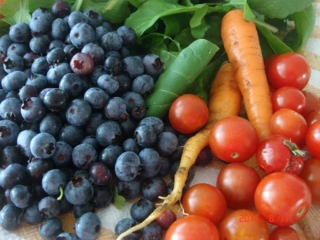
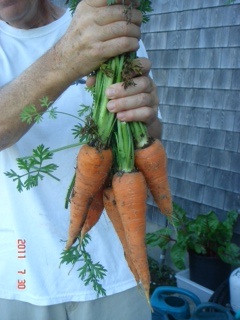
“Every summer, 40 million backyard farmers produce more food than they can use, while people in their communities go hungry. If only they could link up. Enter Gary Oppenheimer, 59, of West Milford, N.J. He was directing a community garden a couple of years ago when inspiration struck. In May 2009, AmpleHarvest.org hit the Internet, connecting food pantries and gardeners. In just 150 days, Rosie’s Place in Boston became the 1,000th pantry on the site, and the growth has continued. As of Labor Day, 4,188 pantries were listed, in all states. Oppenheimer says the nonprofit organization is actively seeking grant funding to sustain what has sprung up.” Read more here.

If you have extra produce from your garden, you can go to AmpleHarvest to find a food pantry near you.

Photographs: Sandra M. Kelly

Read Full Post »

Follow

Get every new post delivered to your Inbox.

Join 253 other followers