Feeds:
Posts
Comments

Archive for January, 2013

I am grateful to my friend Mary Ann for posting a link to this story on Facebook today.

Julian Guthrie writes in the San Francisco Chronicle:

“Starting in the summer of 2000, a man named Someguy launched 1,000 blank, leather-bound journals into the world to encourage creativity and see how art could connect people.

“The journals trickled back in from places as far flung as Iraq — reaching 40 countries and 50 states — and were filled with gorgeous drawings, political musings, disturbing rants, and poetic vignettes of daily lives.

“The journals, registered and tracked online, were eventually turned into a book, displayed at museums in San Francisco (at the Museum of Modern Art), Los Angeles and Scottsdale, Ariz., and featured in a documentary.

“More than 12 years later, the global art experiment has a new twist: The idea has now been adopted by Bay Area children’s hospitals, where young patients use the journals as a way to connect with other children going through something similar.

“Brian Singer, the San Francisco artist whose handle is Someguy, has been touched by this latest chapter in his social experiment.

” ‘I have heard stories of the impact of these journals, of kids opening up in ways they hadn’t before,’ says Singer, who built a website, 1001journals.com, to help others start similar projects. …

“Singer, 39, who grew up in Cupertino, lives in Noe Valley and commutes by shuttle to his job at Facebook in Menlo Park, where he manages a design group. …

“He remains interested in the phenomenon of sharing among strangers and looking at how to connect people through a physical artifact. Tangible items ‘drive connections in the real world,’ he said.

“There are still many of Singer’s original blank journals out in the world that may one day return.

” ‘They travel on their own,’ Singer says, ‘like a message in a bottle.’ ”

Read more.

Image: San Francisco Chronicle

Read Full Post »

“How will the world find the water to feed a growing population in an era of droughts and water shortages?” asks Fred Pearce of Yale Environment 360 by way of the Christian Science Monitor.

“The answer, a growing number of water experts are saying, is to forget big government-run irrigation projects with their mega-dams, giant canals, and often corrupt and indolent management.

“Farmers across the poor world, they say, are solving their water problems far more effectively with cheap Chinese-made pumps and other low-tech and off-the-shelf equipment. Researchers are concluding that small is both beautiful and productive.

“ ‘Cheap pumps and new ways of powering them are transforming farming and boosting income all over Africa and Asia,’ says Meredith Giordano, lead author of a three-year research project looking at how smallholder farmers are turning their backs on governments and finding their own solutions to water problems. …

“Such innovations are becoming a major driver of economic growth, poverty reduction, and food security, says her report, “Water for Wealth and Food Security,” published by the International Water Management Institute (IWMI), a research center based in Sri Lanka.

“The report says better support for this hidden farmer-led revolution could increase crop yields threefold in some places …

“But such help could be a while coming, because much of the revolution is happening out of sight of governments and international organizations. In Ghana, the study found, small private irrigation schemes cover 185,000 hectares – 25 times more land than public irrigation projects. ‘Yet when I asked the agriculture minister there about these schemes, he hadn’t even heard of them,’ says Colin Chartres, director of IWMI.”

Read more.

Photograph: Noor Khamis/Reuters/File
Boys from Nalepo Primary School draw water using a manual pumping machine in a semi-arid region south of Kenya’s capital, Nairobi.

Read Full Post »

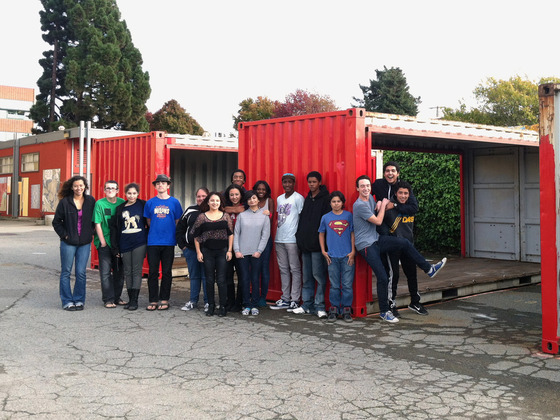
I’m not sure where I first read about Studio H, but I think you will be interested in this high school that engages students in hands-on construction from design to delivery.

The website explains: “Studio H is a public high school design/build curriculum that sparks community development through real-world, built projects. Originally launched in rural Bertie County, North Carolina, Studio H is now based at REALM Charter School in Berkeley, CA.

“By learning through a design sensibility, applied core subjects, and industry-relevant construction skills, students develop the creative capital, critical thinking, and citizenship necessary for their own success and for the future of their communities.

“Over the course of one semester, students earn high school credit and have the opportunity to design, prototype, and build a full-scale community project. Our students have designed and built some crazy chicken coops for families in need, and a 2,000-square-foot farmers market pavilion.”

More here.

Photographs: http://www.studio-h.org

Read Full Post »

My husband, who has made a lot of business trips to Japan (and also has been reading my posts about 100-year-old workers), pointed me to something interesting at the Japan Times.

Jiji writes, “A business project focused on selling decorative leaves for use in Japanese cuisine is attracting overseas attention to Kamikatsu, a mountain town in Tokushima Prefecture. …

“The [Irodori, or bright colors] project, which succeeded in commercializing colored leaves grown in local mountains and fields and now claims members from nearly 200 farms, has become a vital industry in Kamikatsu, which has a population of less than 2,000. …

“The average age of the farmers involved in the project is 70, and many are women. Some earn more than 10 million [yen, more than $100,000] a year from the business.

“Irodori members use tablet computers to check for updated information on orders. The leaves are grown in their own mountains and fields, then distributed to markets across Japan via an agricultural cooperative. …

“According to the Japan International Cooperation Agency, which promotes international visits to Kamikatsu, the response to its English DVD on the Irodori project was huge. It has been translated into Bengali, Spanish and French.

“Tomoji Yokoishi, 54, who came up with the Irodori idea and is president of the managing company, said perceptional shifts are responsible for its success.

“The project turned regular leaves into a valuable resource and turned its elderly into a workforce, Yokoishi explained.”

I’m guessing that the phrase “for use in Japanese cuisine” doesn’t mean anyone eats the leaves. They are probably used to decorate tables where Japanese cuisine is served. Do you think?

Read the Japan Times article, here.

Art: Elaine Richards, 1994 7″ X 10″ Watercolor Collection B. Riff

Read Full Post »

Among the many things that are a fun about a blog is checking out the likes to my entries and learning about common interests. I also love thinking about the people I know who may be reading. Then there are the thoughtful comments from strangers.

Cynthia, for example. She came to the blog after searching on the late, amazing ceramicist Anne Kraus and finding my post “The Mysterious Tea Cups of Anne Kraus.” She says she knew the family.

My entries on new farmers have a led to a nice exchange with an Ohio farmer, DrJeff7, who raises traditional livestock at Heritage Breeds Farm. Here is one of his comments:

“There is definitely a shift toward buying local and buying organic/ grassfed, and all natural. We are staring up with similar goals in mind. I am concerned about the fact that farms continue to ‘go out of business,’ yet the animals get absorbed by larger and larger farming conglomerates. (i.e. factory farms). Their argument is that it is a necessary evil if you want to feed the world. I think that the world needs to move away from supposed progress and head back to the days of traditional farming, where animals see the light of day and chemicals are nowhere to be found (or limited to the best extent).”

And there came a day when I really needed to see this title at 5kidswdisabilities, a WordPress blog: “Beyond One’s Own Problems.”

Listen to this mom. “I work with a social/educational/recreational group for teens with disabilities.  When first getting this group together at the beginning of the school year, I asked them what they wanted to do as part of our program.  Every single one of them said they wanted to ‘help other people.’  Here are students with a variety of disabilities and medical needs, and they wanted to help others! They were mature enough to look beyond their own problems to the problems of others.

“Various suggestions were tossed about … They chose making sandwiches for the homeless. …

“They worked as a team and made 165 sandwiches and twelve dozen cookies. As they worked, they talked about who might get to eat them, what kind of bad luck may have fallen upon that person and so forth.  They talked with much empathy, and not once during their conversation did they mention their own problems.  They were caring about the problems of others.

“After the sandwiches were made, I drove up to Traveler’s Aid, a local spot where the homeless hang out.  The kids … walked and wheeled to the front desk which, fortunately, was wheelchair accessible.  The crowd murmured appreciatively, politely, thankfully.  The kids faces beamed as they turned around and came back to the van.  They were no longer disabled, but capable of helping others.  Suddenly, their problems were not as bad as the people who thanked them; people without shelter and food.”

Read her whole lovely entry here.

Photograph: HeritageBreedsFarm.com

Read Full Post »

The Facebook page of my friend Alden, the oboist, linked to an article on Benoit Rolland, winner of a 2012 MacArthur Award.  Alden said Roland reminded him of the sushi genius in “Jiro Dreams of Sushi,”  a film about a very intense and innovative perfectionist.

The story that Kathleen Burge wrote for the Boston Globe suggests just how inventive Rolland is. “For his entire professional life, Benoît Rolland has been making bows for stringed instruments with one goal: making music easier to play.

“ ‘If a musician is not comfortable with the bow, the bow becomes an obstacle, and he or she cannot be free to play,’ Rolland said. …

“This fall, Rolland, who lives in Watertown with his wife, was rewarded for his innovations and artistry over a career that has included making about 1,800 bows. He was named one of 23 MacArthur Foundation fellows, and given an unrestricted grant of $500,000. …

“Over the years Rolland has made bows for some of the world’s most famous musicians, including violinists Yehudi Menuhin and Anne-Sophie Mutter.

“Kim Kashkashian, a violist who teaches at New England Conservatory, has asked Rolland to make two bows for her.

“ ‘He actually will listen to you play and watch you play and instinctively understand the style of your playing, the particular sensuality of your bow and string relationship,’ said Kashkashian, also a leader with the local Music for Food program.

“Each of the bows Holland made for her has distinctive qualities. One works especially well if she is playing chamber music with a piano, Kashkashian said. ‘The second bow he made for me, which has a really deep chocolatey sound, I would tend to use if I were playing completely alone.’ ”

Read the Globe article here.

Read Full Post »

John recently alerted me to a PBS News Hour interview that my brother’s friend Paul Solman conducted with Rosa Finnegan, an enthusiastic 100-year-old worker. That reminded me that I had purchased the September 3 issue of the Christian Science Monitor Weekly largely because that lovely lady was on the cover.

The lead article had an intriguing title and blurb: “The silver-collar economy — More companies are hiring people 65 and older because they believe they are reliable and productive, while the seniors themselves need and want to work. But is the trend squeezing out young people?”

It interested me because I’m an older worker who is not tired of working. I don’t know if all young people feel squeezed out, but just yesterday, a young employee asked a friend of mine, “Are you thinking of retirement? You’ve been here a long time.” My friend made a polite rejoinder about loving the work and the people and not making any plans to leave.

She has many productive years ahead of her.

Mark Trumbull writes of Rosa Finnegan that she “has plenty of similarities with other wage-earning Americans. She hitches rides in with a co-worker, likes to joke around with colleagues, and feels very grateful to have her job. At the end of the day, she’s ready to sink into a cushy chair at home.

“But Mrs. Finnegan is also a trailblazer. She offers striking proof that employment and productive activity need not end when the so-called retirement years arrive. Let’s put it this way: Where many people now nearing retirement can recall Sputnik, civil rights protests, or the pitching wizardry of Sandy Koufax, she mentions memories of gas-lit streets, the spread of telephones, and working at a rubber plant during World War II.

“Having passed her 100th birthday this year, Finnegan is still working at a needle factory in [Needham, Mass.], helping to make and package the stainless-steel products in custom batches. Yes, she walks a bit more slowly now than many of her co-workers. But Rosa, as they all call her, still has willing hands and a nimble mind. And she has no desire to leave her job.

” ‘I’d rather be here than almost anywhere,’ she says. ‘You feel like you’re still a worthwhile person, even though you’re old – [you’re] not sitting in a rocking chair.’ ”

Read the whole delightful story here. And check out the Solman interview and his video clip, here.

And to all who say U.S. manufacturing is dead, I will just point out that there is a needle factory in Needham.

Photograph: Melanie Stetson Freeman / The Christian Science Monitor
Rosa Finnegan works on a needle at Vita Needle in Needham, Mass.


Read Full Post »

Do you remember the scene in War and Peace (I know, I read it a long time ago, too) in which Prince Andrei, lying wounded on the field of Austerlitz, looks up at the sky and experiences a kind of awakening?

Well, there’s an organization that hopes we will all connect with the sky with that sort of attention and feel renewed.

“It began with a cryptic e-mail from an unfamiliar source,” writes Jan Brogan at the Boston Globe.

“ ‘Look at the sky as often as you can — for about 21 days. I’ll contact you again in 3 wks.’ It included a link to a website with clouds.

“Signing off with ‘More Light,’ this guy could have been a total whack job. But something about the writing said this had nothing to do with UFO sightings. I clicked in.

“The website was ForSpaciousSkies.com. The man who sent the e-mail, Jack Borden, a former Boston television reporter, had had an epiphany as he looked up from a meadow one day in the mid-1970s and saw the sky as if for the first time. He has been on a mission to educate people about sky awareness ever since.

“ ‘When we are unconscious in regard to our surroundings, we are irresponsible to them,’ says Borden, speaking of that mission now.

“It began with a series of televised man-on-the-street interviews. Borden stopped pedestrians, covered their eyes, and asked what the sky looked like. Most had no clue. They were rushing through their lives without ever looking up.” More.

I want to take up the challenge, pay more attention to the sky. I’m good about this when I go out early in the dark for my walk and take a deep breath of the moon and stars, but I should be more attentive more often during the day. I think my hiking and skiing and sailing friends must get sky vitamins  all the time. They probably don’t even think about it.

I include a couple pictures from times I did pay attention during the day.

042912_Japanese_Maple_3

063012_clouds (2)

Read Full Post »

Catch this story on National Public Radio today?

Jake Scott, a math teacher and wrestling coach in Silver Spring, Maryland, draws students in with clever ways to memorize formulas.

“Keeping control of the class is one thing, but holding their attention through complicated calculations and theorems is another challenge altogether. So Scott gets a little extra help from his alter ego, 2 Pi.

“About three years ago, Scott started infusing rap into his lessons.”

He describes to NPR’s David Greene his early lack of success in school, his time on the streets, the help he received from taking up wrestling, and the reasons he eventually got into math.

” ‘You know, when my dad lost his sight, I started doing accounting for him, and math was the one area that I was able to succeed in,’ Scott says. ‘Because of my time in the streets, my vocabulary wasn’t very extensive, and so I shied away from English. I was bored to death by history. Math, on the other hand — I didn’t need to know how to speak well in order to do well in math, so that was very helpful, when I look back. It helped me to grow in my appreciation for numbers.’

“Scott says that one of his most important goals as a teacher is to make meaningful connections with his students. This drive to connect with the kids in his classroom influenced him to begin rapping as 2 Pi.

” ‘I mean, I think that we can preach to kids until they turn blue and we turn blue, but if there’s no connection, then there’s no response,’ Scott says. ‘I mean, I constantly search for ways to connect with students — with the language, with conversations, music.” Read more here.


Read Full Post »

Photograph: Julio Cortez/AP
Musician Julio Fernandez during a Voices of Valor music session at Montclair State University.

Today I am returning to the topic of veterans programs that help people overcome post-traumatic stress and reintegrate into civilian life. (Interesting how often these programs involve gardening or the arts — which we always knew were good for us!)

Samantha Henry at the Boston Globe has the story.

“During stressful times as a combat medic in Afghanistan, Mason Sullivan found solace in Vivaldi. New Jersey native Nairobi Cruz was comforted by country music, a genre she had never heard before joining the Army. For Jose Mercedes, it was an eclectic iPod mix that helped him cope with losing an arm during a tour of duty in Iraq.

“These three young veterans all say music played a crucial role in alleviating the stresses of active duty. Now, all three are enrolled in a program that hopes to use music to ease their reintegration into civilian life.

‘‘ ‘It’s a therapy session without the “sit down, lay down, and write notes,” ‘ Mercedes, 26, of Union City, said of the music program. ‘It’s different — it’s an alternative that’s way better.’

“The pilot program, called Voices of Valor, has veterans work as a group to synthesize their experiences into musical lyrics. Guided by musicians and a psychology mentor, they write and record a song, and then hold a CD release party. The program is currently underway at Montclair State University, where students participate through the school’s veteran affairs program.

“Developed by husband and wife team Brian Dallow and Rena Fruchter, it is open to veterans of any age and background. No musical experience is required.” More.

P.S. A word on the power of reddit. John posted my blog entry from yesterday in the Christmas category at reddit and it increased traffic to this site by a factor of 10 so far.

Read Full Post »

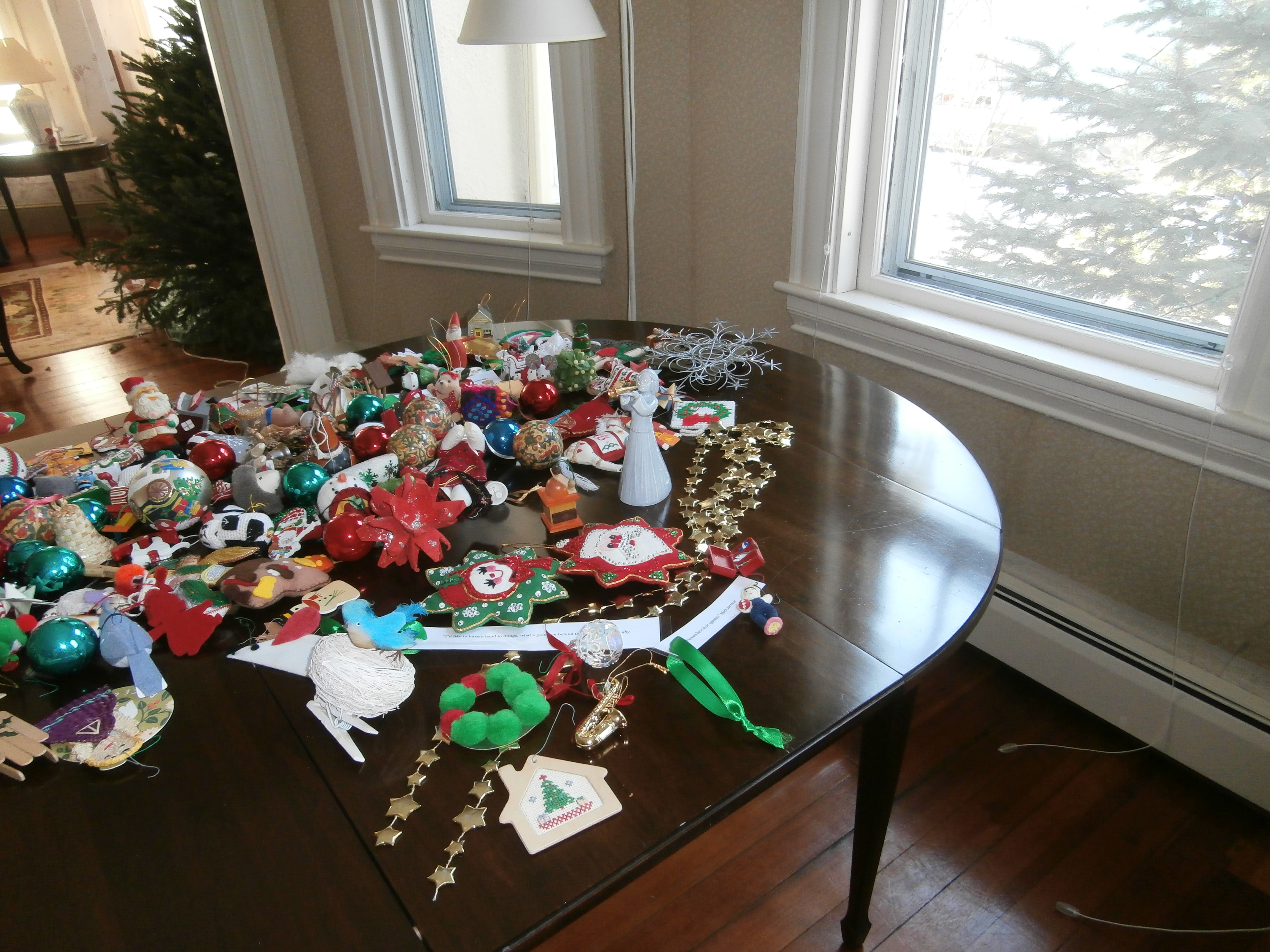
When I take down the tree, I like to allow myself time.

Time to unroll the strings of lights and re-roll them in tissue paper. Time to lift off the sparkly cobwebs of tinsel and store them in a basket for another day.

Time for the ornaments, nearly every one eliciting a memory of something.

The small wreath of green and red puff balls that Suzanne made in the First Parish craft workshop (attended by nearly every kid in town, regardless of religion). The cross-stitch embroidery John made with hardly any help at age 3 or 4. The fishing tackle box and the saxophone representing past interests. The smiley felt-and-sequin jobs that 90-something Aunt Mae kept secret until Christmas. The coffee grinder for my husband. The goofy red ornament that I made from egg cartons when I was first married. The bird-in-a-nest that is supposed to bring good luck. The Chinese doll I got at Niagara-on-the-Lake the year we took turns babysitting the kids in order to see shows at the G.B. Shaw festival. The frosty ball from DeAnna’s winter wedding. And my new “tradition,” quotations hung on a ribbon.

I am the only person who remembers the things I remember exactly the way I remember them; you are the only person who remembers the things you remember exactly the way you remember them.

taking the tree down

ornaments

Read Full Post »

Unless you are going to the Danforth Museum of Art, I do not recommend ever going to Framingham (traffic issues, strip mall issues).

But I am very glad I finally made it to the Danforth today because it is a lovely museum with a community outreach effort that I admire.

The exhibit I went to see was described in the Boston Globe by by Sebastian Smee.

“One of the things you notice first in ‘Eternal Presence,’ a terrific career survey of John Wilson at the Danforth Museum of Art, is how attentive Wilson is to the faces of children. From his earliest days sketching his brother to his most recent large-scale drawings in charcoal, the impulse has remained the same: It is an impulse toward clarity, toward truth. He doesn’t sentimentalize or caricature children. …

“What you notice later is the high number of pictures showing children in the arms of adult men and women. … Wilson is after something elemental and profound. But the resulting image is not just another mother and child, or dad with young kid. There is instead, each time, something tender and hard-won about what you are looking at. A hope, a promise, a lament all in one.

“Wilson, 90, is one of Boston’s most esteemed and accomplished artists. He was born in Roxbury, the son of parents from British Guiana (now the nation of Guyana), was admitted to the School of the Museum of Fine Arts in 1939 after developing a natural aptitude for art at the Roxbury Boys Club, where he attended classes taught by SMFA students.”

Smee goes on to describe Wilson’s long career, including a stint in France, his interest in the Mexican muralists, and his sculptures of Martin Luther King Jr. (one is in the Capitol rotunda).

Amazing that the artist is around and will be giving a talk at the museum. Try to go. The show is up until March 24. And you may enjoy as much as I did the African American sculptures by Meta Vaux Warrick Fuller from the permanent collection and the joyful Harlem watercolors of Richard Yarde.

More at the Globe.

Lithograph by John Wilson

Read Full Post »

Every couple weeks, it seems, I read another story about young people taking up farming. It is not an easy thing to do.

This photographer couple is getting started by attending Farm School in Athol, Mass. They also are recording their progress on a website called Plough & Stars.

“Dina Rudick has worked as a staff photographer and videographer for the Boston Globe for 10 years. … Dina is also an adjunct faculty member at Boston University’s School of Journalism and has worked as a media consultant and media trainer … Her work can be seen at www.dinarudick.com.

“Erik Jacobs is also an award winning photographer …  A selection of his editorial work can be seen at www.JacobsPhotographic.us.

“Together, Erik and Dina also run a boutique video production company called Anthem Multimedia.”

But they want to be farmers.

Here is a bit of their blogging about Farm School:

“We’re six weeks into life at Maggie’s and already we’ve established steady working relationships with the all animals on our farm.  We lead cows to fresh pasture daily and pull fresh eggs out from under broody hens.  We try to our best to keep the peace with Mr. Marbles the pushy ram and I’ve even grown accustomed to the regular mouse fiestas inside my bedroom walls.” You can follow their adventures here.

A blog is not exactly run of the mill when written by award-winning photographers. Their pictures are fantastic.

P.S. Here is a past post I wrote on the young-farmer trend.

Photograph at http://ploughandstarsproject.com/we-are/

Read Full Post »

Today I had an amusing back and forth with Fire Islanders past and present. It was about a fund raiser for what we used to call “Group” back when I was a day camper and later a counselor and writer-director of teenage musicals.

The fundraiser is to restore the Ocean Beach Youth Group (“Group”) building below, which was pummeled by Hurricane Sandy. From the first e-mail:

“Food . Beer & Wine . Auction . Guest Bartenders . Tequila Tasting
“Sun., Jan. 6, 2013, 4-7 pm @ Rodeo Bar, 375 Third Avenue, NYC
“$50 cash/check at door, 21+
“$30 for 16-20 For advance tickets or to make a donation, visit http://www.nycharities.org/Events/EventLevels.aspx?ETID=5691 OBYG is a 501(c)3 organization.
“As an added bonus Tony Roberts of Broadway fame and Youth Group Alumnus will be our guest.”

I wrote back that I was in one of Tony Roberts’s teenage plays (back when his name was still Dave) and can sing most of the lyrics to the theme song of his show Like You Like It.

I then indulged in some contradictory reminiscing with my first co-writer/director and with the daughter of playwright Arnold Horwitt, who was an adviser on the first show we wrote.

“Memories can be beautiful and yet” … (Oh, sorry, we used to burst into song a lot.)

But about memories. I know I have the most accurate memories for the shows I worked on, yet friends keep remembering differently. And who can blame Arnold Horwitt’s daughter, for example, if she thinks her father wrote all the lyrics to our “Return of the Native” when he only contributed the song that he had already written for a cruise to fight a bridge, “Everything’s Coming Up Moses”? He was a huge support, and that’s what she gets right.

Want me to sing anything for you?

Read Full Post »

Photograph: Ginnette Riquelme for The New York Times
Artist Amor Muñoz pays workers at her mobile factory about $7.50 an hour. “I’m interested in sharing the experience of art,” Ms. Muñoz says.

An artist in Mexico City hires people off the street at $7.50 an hour to help create “electronic textiles.”

Amor Muñoz uses a megaphone to shout, “One hundred pesos an hour!”

Damien Cave at the NY Times continues the story. “The rush was on. By the time Ms. Muñoz parked in her usual spot outside a hospital in one of Mexico City’s peripheral neighborhoods, a line had already formed. Women of all ages squeezed together — one held a baby, another was nearly too old to walk — as Ms. Muñoz opened up a white wooden box revealing thread, needles, cloth, timecards and employment contracts. The work involved creating interactive art pieces that combine the old craft of sewing with 20th-century electronics and 21st-century tags allowing smartphone users to look up who worked on a given piece. …

“Her maquiladora, or factory, she said, is a ‘fantasy’ meant to condemn the harsh reality of a global economy that uses and discards poor workers, especially women, to keep prices low. …

“She described Mexican wages as an insult to human dignity, and every time her mobile factory appears, the power of work for reasonable pay goes on display. The crowds that gather are typically large. Sometimes people push and shove for two hours of work and $15, though once the day’s employees are selected (first come first hired), a calm tends to follow. …

“Many of the women seemed to appreciate a chance to be involved in an art project. María González, 75, smiled widely when handed a needle and adjusted her purple scarf, excited to be creating something rather than worrying about her husband in the hospital. ‘This,’ she said, sewing without looking down, ‘is a wonderful distraction.’ ”

Read more about how happy the women are to work at that wage on art, even if it’s only for two hours.

Read Full Post »

« Newer Posts - Older Posts »