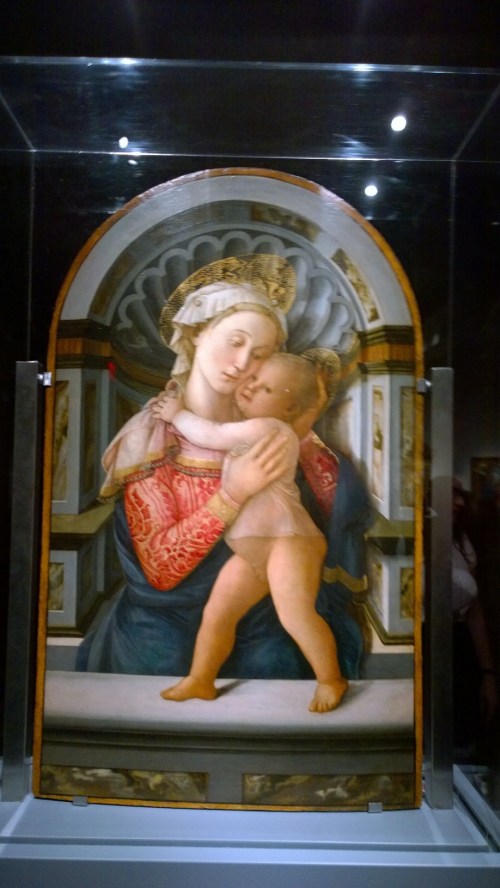
I made it to “Botticelli and the Search for the Divine” at the Museum of Fine Arts. By the time I paid for the ticket, the parking garage, lunch, and gas, it was an expensive outing, but I was glad I went. The show closes July 9.
Curiously, I think I loved the tenderness of the mother-and-child by Felippo Lippi (above) the most. That isn’t to say there wasn’t a splendid Botticelli Venus, holding her long tresses in a way that made her look like Eve and the snake. And I was delighted to see the famous Minerva and centaur that I admired so much in Florence when I was 16.
I don’t think I ever knew the centaur story. I ask you, does it look more like the Goddess of War just defeated a warlike centaur or like a tragic couple accepting that they have no future together? The latter version is what I made up, and it still works for me.
But getting back to Botticelli’s teacher: I remembered the name from “Fra Felippo Lippi,” a long, biographical poem by Robert Browning that we were assigned in high school.
So when I got home, I went on Google to have a look. The poem includes a description of the artist’s early years as a street urchin, before being handed over to the friars to be trained as a monk. I wanted to share this section of the poem about how Lippi became a close observer of his world.
“But, mind you, when a boy starves in the streets
“Eight years together, as my fortune was,
“Watching folk’s faces to know who will fling
“The bit of half-stripped grape-bunch he desires,
“And who will curse or kick him for his pains, —
“Which gentleman processional and fine,
“Holding a candle to the Sacrament,
“Will wink and let him lift a plate and catch
“The droppings of the wax to sell again,
“Or holla for the Eight and have him whipped, —
“How say I? — nay, which dog bites, which lets drop
“His bone from the heap of offal in the street, —
“Why, soul and sense of him grow sharp alike,
“He learns the look of things, and none the less
“For admonition from the hunger-pinch.
“I had a store of such remarks, be sure,
“Which, after I found leisure, turned to use.
“I drew men’s faces on my copy-books,
“Scrawled them within the antiphonary’s marge,
“Joined legs and arms to the long music-notes,
“Found eyes and nose and chin for A’s and B’s,
“And made a string of pictures of the world
“Betwixt the ins and outs of verb and noun …”
More on Lippi at Wikipedia, here, and on Botticelli, here.


 Suzanne's Mom's Blog
Thanks. You made me remember what a deep impression all the beautiful art work in Florence made on me when I first saw them in my youth. I was carried away. Still I can feel the same admiration and wonder.
What did the Minerva and Centaur suggest to a youthful Stuga 40?
I SO wish I could’ve seen this show! But it’s the poem that really moves me–I didn’t know this at all and it’s an amazing set of words, that whole idea that his need to read people, to stay alive, made him into a great artist.
It’s also interesting as an act of imagination on Browning’s part — he couldn’t have had many actual facts about Lippi. So there is something in that poem about Browning’s own need to observe closely and his evolution as an artist of words. Something I have noticed in my own life is that people with a special gift for words often come from a place of heightened word resonance: one person had a severe stammer and learned to make fewer words carry more weight; another, for her own peace of mind, learned to be alert to innuendo and double meanings.
I was not yet very thoughtful when young, more of full of feelings and very active. Sometimes too active. Life was an Big Adventure. In Italy and France I experienced and met with Art and Love. Was carried away by all the beautiful moments when I got to see wonderful art, listen to music, listen to people who had a big knowledge and competence in the subjects. Today when I know more, I appreciate being reminded of how important that period was in my life and still is.
Oh the poem… touches the heart!
Yes. I found it. Thanks!