Photo: NextCity
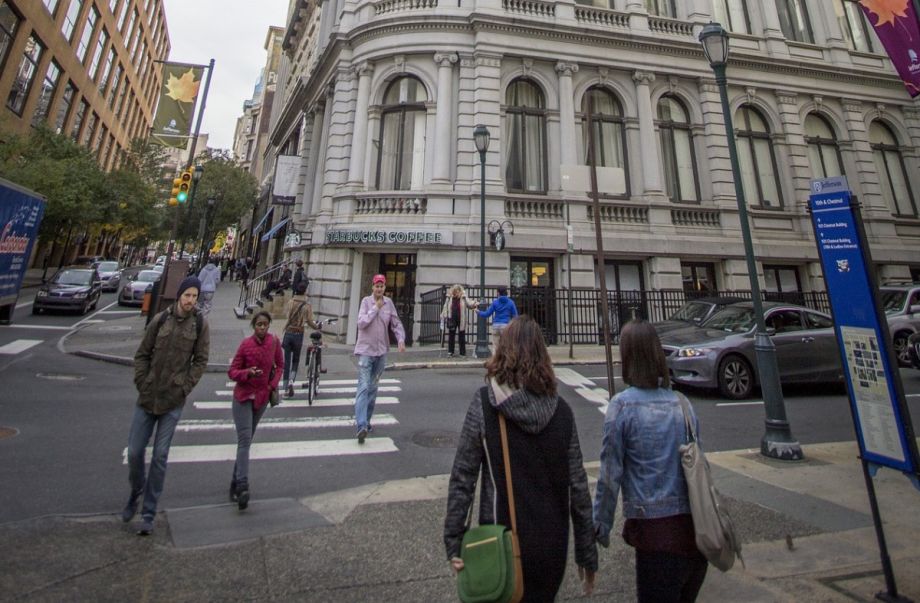
A Philadelphia street scene
The ideas of writer Jane Jacobs, well-known for her influence on city planning, continue to be tested. Is it true, for example, that having a lot of “eyes on the street” reduces crime? Jared Brey writes at NextCity about efforts in Philadelphia to find out.
“In the five-and-a-half decades since Jane Jacobs published The Death and Life of Great American Cities, her core contention — that urban vitality and safety are a function of small-scale density, a mixture of uses and ‘eyes on the street’ — has become conventional wisdom in urban theory. …
“In June, a team of researchers released a paper, titled ‘Analysis of Urban Vibrancy and Safety in Philadelphia,’ that attempts to begin a quantitative analysis of Jacobsian theory by bringing together publicly available data sets related to crime, business activity and the built environment. The study is the first of a series they have planned.
“In order to test the ‘eyes on the street’ notion, the authors — three statisticians at the Wharton School at the University of Pennsylvania and an architect — investigated the correlations between public safety and population density, population count, zoning, business activity, and business hours. They also designed a model of ‘business vibrancy,’ meant to serve as a proxy for Jacobs’ concept of eyes on the street, based on the density of businesses in certain areas and the amount of ‘excess business hours’ on them — meaning blocks with businesses open longer than what the authors calculated to be the citywide average. …
“Among the authors’ findings:
* Population density is not as strongly associated with crime rates as population count.
* More crimes occur on blocks with more businesses, but fewer in the direct vicinity of businesses that have longer-than-average operating hours.
* Crime rates are higher in neighborhoods with high rates of vacancy, but within high-vacancy neighborhoods, fewer crimes are reported in the direct vicinity of vacant properties. …
“ ‘What it says is measuring human activity is subtle and difficult,’ [co-author Shane Jensen, a statistics professor at Wharton,] says. ‘Yes, it does seem like there is something to this concept of eyes on the street, but I don’t think it’s just as simple as making sure that there’s businesses on every street corner and stuff like that. If anything, the more high-resolution you break this down, the more insight you can glean.’ ” More at NextCity.
Here’s my question: as online shopping causes retail storefronts to close, how do we preserve any “eyes on the street” at all?

 Suzanne's Mom's Blog
A good question. Could we have small daycare centers close to work? Or more coffee houses, restaurants, showrooms etc? Or places where we just could meet?
LikeLike
What good ideas! And how about auction showrooms, like the one we went to together in Stockholm? Can’t do that online.
LikeLiked by 1 person
Yes, that is a good idea as well as “Day-SPA” or retreat-rooms. We need both stimulation and taking care of both body and soul.
LikeLiked by 1 person