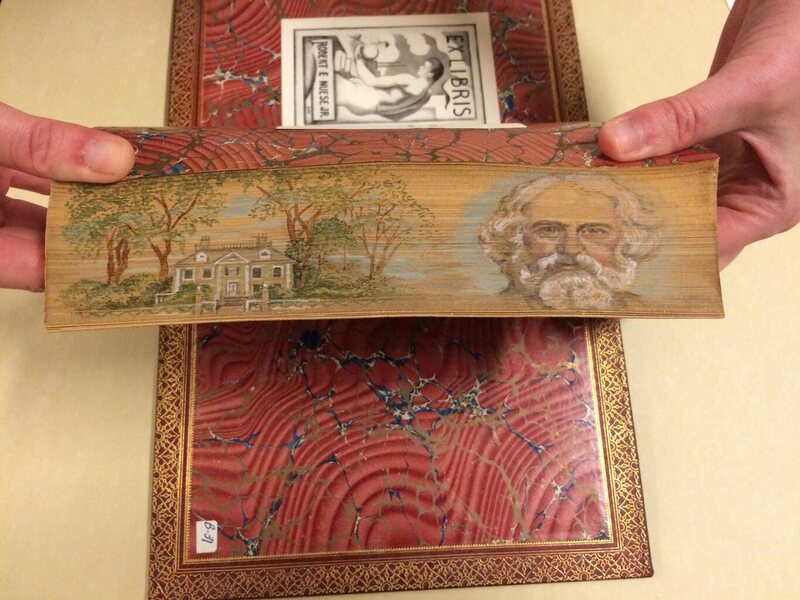
 Photo: Swem Library
Art on page edges from The Complete Poetical Works of Henry Wadsworth Longfellow. See 22 other examples at Atlas Obscura.
Have you ever noticed paintings along the page edges of old books? According to a 2016 Atlas Obscura article by Eric Grundhauser, they’re called “fore-page paintings.”
He writes, “While you don’t see them very often these days, fore-edge paintings were once some of the loveliest book illustrations around. … A fore-edge painting refers to an image painted or drawn on the closed leaves of a book. …
“Some ambitious, ‘disappearing’ fore-edge paintings were painted on the inside edges of the pages, so that the hidden scenes could only be seen when the page block was fanned in a certain direction. …
“These secret illustrations could be doubled, with an illustration on either side of the pages, revealing themselves depending on the slant of the page block (known as the ‘two-way double’). Some were painted so that if the book was laid open in the center, naturally splaying the pages to either side, two different illustrations could be seen on either side (known as a ‘split double’). …
“ ‘Sometimes the fore-edge paintings corresponded to the subject of the book, and sometimes not,’ says Jay Gaidmore, Director of Special Collections at the Earl Gregg Swem Library. The library holds the 700-strong Ralph H. Wark Collection, the largest collection of fore-edge painted books in America. …
“ ‘Most of the books are 19th century English fore-edges, but there are a few American scenes.’
“Fore-edge paintings can be found on books dating back to the 11th century, with early examples being decorated with symbolism and heraldry. …
“According to the Boston Public Library’s website for their 250+ collection of fore-edge books, for the most part the paintings were made using watercolors, and went unsigned, often being commissioned by a book-binding firm. …
“The technique has even been printed onto some modern books like Chip Kidd’s 2001 novel, The Cheese Monkeys, which was printed with a two-way double, disappearing fore-edge message. If the pages are shifted in one direction, the phrase ‘GOOD IS DEAD,’ appears, while if they are shifted in the opposite direction, the message, ‘DO YOU SEE?’ can be read.”
Tip of the hat to Fort Point artist Karen McFeaters, who retweeted this lead from @michikokakutani. More here, where you can see 22 additional examples.

 Suzanne's Mom's Blog
I went and looked at the examples and cannot believe the level of detail! I wonder who the first person was, to look at the edge of a book and see a blank canvas . . .
LikeLike
I feel like I have seen this type of thing somewhere, possibly on an old book my father had. It’s pretty cool.
LikeLike