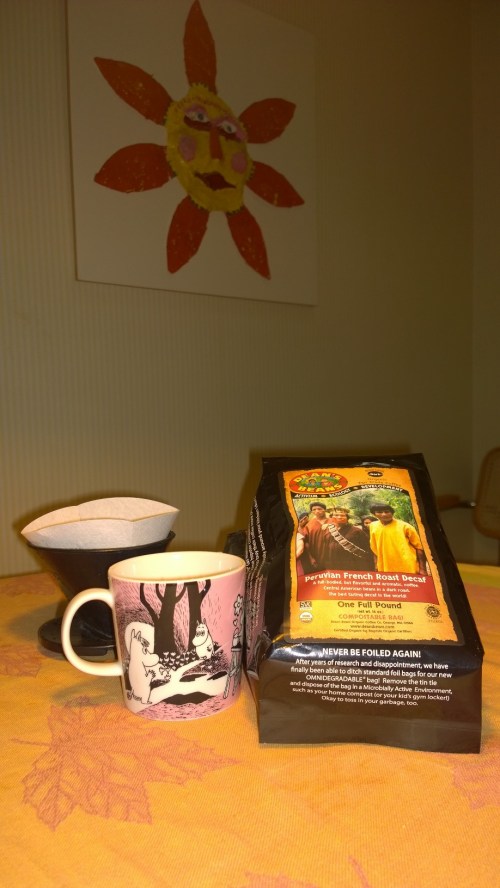
When we got married, the Lawrences gave us a coffee grinder.
That gift unexpectedly launched us on decades of coffee experimentation and turned us into what you’d be justified in calling coffee snobs. Two people who once thought that a can of Chock Full o’ Nuts was the ne plus ultra of coffee drinking nowadays never go anywhere overnight without our special filters and grinds. And often a gadget for boiling water.
It started with grinding the beans. But, we wondered, what were the best beans? We tried beans from the grocery store, from specialty shops, and by mail order. We tried beans that promoted causes like the environment and Third World poverty alleviation like Equal Exchange and Dean’s Beans. We learned that “shade-grown coffee” meant small farmers kept more of the profits — and birds kept more habitat.
We attended esoteric cuppings by characters like George Howell (“the bouquet of La Esmeralda El Bosque from Panama has hints of white peach, orange, and sweet lemons”).
We tried to figure out what were the best roasts for us. Mild? Dark? Espresso?
Then once we liked a kind of bean, we needed to know what was the best way to brew the coffee. We gave up on a battered drip coffee maker that was my mother’s and tried a gold-coated filter set-up, but we didn’t know how much water to use. The conundrum called for the invention of a Coffee Taster Lady, which, since I was learning Esperanto at the time, was actually called a Kafgustumistino.
When my dentist pointed out the coffee stains on my teeth, I experimented for a while with doing my tasting work using straws — plastic ones at first and then a special glass one that wouldn’t melt.
Eventually both my husband and I developed an instinct for how much water was right. We became regular purchasers of Melitta filters.
But we weren’t done experimenting, not by any means. My husband decided he wanted cappuccinos every day and wore out several different machines before giving up on that and resorting to filters and a large thermos.
By that time, our tastes had parted ways. We used separate coffee grinders (Mary Louise once called them “his” and “hers”) and separate brewing approaches (he likes his coffee strong and drinks more cups; I have one cup a day and use a one-cup filter).
It’s unlikely that we are completely finished experimenting. I can say we have both settled on Dean’s Beans as the most delicious, but you do pay a premium for a socially and environmentally aware provider.
What has this goofy obsession wrought? John doesn’t touch the stuff; instead he drinks tea all day long. Suzanne treats coffee like magic fuel.
And she’s experimenting with better and better filter holders.

 Suzanne's Mom's Blog
It is a great pleasure reading your blog, it is informing, educational and deep analyses of human character and appreciation to the differences and commonality between humans, flowers and even rocks. This article about the cup of coffee is a wonderful visit with you eloquently written, even I could smell the aroma.
LikeLike
Oh, my goodness, that’s way too much praise, but I appreciate it. So much of this blog is just borrowing other people’s stories. I would love to write more original material, but ideas don’t come to me often. (PS: I hope to see you both in person before too long.)
LikeLike
I like the cup.
LikeLike
Moomintrolls, as you know. For the information of other readers, they are Finnish. See https://en.wikipedia.org/wiki/Moomins.
LikeLike
My goodness–you DO take this seriously, don’t you? I seem to be content if it’s coffee and it’s hot . . . .
LikeLike
One would think that coffee was essential to waking up in the morning, but I have noticed that if I have coffee, I wake up in 15 minutes, and if I don’t have coffee, I wake up in a quarter of an hour. 🙂
LikeLike
I have never been much of a coffee or tea (or wine or beer or spirits for that matter) drinker. But I admire your curiosity and environmental awareness. I also love this great Esperanto word: a Kafgustumistino!
LikeLike
Thanks. I needed a little help to invent that word, which is something you can do with Esperanto. I turned to my teacher, a fluent Esperanto speaker living in upstate NY, who had literally been rescued from Buchenwald by Esperantists he knew in Britain.
LikeLike