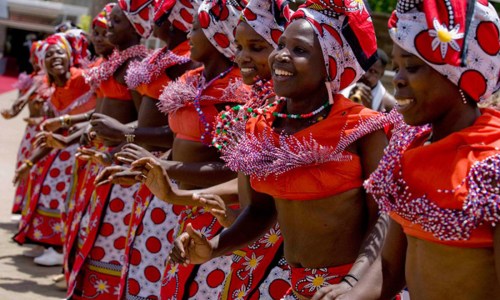
Photo: Kate Holt/Flickr
The joy on the faces of these performers in Kenya illustrates a universal truth: people love to dance. And it turns out, dancing informs our development in significant ways.
There’s something about being human that inclines one to dancing. Not necessarily ballet or hip hop or ballroom dancing, but dancelike movement that is part of everyday lives. The research on this may surprise you.
Kimerer LaMothe writes at Aeon, “Dancing is a human universal, but why? … What if humans are the primates whose capacity to dance (shared by some birds and mammals) was the signature strategy enabling the evolution of a distinctively large and interconnected brain, empathic heart and ecological adaptability? And what if dancing plays this role for humans not just in prehistoric times, but continuing into the present? …
“Researchers are discovering the vital role played by bodily movement not only in the evolution of the human species, but in the present-day social and psychological development of healthy individuals. Moreover, it is not just bodily movement itself that registers as vital in these cases, but a threefold capacity: to notice and recreate movement patterns; to remember and share movement patterns; and to mobilise these movement patterns as a means for sensing and responding to whatever appears. This threefold capacity is what every dance technique or tradition exercises and educates.
“According to the New York University neuroscientist Rodolfo Llinás, writing in the book I of the Vortex (2001), bodily movement builds brains. A brain takes shape as it records patterns of neuromuscular coordination, and then remembers the outcomes in terms of pain or pleasure, emotional tags that help it assess whether to mobilise that movement again, and if so, how.
“In so far as bodily movements build the brain, every movement a human makes matters. Each repetition of a movement deepens and strengthens the pattern of mind-body coordination that making that movement requires; and the repetition also defines avenues along which future attention and energy flow. Every movement made and remembered shapes how an organism grows – what it senses and how it responds. …
“Humans have a unique capacity to notice, recreate and remember patterns of movement. More abundant in the human brain than any other mammalian brain, mirror neurons fire when a person notices a movement, recreating the pattern of neuromuscular coordination needed to make that movement. In this way, humans can learn to recreate the movement of others – not only other humans, but also trees and giraffes, predators and prey, fire, rivers and the Sun. As the neuroscientist V S Ramachandran writes in his book The Tell-Tale Brain (2011), mirror neurons ‘appear to be the evolutionary key to our attainment of full-fledged culture’ by allowing humans ‘to adopt each other’s point of view and empathise with one another.’
“Nevertheless, the term ‘mirror’ is misleading; it hides the agency of bodily movement. A brain does not provide a passive reflection. As eyes register movement, what a person sees is informed by the sensory awareness that his previous movements have helped him develop. He responds along the trajectories of attention that these previous movements have created. From this perspective, dance is a human capacity, not just one possible activity among others. …
“In this light, every dance technique or tradition appears as a stream of knowledge – an ever-evolving collection of movement patterns discovered and remembered for how well they hone the human capacity for movement-making. Most of all, dancing provides humans with the opportunity to learn how their movements matter. They can become aware of how the movements they make are training them – or not – to cultivate the sensory awareness required to empathise across species and with the Earth itself. In this regard, dance remains a vital art. From the perspective of bodily becoming, humans cannot not dance.”
This Aeon article came from the website Arts Journal, which brings together arts stories from around the world. Read more at Aeon, here.


 Suzanne's Mom's Blog
One of the things I enjoyed about living in El Salvador was all of the dancing. It definitely ads joy to life. Cheers
LikeLike
That is something Central American migrants could offer to our communities. I would welcome more of that in my life.
LikeLiked by 1 person
Dancing, making music, making art–so many forms of human expression. I wish I’d had some sort of dance training but I’ll just have to stick to the joy of the hokey-pokey!
LikeLike
Oy. Hokey pokey reminds me of my 4-H days. But why should I laugh? That kind of dance was joyful, too.
LikeLike