Feeds:
Posts
Comments

Archive for November, 2022

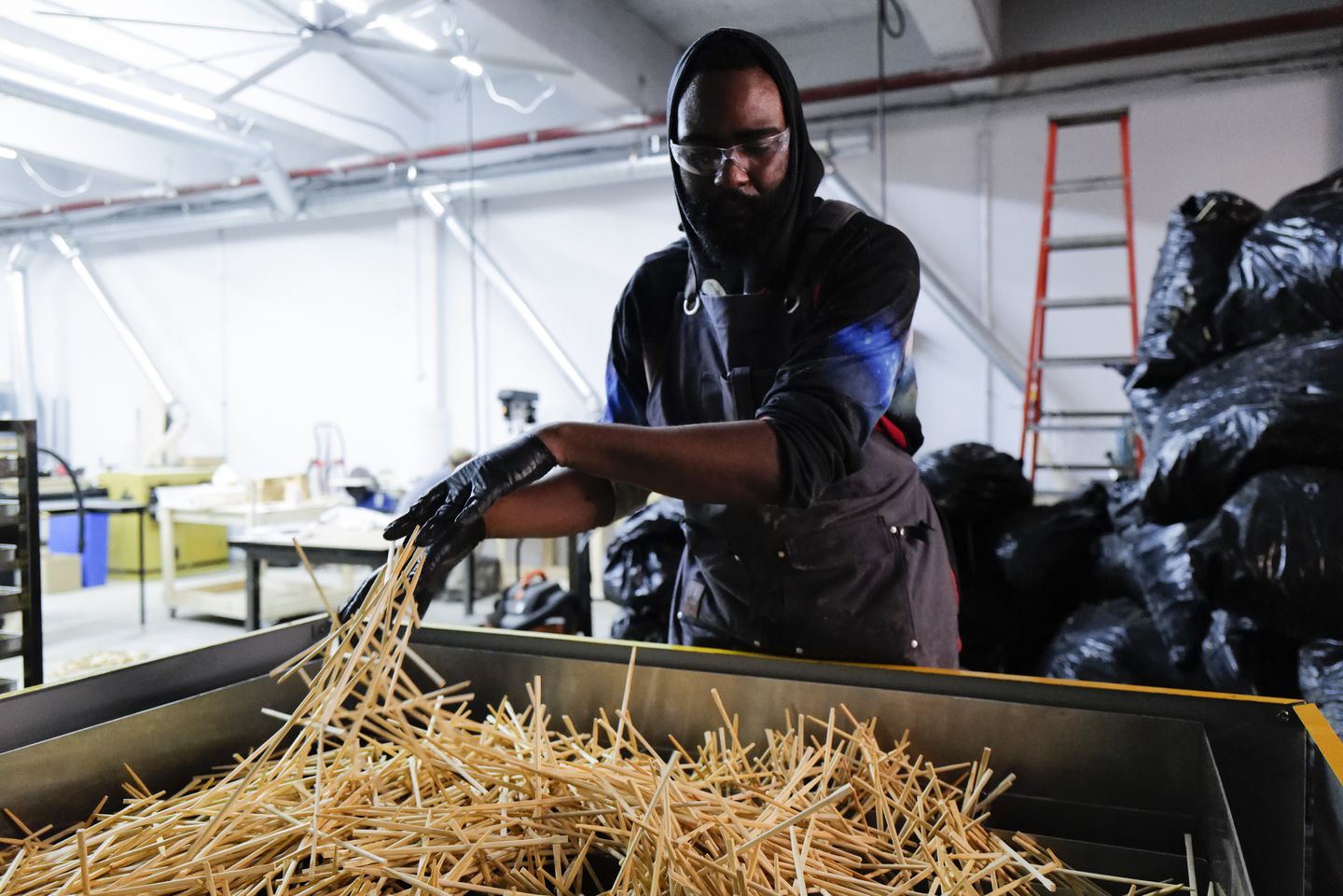
Photo: Carlin Stiehl/Boston Globe.
The Boston Globe reports that at ChopValue, bags of used chopsticks get “sorted — and made into everything from coasters to furniture.” ChopValue is a Canadian company that franchises factories.

Do you find yourself noticing more often just how many items we use and throw out? Many of us now seek out products that are reusable. We do this on our own because anytime a law is made, companies find a way to get around it.

Our town bans plastic take-home bags and plastic bottled water. Guess what? CVS merely made a heavier plastic bag and called it reusable. Bottled-water companies added a hint of flavoring, a loophole that allows them to sell plastic bottles here. So let’s do what we can on our own for sustainability.

Diti Kohli writes at the Boston Globe, “Elaine Chow believes your chopsticks can be more than utensils. In fact, she knows they can.

“The Savin Hill resident is giving ‘a mountain of chopsticks’ a second life at a new micro-factory that was launched in Charlestown in early September. … There, Chow melds the breakable wooden staples of Asian food into something more: cellphone stands ($11), charcuterie boards ($67), and even tables ($960).

“It’s all possible through ChopValue, a Canadian company that franchises factories that create chopstick-based homewares to people like Chow. … She leads the charge locally by collecting used utensils from more than 100 Greater Boston restaurants and running the machines that turn them into their final form. Chow eventually packs and delivers online orders of cribbage boards and workstation desks — all once used to eat sushi or stir-fry — all over New England.

“The draw for her is sustainability, and the ChopValue micro-factory already reigns as one of the only entirely cyclical businesses in Eastern Massachusetts, Chow said. …

‘People are realizing more and more that we can’t just continue to consume and build up piles of trash. We can do better.’

“Here’s how it works. Four days a week, a ChopValue truck visits restaurants around the region, picking up bags of used chopsticks. That itself is a win-win: Businesses are left with less waste to dispose of, and Chow has raw materials to work with. In six months, she has amassed 2.5 million chopsticks, weighing 15,000 pounds, and that number keeps growing.

“Back at the factory, Chow and three employees sort the sticks by color and separate them into mesh baskets. Then the utensils are dipped into resin and baked for 12 hours at 200 degrees, a process that allows them to harden and the resin to crystalize. Staffers then press a 3,000-pound machine on the sticks to flatten them, and what comes out on the other side is a durable tile — one of three sizes — that can be connected, sanded, and cut into the finished product.

“The process has proved to be labor-intensive, and Chow is on the hunt for two more employees, which is tough in the tight labor market. … After years of working in human relations, she has fallen in love with the factory’s green mission — and the chance to build on a love for woodworking that she picked up during the pandemic. Chow built a picnic table and shed to cover her trash bins during early COVID, before quitting her job and buying the franchise in September 2021.

“ ‘I have forever and ever been obsessive [with] recycling,’ she said. But she found ChopValue while scrolling through social media one day. ‘I actually have the computer algorithm to thank. It finally did a good thing.’ ”

More at the Globe, here.
Read Full Post »

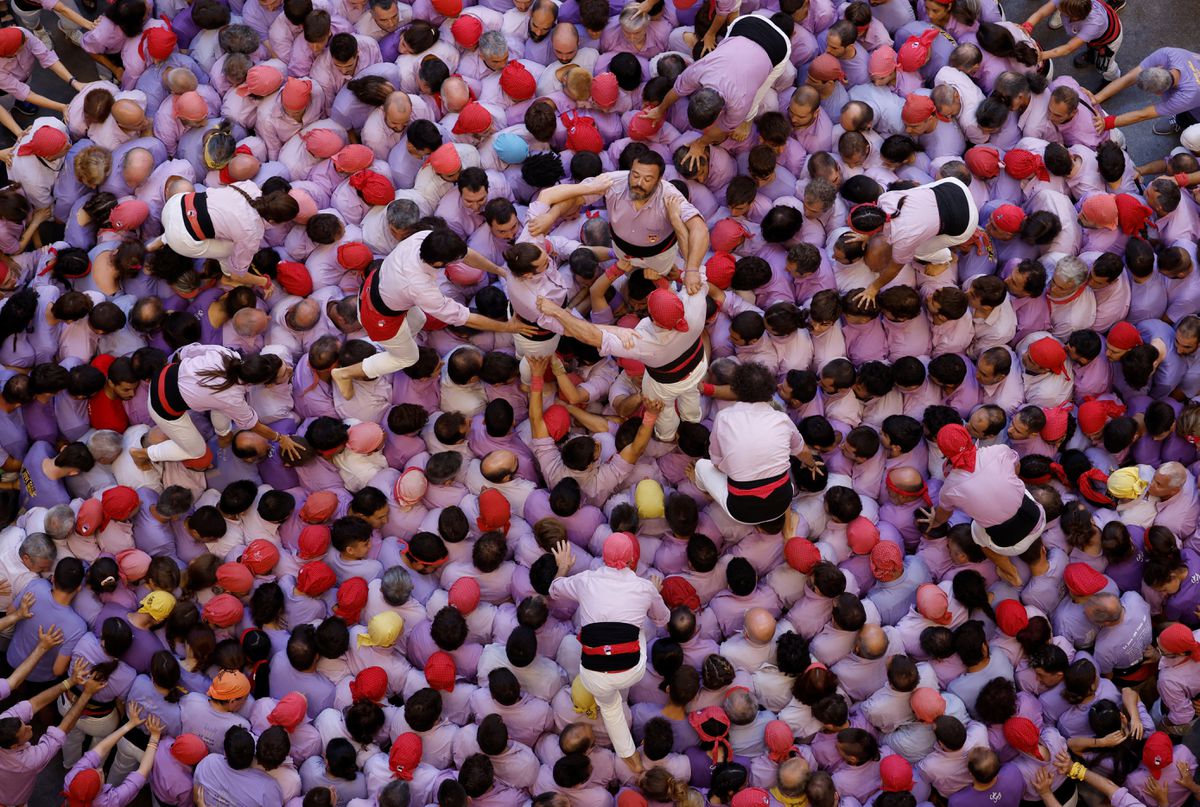
Photo: Reuters/Albert Gea.
Reuters shows Colla Jove Xiquets de Tarragona starting “to form a human tower called ‘castell’ during a biannual human tower competition in Tarragona, Spain, October 2, 2022.

You don’t have to be a kid to play. Here’s a story on grown-ups having fun like kids. Of course, there are a few kids along with them, setting the proper tone for playtime.

Alan Ruiz Terol reports at Public Radio International’s The World, “A human tower rising higher than 26 feet swung perilously as 7-year-old Mar Mollà reached its top amid cheers from the crowd. 

“ ‘The views were great,’ she said later. ‘I could see all the colors and the arena vibrating.’

“[Recently] the town of Tarragona, in Spain’s northeastern region of Catalonia, hosted a massive tournament featuring the finest teams of human tower builders, or castellers. …

“One of the teams competing on Saturday was the Castellers de la Vila de Gràcia. Mar Mollà was one its youngest members. She also had one of the most difficult tasks. As she made her way up to the top of the castell on Saturday, her father, Daniel Mollà, watched nervously.

“ ‘I was worried,’ he explained, minutes later. ‘But it’s up to her; she’s the one who knows if [the castell] will fall or not.’

“To build a castell, dozens of people must stand at the base pressed against each other to provide stability, and, if things go wrong, a safety net. Others venture upward, climbing and being climbed over; forming one tier, and then another, and another. Finally, a kid crowns the human tower by raising a hand.

“Human towers are graded according to their height and difficulty. To get the full score, crowning the castell is not enough — it must be dismantled without collapsing. While falls are rare, they do occur, and kids wear helmets to avoid severe injuries. …

“Human towers are a centuries-old tradition in Catalonia, and are widely seen as a symbol of its own distinct culture and nationalist aspirations. …

“ ‘The oldest reference to castells dates back to 1791, to a local festival in the town of Valls,’ historian Àlex Cervelló said. 

“Human towers are thought to be a spin-off of a religious dance that featured acrobatic constructions known as Ball de Valencians. According to Cervelló, participants might have competed against each other, building higher and more complex structures, until castells became a separate tradition. …

“Following the Spanish Civil War in the 1930s, the Francisco Franco dictatorship tried to deprive castells of any hint of Catalan nationalism, Cervelló said, as part of its persecution of political dissidence.

“In the 1980s, shortly after Franco’s death, teams of castellers began incorporating women, making it possible to build towers of unprecedented height, and kickstarting a golden era.

“In 2010, the UNESCO recognized castells as Intangible Cultural Heritage of Humanity. …

“Júlia Pozo, who looks after the youngest members of the Castellers de la Vila de Gràcia, praised the bravery of Mollà and other kids climbing to the top of castells. Ultimately, she said, they’re the ones who decide whether a castell is crowned.

“ ‘If they are afraid and don’t want to climb, they let us know, and we either try to find someone else, or we dismantle it,’ Pozo said. 

“But some, she said, will venture upward even if they are afraid, pulled by their ‘casteller spirit.’ ” 

Be sure to click at the World, here, and enjoy the happy grins on faces old and young.

Read Full Post »

« Newer Posts