Photo: Society6.
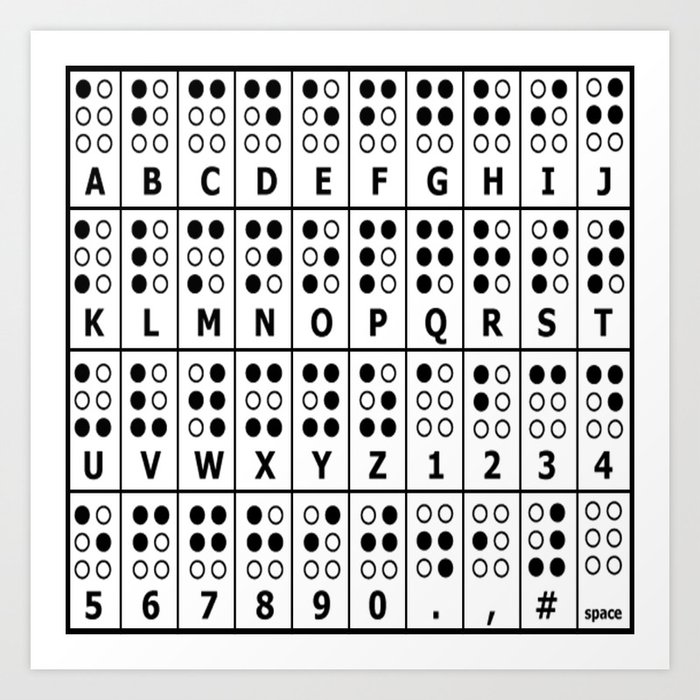
Blind alphabet.
I know two people who are losing their sight, but not well enough to ask if they are learning Braille. I always wondered if that is what I would do if I lost my sight, realizing of course, that it is more likely to happen when I’m older and learning takes longer.
Here is a bit about the changing world of Braille by Sophia Stewart at Publisher’s Weekly.
“A few times a day, a strange, pulsating sound fills the Boston headquarters of the National Braille Press. Thun-thun. Thun-thun. This is what employees of the nonprofit braille publisher call the office’s ‘braille heartbeat,’ generated by an assortment of printing presses — 50-year-old Heidelbergs and modern big-roll embossers alike — pumping away in the basement, producing books and other reading materials for blind readers.
“NBP has been at the forefront of braille publishing since 1927, when it was founded by the blind Italian immigrant Francis Ierardi — a classmate of Helen Keller’s at the Perkins School — as a weekly newspaper serving Boston’s blind community. Demand was so great that it went national after just three months. Since then the organization has expanded far beyond a single publication. Today, NBP produces and distributes braille books, reading materials, and technologies for the nation, with clients ranging from individual blind readers to the Library of Congress.
“Bringing braille to young readers in particular is central to NBP’s mission. ‘Our goal is to support braille literacy,’ said NBP president and CEO Brian MacDonald, and fostering that literacy depends on early intervention. As part of its ongoing efforts, in 1983, NBP launched one of its flagship programs, the Children’s Braille Book Club. The first-of-its-kind subscription service pioneered the ‘print/braille’ book format by distributing mainstream children’s books with added braille. (Under the 1996 Chafee Amendment to the U.S. Copyright Law, nonprofits can reproduce copyrighted works in forms that make them accessible for people with disabilities that impact reading.)
“When Harry Potter and the Deathly Hallows was published in 2007, NBP drew headlines by hosting a midnight release party, complete with accessible editions of the book. Scholastic sent NBP the manuscript early in order for it to be transcribed, and the office had to cover its windows and employ an armed guard to protect what was at that point the most valuable manuscript in the world. Staff worked around the clock to ensure the braille volumes were ready in time.
“The work paid off, and on the evening of July 20, young readers in wizard costumes descended on NBP’s offices to unbox their copies of the final Harry Potter book at the stroke of midnight, just as their sighted peers were doing throughout the country.
“What makes NBP unique is its publishing arm. NBP is the only organization in the U.S. that publishes its own books by blind authors for blind readers. Editorial director Kesel Wilson, who had a long career in traditional publishing at companies such as Scholastic and Pearson before joining NBP, commissions and edits original titles.
“The number of new books varies each year because Wilson, who said she’s ‘deeply connected’ to the community NBP serves, commissions titles based on ‘actual demand.’ When she has an idea for a book, she speaks with NBP authors and readers to gauge whether it would meet an immediate need. As a result, NBP has become known for its technology books, which include manuals for various software, operating systems, apps, and devices, as well as lifestyle titles on topics including cooking, fitness, and online dating. Recently, NBP published a guide to emoji, reproducing 97 face emoji as tactile graphics to help blind readers identify the differences among them, which ‘can be as subtle as a lifted eyebrow,’ Wilson said.
“The publishing arm is largely subsidized by what MacDonald called NBP’s ‘exploding’ B2B business producing brochures, tests, textbooks, business cards, airline safety guides, and more. In 2021, for example, NBP produced 35,000 large-print and braille menus for Starbucks stores. These kinds of projects allow it to sell its own books below cost, despite the enormous expense of producing braille, through its own online bookstore. The bookstore is the primary sales outlet for NBP’s titles, which the press promotes at the National Federation for the Blind’s annual convention as well as other related conferences and gatherings.
“ ‘We sell our books at the same price as a print book,’ MacDonald said of the online store, ‘because we don’t think it’s fair for a blind person to pay more, even though braille costs three to four times more to produce.’
“Producing braille books largely falls on the shoulders of specialized publishers like NBP, but some editors think mainstream publishers could be doing more. In 2016, DK senior editor Fleur Star, who works in the U.K., helped launch the DK Braille Books series, which to date comprises five children’s books that combine print, braille, printed images, and tactile images.
“The idea for the series, produced in partnership with the Royal National Institute of Blind People, arose in 2013, when Clearvision, a postal lending library of print/braille children’s books, visited DK’s London offices and outlined how mutually legible print/braille books can unite blind and sighted readers. Star and several colleagues were moved to action.”
More at Publisher’s Weekly, here.

 Suzanne's Mom's Blog
A whole community I rarely think about — and thus know almost nothing about! Thanks for finding and sharing this article.
LikeLike
New to me: books that serve both blind and sighted children.
LikeLiked by 1 person
New to me also! But I’m thrilled that they aren’t charging more for the braille printing even though it’s more costly. Those blind folks need books too!!
LikeLike
So true!
LikeLike