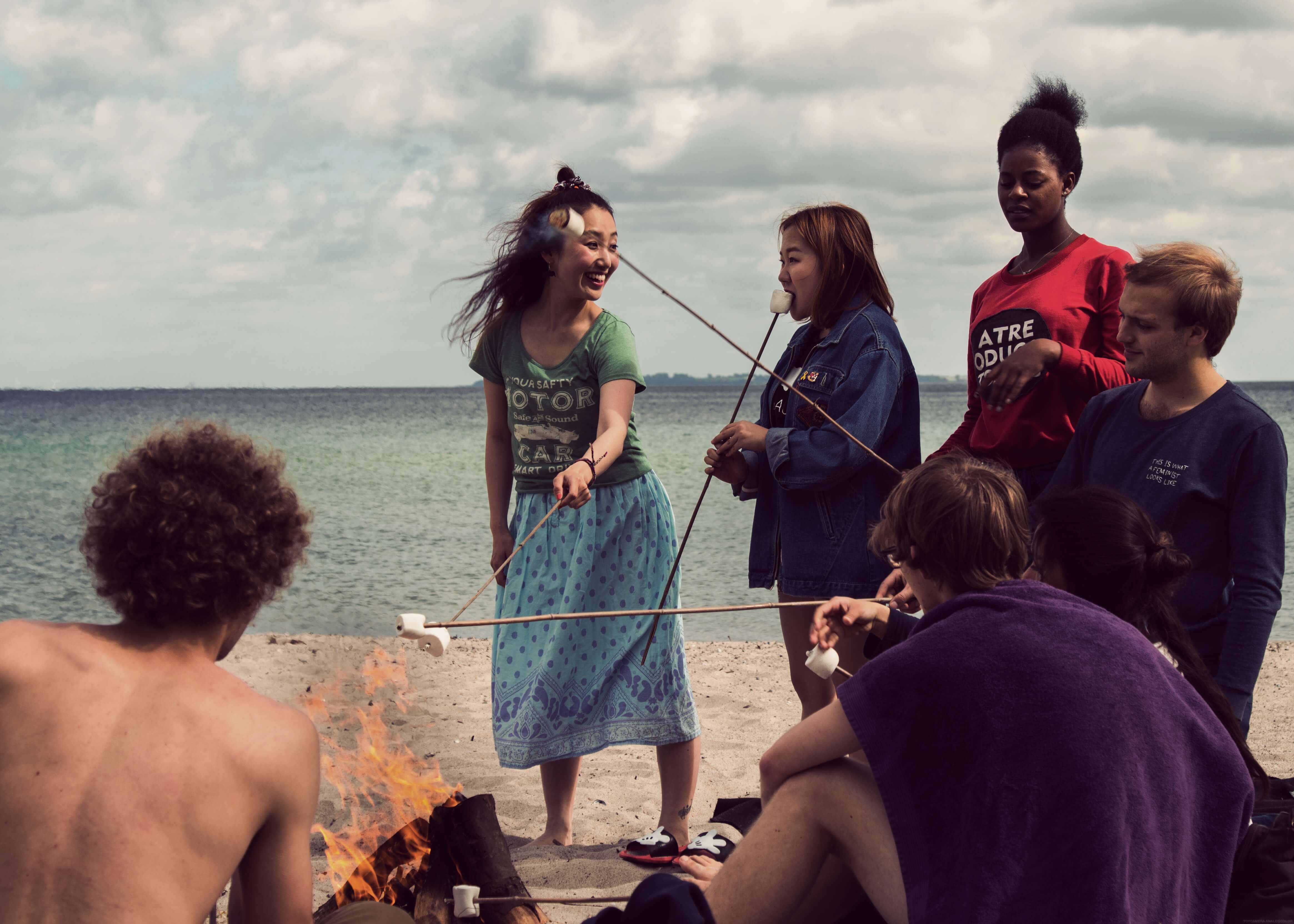
Photo: International People’s College.
Leisure time at an unusual school in Elsinore, Denmark. Some Ukrainian young people have found new ideas there for a stronger post-war democracy.
In Denmark, a non traditional high school called a “folk high school” is the model for a movement in Ukraine to build the strengths needed for a strong participative democracy. You could say “a folk school with Ukrainian characteristics.”
Amanda Leigh Lichtenstein reports at the radio show the World about work at “the International People’s College, a residential school located on a tree-studded campus in Elsinore, a historic town just an hour by train from the capital. …
“The IPC, one of Denmark’s oldest folk high schools, focuses exclusively on global affairs, and all classes are taught in English.
“[Marta Kostiv], a 23-year-old student from Lviv, said that she heard about the chance to study at the IPC when she was still in Ukraine.
“ ‘I saw in one of their group chats that IPC is proposing a scholarship for Ukrainian students, so I applied for it, and I’m really glad.’ …
“Since Russia’s full-scale invasion began, 27 students from Ukraine have been accepted to study at various Danish folk high schools across the country as part of a special endowment to encourage young Ukrainians to learn about democratic change and civil society-building — a purpose aligned with the overall history and aim of the Danish folk high school system.
“Denmark’s 70 folk high schools are residential colleges where young adults come to live and learn together for up to six months with no grades or exams.
These schools embody the concept of bildung — a German word for a learning approach that blends personal, civic and moral development through shared values like cooperation, empathy and dialogue.
“The idea for the endowment came from a small group of educators in Ukraine with Bildung in Ukraine, a nongovernmental organization that believes that bildung holds the key to the country’s future.
“ ‘A very clear message from [Bildung in Ukraine] was to please open your schools for our youth because they need something meaningful to do while the country’s in a state of war,’ said Sara Skovborg Mortensen, who oversees international partnerships with the Association of Danish Folk High Schools. ‘And we need to prepare and democratize [and] build strong individuals for a time after the war.’
“A 24-week semester at the IPC costs about $6,500, which the special endowment makes free of charge. Students can apply to attend any type of Danish folk high school; they emphasize everything from gymnastics to the arts to spirituality.
“At the IPC, residents do everything together, sharing meals and cleaning up in the kitchen, working on class projects, attending cultural nights, hanging out in the library and partying together on the weekends.
“Students and faculty say the school’s emphasis on small-group dialogue and personal storytelling helps them break through cultural barriers and stereotypes.
“ ‘The classes are different, so we have choir, we have intercultural communication, Asian studies, we have all of that, even gardening. And my goal was to try everything I could,’ said Kirill Karuna, a 22-year-old student from Kyiv. ‘You just cannot help but fall in love with this whole concept.’
“Karuna originally applied to stay 12 weeks but was convinced to stay the full 24 weeks and said that he does not regret it — he even discovered his love for filmmaking here.
“ ‘What I’ve learned about myself is that it’s all right to deviate from society and be on your own,’ Karuna added, ‘but don’t go to extremes and don’t leave the [community] for too long.’ …
“Kostiv admitted that ‘even if you move abroad, you can’t get rid of your problems,’ [adding] that she is eager to return to Ukraine, find meaningful work and continue to build her life there. ‘The thing I will [return with] is curiosity,’ Kostiv said, noting how she was encouraged to explore the arts and try new things. …
“The 19th-century thinker N.F.S. Grundtvig is credited as the creative genius behind the folk high school system.
“ ‘He was a priest. He was a poet. He was a politician. He was a pedagogical thinker. And he was a philosopher. And basically, Grundtvig’s thought was that we need to educate the Danish population — the sons of farmers — who only had very little education at that time,’ said headmaster Soren Launbjerg. …
“Over time, folk high schools flourished as a fundamental force in the formation of Danish consciousness. Many leaders and activists around the world would later turn to the folk high school system as a working model for civic engagement, nation-building and democracy.
“Julie Shackleford, an American anthropologist and teacher at the IPC, oversees the school’s archives in a few crowded offices bursting with historical documents, records and relics. …
“ ‘In Denmark, they went from an absolute monarchy to democracy overnight. How do you participate in that when … you’ve never had a voice before? What do you do? So, people needed some training in finding their voice,’ she said. …
“Elena Tochilina, one of the founding members of Bildung in Ukraine, has been in residence at the IPC in Denmark since February to learn more about the folk high school system and find ways to adapt to the Ukraine context.
“Tochilina said that the need for social change in Ukraine erupted in 2013-2014 with waves of large-scale protests calling for massive political reforms that became known as the revolution of dignity.
“ ‘We were very clear that revolutions sometimes are needed, but it’s better to evolve through self-development, through education,’ Tochilina said.
“About a year and a half before Russia’s full-scale invasion into Ukraine, the group outlined plans, created a road map, established a nongovernmental organization and purchased land for the school. ‘When the war started, of course, everything stopped,’ Tochilina said.
“But the war has also crystallized the need for democratic values in Ukraine, she said.
“ ‘And it seems like we’ve got the key, we’ve got the knowledge of how to educate a critical mass of people who will be voters in the future and will be making more conscious choices,’ Tochilina said.
“The folk high school system offers a blueprint for ‘installing a new mindset’ among Ukrainian youth, Tochilina said, but not everything is directly transferable to a Ukrainian context. For example, Tochilina said the IPC’s habitual morning singing gave her flashbacks to mandatory, Soviet-era Young Pioneer camps she attended as a child.
“ ‘You always have to be in the group and you have to stay in the group … I can notice some of these socialist traces in Danish society,’ she said, adding that the Ukrainian approach will require far more flexibility — and freedom.”
More at radio show the World, here. No paywall.

 Suzanne's Mom's Blog
Sounds like a great education. Glad they’ve invited Ukranian students to attend free of charge.
LikeLike
There will be a lot to do when Ukraine starts to rebuild. I like to think that these students will take on the challenge.
LikeLiked by 1 person
What terrific schools — “with no grades or exams.” I very much like this concept of bildung! I’d like to attend one.
LikeLiked by 1 person
I’ve always thought that, in education, so much depends on how great the teacher is. But the underlying folk school concepts are worth thinking about.
LikeLike
[…] International School in Denmark […]
LikeLike