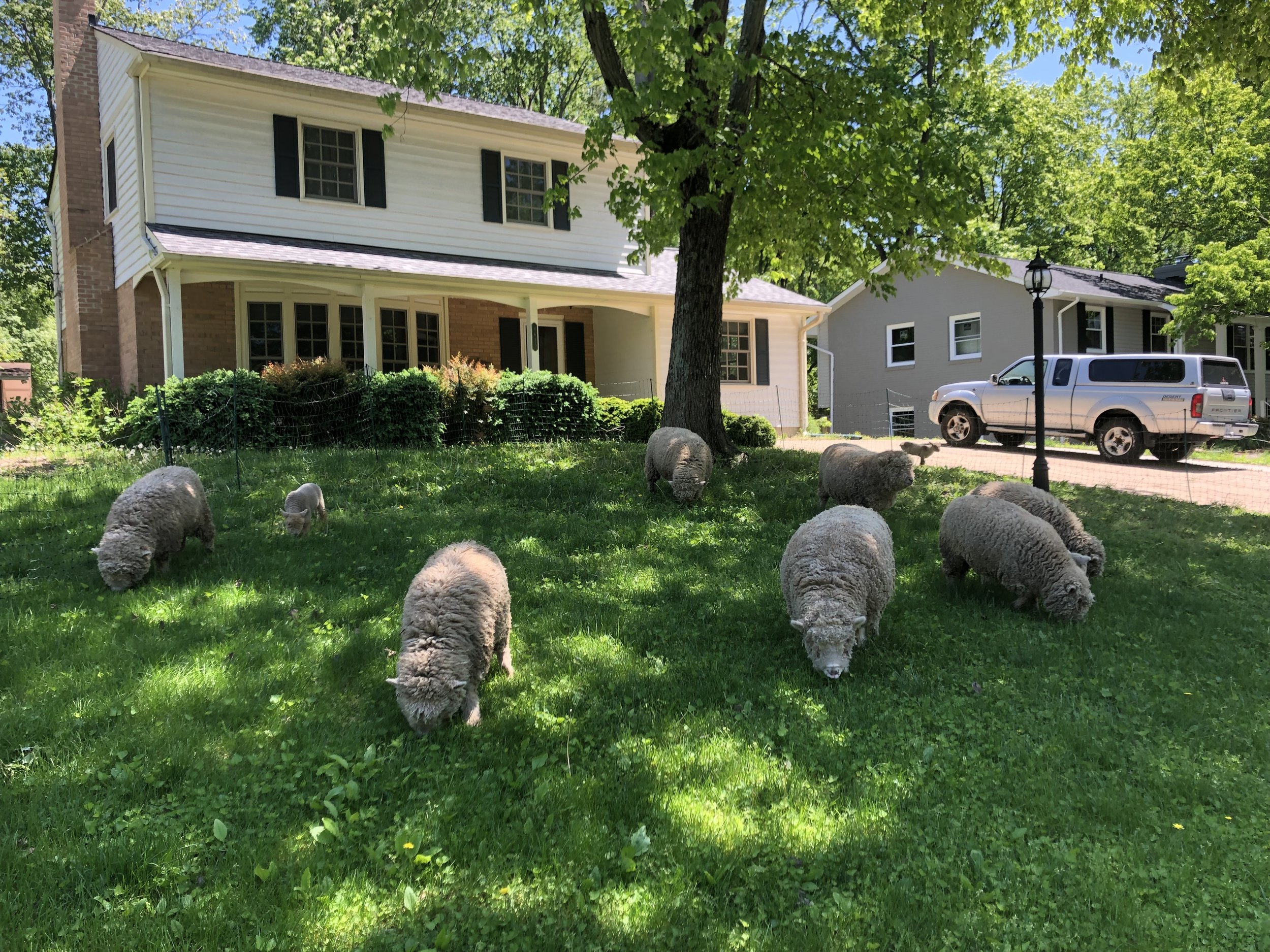
Photo: Lambmowers.com.
When I was in New York during my sister’s illness, I walked around a lot and saw some wonderful sights. One was a small churchyard where rented sheep from out of state were doing the maintenance work.
The idea is catching on.
Michael J. Coren writes at the Washington Post, “Every summer, before heading to the beach, we’d have to ensure [my friend’s] grass was cut. We’d push a roaring lawn mower under the scorching Florida sun. The carpet of scratchy St. Augustine grass seemed to grow faster than we could mow it.
“If only I had known about the amazing grazing solution pioneered millennia ago. ‘Lawn mowers’ were once synonymous with hoofed livestock — goats, sheep, horses and other herbivores — that foraged grasses, seedlings and what are now called weeds. By constantly mowing and fertilizing, they created open pastures and lawns.
“A variety of storied lawns have relied on grazing to keep up appearances. Starting in 1863, sheep were a common sight in New York’s Central Park — the ‘Sheep Meadow‘ was not a metaphor. Flocks could be found munching on public parks in London, Boston and Chicago. In 1914, more than 100 sheep were invited to the nation’s capital to graze near the Lincoln Memorial, and later the White House grounds. Then they promptly disappeared as machines assumed their role.
“After a long hiatus, animals are returning. Europe, ravaged by wildfires, is now paying for fire flocks, herds of sheep to thin vegetation and reduce wildfire risk, resurrecting the silvopastoralism of the past. Sheep are appearing in solar farms, vineyards, cemeteries, golf courses and even atop green roofs. California is enlisting goats as firefighters across the state, while the University of California at Davis relies on sheep to keep its campus in good health.
“Suburbia is the next frontier. Lamb Mowers, billed as the country’s only sheep-led lawn care service, is munching its way to success. The small business in Northern Virginia employs more than a dozen sheep to mow, weed and fertilize suburban lawns across the region. The modest animals are changing hearts and minds, and perhaps pointing Americans toward a different relationship with their grass.
“If grass were a crop, it would be the largest in the United States. Turf grass covers an estimated 1.9 percent of the continental United States, according to a 2005 NASA analysis of satellite images, including residential and commercial lawns, golf courses and similar landscapes. Together, these would represent the largest irrigated crop in the United States, three times bigger than corn.
“This comes at a steep cost— not least to wildlife displaced by sod. The average homeowner spends about 70 hours a year on lawn and garden care, according to the U.S. Bureau of Labor Statistics’ American Time Use Survey. Maintenance costs are hundreds of dollars per year, according to estimates by the University of Nebraska-Lincoln’s extension service.
“But Cory Suter, the self-described ‘Chief Shepherd’ of Lamb Mowers, discovered another way on his permaculture farm in Northern Virginia. Since 2016, rather than pull out heavy equipment, Suter released his flock of babydoll Southdown sheep to graze on nuisance plants such as poison ivy and multiflora rose. It worked. And he realized a market probably existed in the surrounding suburbs.
“So he bought a trailer, loaded up about 15 sheep, and opened for business. People were soon booking regular two-hour, $195 visits for ‘weed and feed’: The sheep clip the grass tops and munch weeds, while leaving sheep pellets that dissolve into rich fertilizer in the first rain or watering.For bigger jobs, Lamb Mowers offered a 24-hour Sheep-over’ for $250, a price he says is competitive with comparable fossil-fuel-powered lawn services.
“Sheep are lawn care experts. They are more gentle grazers than goats or horses, clipping grass tops and nibbling weeds homeowners would like removed. They leave about four inches of the blade: just the right height, says Michigan State University Extension, to maximize root growth and shade out weeds. Any lower, as some lawn companies mow, and the grass will grow even faster to reach the sun, necessitating more mowing.
“ ‘Sheep love the sweet tips of grass, and biodiverse diets like the weeds in your yard’ including bittercress, chickweed and onion grass, says Suter, who grew up farming on a Mennonite homestead in the Shenandoah Valley of Virginia. ‘That’s a perfect buffet for our sheep.’ ” More at the Post, here.
Is now the time I remind readers that lawns are generally bad for the environment and that we need lawn weeds for pollinators if we want them to make our food possible? Oh, well, sometimes we do need lawns. For kids to play on, say. Definitely better than plastic astroturf.

 Suzanne's Mom's Blog
I wish my sister would do this with her Icelandic sheep. Right now they are a very expensive hobby. I am going to share this blog post with her.
LikeLike
Way to go!
LikeLiked by 2 people
Agreed
LikeLike
It’s a win win! I have friends with a farm and they “hire” goats to come clean up a couple times a year, brilliant!
LikeLiked by 1 person
I’ve heard of hiring goats, too, just not at a farm. That’s cool!
LikeLiked by 1 person