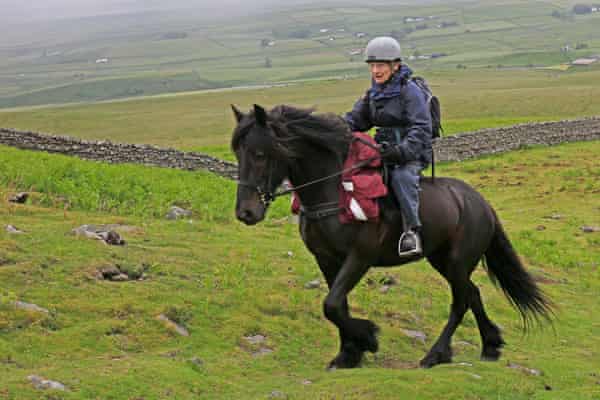
Photo: The Guardian.
Ninety-seven-year-old equestrian and botanist Margaret Bradshaw is the chief caretaker of some of the UK’s rarest flowers.
Where we live now, the majority of people are not as involved in the world as they used to be. But there are those who stay “in the fray,” embracing all the abrasions and adjustments that rubbing up against the world brings.
At the Guardian, Phoebe Weston reports on Margaret Bradshaw, 97, of Teesdale, UK, who fights to preserve a unique mix of plants in her region and intends to keep moving. Often on horseback.
“Margaret Bradshaw crouches on all fours on Widdybank Fell in Teesdale, being drenched by sheets of horizontal rain. The 97-year-old botanist mumbles the names of arcane plants as she scours the damp ground.
“This part of the uplands is a seemingly empty landscape, heavily grazed by sheep, but it hides botanical treasures that have been here for more than 10,000 years. Some of the plants can’t be found anywhere else in the UK and – until Bradshaw arrived on the scene – many were unaccounted for.
“Bradshaw is the chief caretaker of some of the country’s rarest flowers. She has spent seven decades obsessively studying the unique arctic-alpine flora of Teesdale, in the north of England. …
“Where once they were widespread in Britain, now only fragments remain, and 28 species are threatened with extinction.
“ ‘Everything about Teesdale is unique,’ says Bradshaw with pride – and the authority of someone who has just written a 288-page book on the subject.
“Teesdale’s Special Flora: Places, Plants and People was published as part of the Princeton Wild Guides series in February. The ‘Teesdale assemblage’ is celebrated because it is a mix of alpine-arctic flowers and southern European species; nowhere else in Britain do they all grow together.
“Now, though, the area’s unique attributes are under threat. Bradshaw has been recording rare plants here since the early 1950s and has witnessed great declines. [She] first heard about Teesdale when she was a student at Leeds University almost 80 years ago. ‘It stuck in my mind,’ she says. ‘I knew it had a special flora.’ She moved to the area, having never been there before, and did a doctorate in botany at Durham University.
“After a 20-year stint in Devon from 1980, she returned to Teesdale and found all plants had ‘decreased substantially.’ Since the 1960s, plant abundance has dropped by 54% on average. Some have essentially disappeared, such as the dwarf milkwort, down by 98%, and the hoary whitlow-grass, down by 100% (there is now just one recorded plant). …
“She says: ‘We’ve got various buildings in the country – Stonehenge, Durham Cathedral, and others; if they were crumbling away, there would be groups and money helping stop it, because people would say: “We can’t let this happen.” These flowers’ communities are much, much older, and in some respects they are more beautiful.’
“The main reason for the decline of these plants is an unusual one – not enough sheep. The number of sheep on the fells had been reduced by half by 2000, as the uplands were generally believed to be ‘overgrazed.’ Bradshaw says while some upland areas are ‘sheepwrecked,’ reducing grazing on Teesdale has been devastating. Longer grass overshadows the delicate flowers, taking away the light they need to grow.
“As a result of her findings and her work with farmers who graze the land – as well as Natural England, which manages it – sheep numbers are increasing and the timing of grazing is being carefully managed. This has led to the partial recovery of some plants.
“But the question of other factors looms: the effects of artificial fertilizers; rabbits, which have their own impact on grazing; and the climate crisis. …
“Bradshaw is committed to working these mysteries out – and is a model for how to live in your 90s. At 93, she set up Teesdale Special Flora Research and Conservation Trust to record rare plants and find people to continue her work in the future. A keen horse rider, at 95 she did a 55-mile (88km) horse trek across Teesdale, raising almost [$13,000] for the trust. I ask her the secret to longevity. ‘Just keep going,’ she says. ‘Keep at it. Don’t sit down and just watch the telly.’ ”
Check out the wildflower photos at the Guardian, here. No paywall.

 Suzanne's Mom's Blog
I sent this to my 93 yo cousin…
>
LikeLike
I was so please to meet her and her daughter!
LikeLike
What an extraordinary lady
LikeLike
She’s gonna go down fighting!
LikeLiked by 1 person
Wow! I certainly have no excuse to take it easy.
LikeLike
When we look back at times we know firsthand, we tend to feel old. But to the person we will be next year or in five years, our current age is young.
LikeLiked by 1 person