Photo: Isabelle de Pommereau.
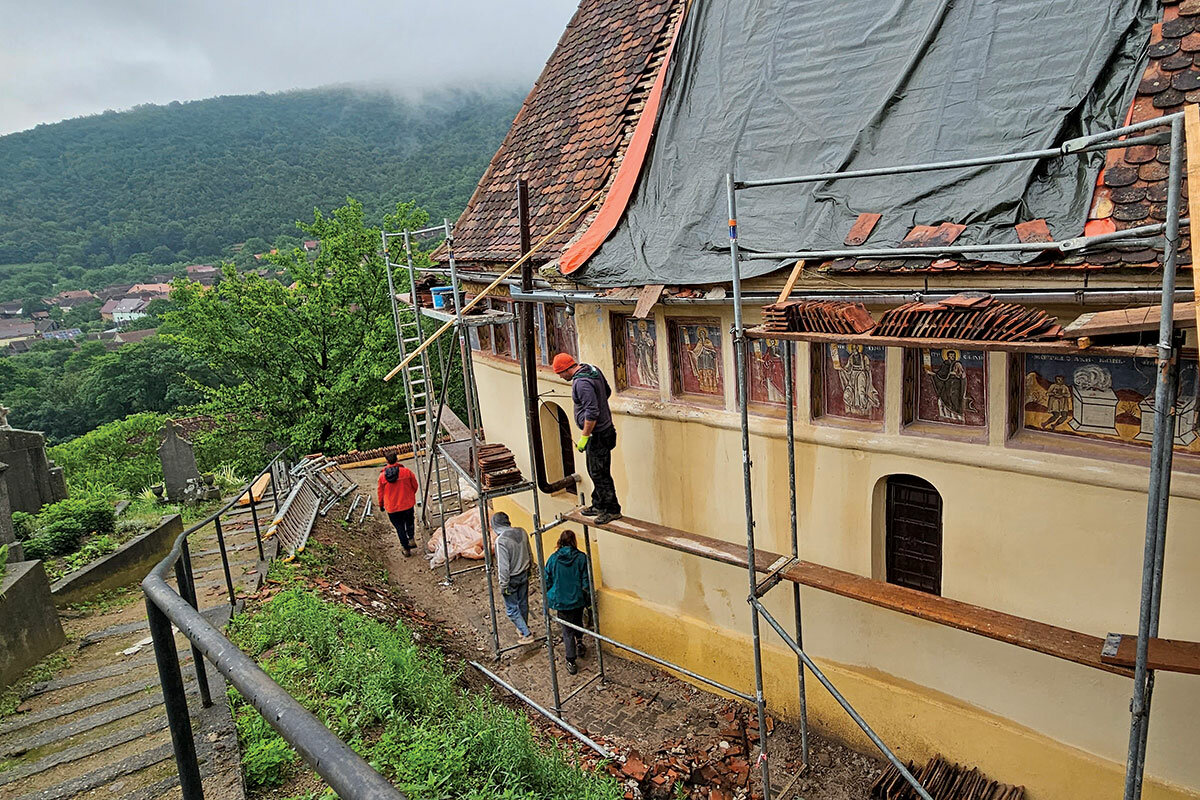
Eugen Vaida and an Ambulance for Monuments team repair the Church of St. Nicholas the Hierarch in Fântânele, Romania.
Today’s story is all about the Power of One. That is, one who organizes many. The setting is a post-Communist country that is struggling to build its economy and has little left over for preserving cultural monuments.
Isabelle de Pommereau writes at the Christian Science Monitor, “It is midday on a damp Friday. Eugen Vaida guides his team into the final phase of re-tiling the roof of a church, at the crest of a forested hill in this mountainous Transylvanian village.
“Village craftspeople and students from the city meticulously lay tiles on the roof timbers of the 18th-century Romanian Orthodox Church of St. Nicholas of the Hierarch. From the scaffolding, students respectfully and attentively watch Nicolae Gabriel Lungu, who is descended from a Romani family who all knew this skill. Soon an older woman summons the crew to share in a platter of clătite, thin cheese-filled crepes.
“Once bustling with families and culture, Mr. Vaida’s home region had become a string of largely empty villages surrounding abandoned stone churches. But now, watching this group interact, he has newfound hope. The repair by his group, Ambulance for Monuments, will help safeguard the church’s stunning outer frescoes. And the impact will ripple far beyond the building itself.
“ ‘People are starting to understand the value of heritage,’ Mr. Vaida says. For the past seven years, he’s been driving around the country with a van equipped with tools and volunteers in a race against time to rescue endangered historic buildings. He has helped save more than 55 historical structures on the verge of collapse, from medieval churches and fortification walls to old watermills and UNESCO World Heritage Sites. He does so by impressing preservation methods and mindsets onto local communities.
“ ‘I wanted to reconnect the members of the community to their roots, make them aware that those buildings are part of their cultural identity, and show them how they can continue the work we do,’ he says.
“Mr. Vaida offers a ‘best-practice example of how, with not so much effort, you can save the identity of Romania as a country,’ says Ciprian Stefan, director of the ASTRA Museum, Europe’s largest open-air ethnographic museum, in Sibiu.
“Romania’s rich cultural legacy of painted churches and fortified villages was shaped over centuries. But close to 600 historic monuments are in an acute state of degradation, victims of years of dictatorship, poor legislation, and plain neglect, experts say.
“Mr. Vaida experienced the destruction in a very personal way. He grew up playing with Romani and Hungarian friends, as well as the German Saxons who had literally built the region. When the 1989 collapse of communist dictatorship flung Romania’s doors wide open, half a million people left. The mass exodus tore the Romanian soul apart – and fractured Mr. Vaida’s own identity. Ambulance for Monuments is an attempt to reclaim both his identity and that of his country. …
“He, too, left for the city, to get an education, and he became a successful architect in Bucharest. But six years into the job, he quit to return home. The big city was not his future; his home village was.
“He soon discovered that many village craftspeople who had passed on their know-how from generation to generation had left for Western Europe. … Mr. Vaida wanted to use his architectural skills to save his region’s extraordinary architectural and cultural heritage. He started by teaching children about local history. …
“In 2016, he launched Ambulance for Monuments in hopes of connecting architectural students, craftspeople, and communities around a new effort to restore decaying historic buildings. …
“Volunteer students get hands-on practice in historical restoration; local craftspeople get jobs; and communities help house and feed the teams, and donate the material. … ‘It’s going from grassroots up, from down to up,’ says Mr. Vaida. …
” ‘He doesn’t go to villagers to ask for anything, but he goes there to give something,’ says Mr. Stefan. ‘The community stays in the shadows at first. When they see Eugen comes with material and manpower to restore their church, they say, “Let’s help him,” and, little by little, they come and help with housing, with food.’ …
“The task of rescuing Romania’s cultural legacy is huge, but Mr. Vaida sees signs of progress. … ‘People are moving back to the villages of their grandparents, because they feel they belong there,’ he says. ‘They are rediscovering old houses, their heritage, their villages, and are getting involved in the preservation of this type of living.’ ”
More at the Monitor, here. No paywall. Subscriptions solicited.

 Suzanne's Mom's Blog
The country has suffered so much. It’s wonderful that someone is trying to preserve the historical buildings.
LikeLike
I was interested that he had rapport with other ethic groups. I know through the work my church does in Transylvania that many Hungarians and Romanians hold on to bitterness. I didn’t know about Saxons.
LikeLike