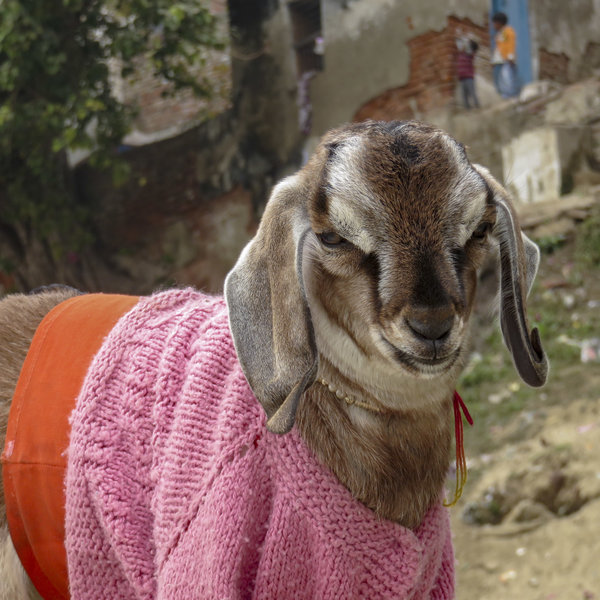
Photo: Goats in Sweaters.
New research suggests there is more to livestock than meets the eye.
Many pet owners would swear that their dogs are always thinking. Maybe it’s not only dogs. What farmyard animals do when responding to the circumstances around them also looks a lot like thinking.
David Grimm reports at Science about new research into what goes on in animals’ minds.
“You’d never mistake a goat for a dog,” he writes, “but on an unseasonably warm afternoon in early September, I almost do. I’m in a red-brick barn in northern Germany, trying to keep my sanity amid some of the most unholy noises I’ve ever heard. Sixty Nigerian dwarf goats are taking turns crashing their horns against wooden stalls while unleashing a cacophony of bleats, groans, and retching wails that make it nearly impossible to hold a conversation. Then, amid the chaos, something remarkable happens. One of the animals raises her head over her enclosure and gazes pensively at me, her widely spaced eyes and odd, rectangular pupils seeking to make contact — and perhaps even connection.
“It’s a look we see in other humans, in our pets, and in our primate relatives. But not in animals raised for food. Or maybe we just haven’t been looking hard enough.
“That’s the core idea here at the Research Institute for Farm Animal Biology (FBN), one of the world’s leading centers for investigating the minds of goats, pigs, and other livestock. … Scientists are probing the mental and emotional lives of animals we’ve lived with for thousands of years, yet, from a cognitive perspective, know almost nothing about.
“The work is part of a small, but growing field that’s beginning to overturn the idea that livestock are dumb and unworthy of scientific attention. Over the past decade, researchers at FBN and elsewhere have shown that pigs show signs of empathy, goats rival dogs in some tests of social intelligence, and … cows can be potty trained, suggesting a self-awareness behind the blank stares and cud chewing that has shocked even some experts. …
“The field faces challenges, however. …. Farm animals can be huge, many are hard to train, and traditional funders and high-profile journals have generally spurned such studies. But as scientists push past these obstacles. … What they learn could even change the way we house and treat these creatures. …
“In an enclosed L-shaped barn at FBN that houses more than 700 pigs … researchers are herding hulking hogs — just 6 months old but already 120 kilograms [265 pounds] — one by one into a run with a treadmill. Instead of a conventional treadmill’s control panel, there’s a grapefruit-size glowing blue button at snout height that the animals can press to run the machine for a few seconds. Today, however, no one seems very interested in working out.
“Like a person having second thoughts about their gym membership, most of the pigs step briefly onto the treadmill, then walk off, emitting squeals and deep, belchlike grunts as they exit through a door on the other side of the run.
“ ‘We have sports pigs, but also couch potato pigs,’ [Birger Puppe, director of FBN’s Institute of Behavioural Physiology] laughs. Katharina Metzger and Annika Krause, the postdoc and technician, respectively, running the study, tell me I may be making the animals nervous. Last week, they say, one pushed the button seven times and kept coming back for more.
“The goal is to train the pigs for an experiment that will test whether they’ll exercise just because it makes them feel good, a window into their emotions. ‘The idea comes from human sports physiology,’ Puppe says. ‘That exercise can improve mood.’
“A couple of decades ago, work like this would have been laughed out of the barn. There are an estimated 78 billion farm animals on Earth — a number that dwarfs monkeys, rodents, and humans combined — and we have lived with them longer than any other creature save dogs. Yet in an era where researchers are modeling rat brains on computers and showing that our canine pals may be able to intuit our thoughts, livestock remain a black box.
“That’s because, until recently, scientists didn’t take their cognition seriously. ‘When I went to my first research conferences, people didn’t understand why I was studying the minds of farm animals,’ says Christian Nawroth, a behavioral biologist at FBN. Why waste your time if it’s not going to improve milk or meat production, he recalls them asking.’ …
“After abandoning his early work with pigs because he found the animals too hard to train, he switched to goats, which seemed just as interested in him as he was in them. ‘They pay a lot of visual attention to what you’re doing,’ he says. ‘It may not seem like there’s a lot going on in their head, but they are processing information all the time, even if they’re just standing there looking at you.’ …
“In early work, he explored how goats measure up to dogs in a battery of cognitive tests. In an experiment known as the ‘impossible task,’ dogs confronted with a food bowl they can’t access turn to humans for help, a behavior that’s been chalked up to their intensive coevolution with us. But Nawroth showed that goats did the same. …
“Further experiments showed that goats, like dogs, could distinguish between pictures of happy and angry people, suggesting they are tuned into our emotional states; that they could locate food behind an obstacle more quickly if they watched humans move the food there first, a rare example of cross-species learning; and, in Nawroth’s most significant finding, that goats seem to understand what we mean when we point at something, a complex reading of our social cues that eludes even chimpanzees.”
Lots more at Science, here. I must say, this article is making me think more seriously about becoming a vegetarian! I think blogger Laurie Graves already is. Are you?

 Suzanne's Mom's Blog
This is very informative. Thank you
LikeLike