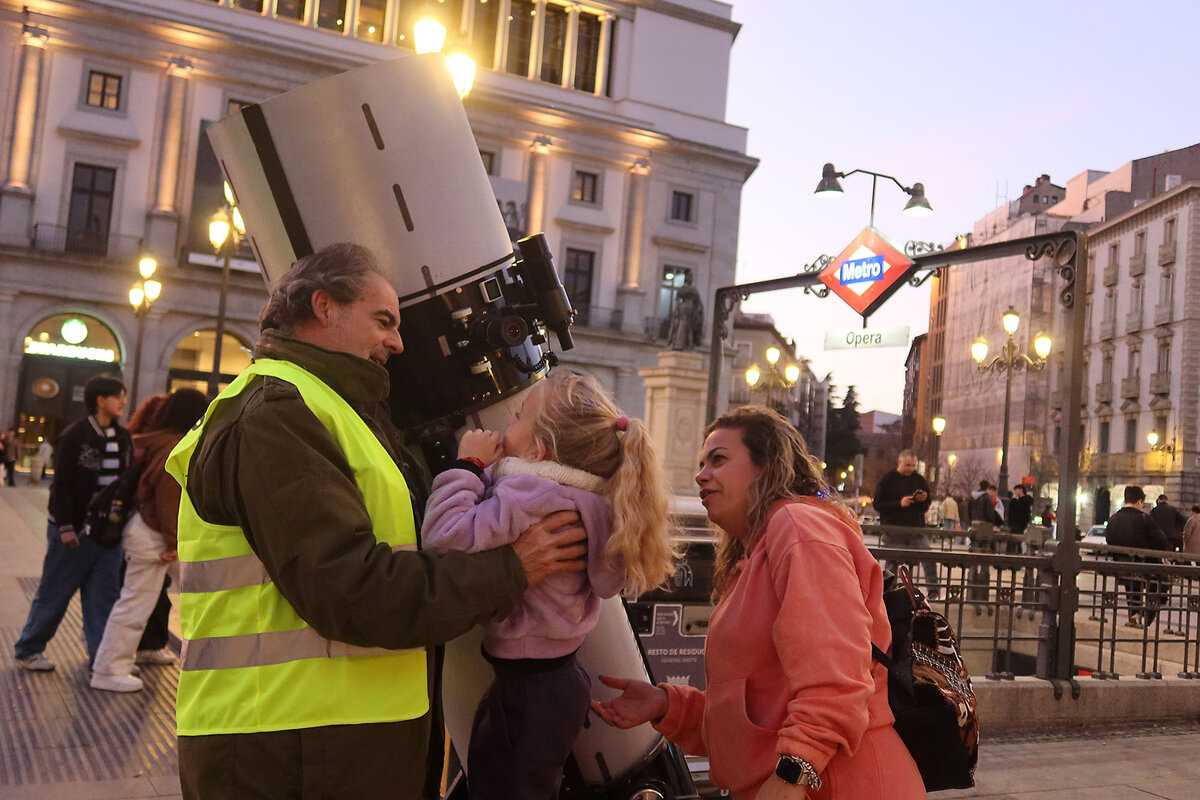
Photo: Erika Page/The Christian Science Monitor.
Alfredo Paniagua lifts a young girl up to see planet Jupiter through his telescope on a sidewalk in Madrid last February.
It seems that people are more likely to engage with the stars in the summer than at other times of year. I myself see a lot more stars when I vacation in New Shoreham in July because there are fewer sources of ambient light. The stars are more noticeable.
Today’s story is about a man in Spain who loves to show anyone who’s interested the wonders of astronomy.
Erika Page reports at the Christian Science Monitor, “As the rest of the city heads out on a Friday evening, Alfredo Paniagua dons a lime-green vest, loads his 180-pound telescope into a van, and drives into the center of Madrid.
“He sets up the telescope at the mouth of the busy Ópera metro station, a block from the Royal Palace. The sun still setting, he swivels the massive cylinder to an invisible point in the sky and fiddles with the focuser. And then he waits.
“It doesn’t take long for curiosity to pique. Children tug on sleeves and point. Friends dressed for an evening out stop to ask what’s up there.
“ ‘Jupiter,’ says Mr. Paniagua. ‘The view is spectacular tonight.’
“A line begins to take shape, curious passersby waiting their turn to peek through the lens. Mr. Paniagua places a footstool for those who need it and lifts the smallest kids up himself. He shows each viewer how to focus the image. Then he steps back for his favorite part. Eyebrows raised, he watches face after face light up at the sight: a perfectly round ball of bright gas marked by two clear stripes near its equator, tiny to the eye yet big enough to fit 1,321 Earths. Four moons stretch out in a straight line below. …
“It’s a nightly ritual Mr. Paniagua has performed for two decades, whenever the sky is clear. He often stays past midnight, sharing his telescope with hundreds of strangers free of charge. Many leave a donation, which he accepts. … ‘I like to think that they begin to ask themselves new questions.’ …
“[The immensity is] what Ana Afonso Martin says she felt looking through Mr. Paniagua’s telescope. She and three friends just arrived from the Canary Islands for a weekend in Madrid. Jupiter was the last thing she expected to find in the capital.
” ‘We are teeny, tiny, and this is immense,’ she says. ‘If you’re always stuck in your world, and you don’t look up at the sky, you don’t realize that.’
“It’s also what pulled Mr. Paniagua into the fold 25 years ago. At the time, he was working odd jobs, mostly as a metalworker, on the outskirts of Madrid. He heard word of a free astronomy course offered by someone in his neighborhood, and signed up.
“It was Saturn that hooked him, on the last day of the class. From there, he and a few others formed the Agrupación Astronómica Madrid Sur (South Madrid Astronomical Association) and began bringing an old telescope to schools, hospitals, small towns, and whoever invited them. Most of what he has learned he taught himself, though he eventually became a certified astronomy monitor through the Starlight Foundation, a nonprofit dedicated to promoting and protecting the night sky. Over time he realized that to reach the most people, he needed to be out on the street. …
‘A growing dark-sky movement is working to protect the night from light pollution, which grew by nearly 10% every year between 2011 and 2022.” More at the Monitor, here.

 Suzanne's Mom's Blog
Leave a comment. Website address isn't required.