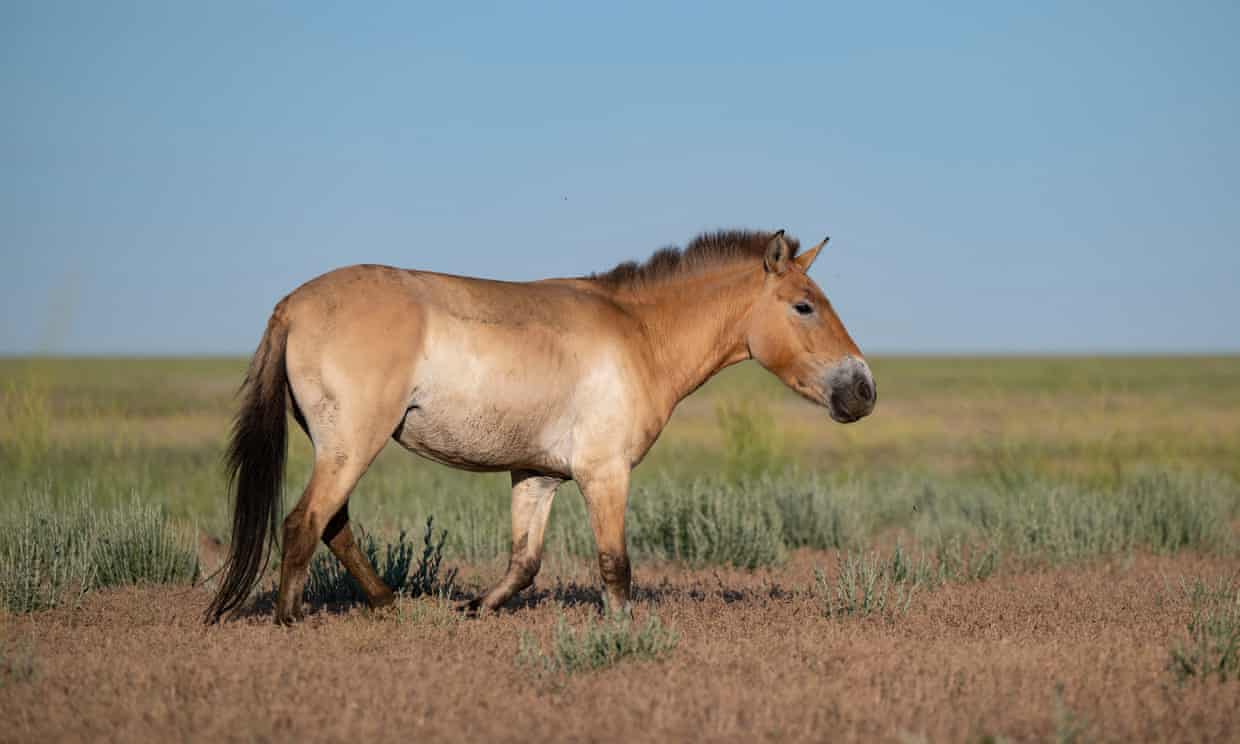
Photo: D Rosengren/Global Rewilding Alliance.
The wild Przewalski’s horses are said to be the only horses in the world that have never been domesticated. They are being reintroduced to the steppes of Kazakhstan.
The woman who cuts my hair has convinced me that, on the whole, zoos are bad for animals — that elephants shifting from one leg to the other for hours at a time are not doing a little happy dance but are bored witless.
Even so, we do hear of zoos doing good work to protect endangered species.
Sophie Kevany reports at the Guardian about some zoos’ recent win for biodiversity.
“A group of the world’s last wild horses have returned to their native Kazakhstan after an absence of about 200 years. The seven horses, four mares from Berlin and a stallion and two other mares from Prague, were flown to the central Asian country on a Czech air force transport plane.
“The wild horses, known as Przewalski’s horses, once roamed the vast steppe grasslands of central Asia, where horses are believed to have been first domesticated about 5,500 years ago.
“People are known to have been riding and milking horses in northern Kazakhstan nearly 2,000 years before the first records of domestication in Europe. Human activity, including hunting the animals for their meat, as well as road building, which fragmented their population, drove the horses close to extinction in the 1960s.
“Filip Mašek, Prague zoo’s spokesperson, said: ‘These are the only remaining wild horses in the world. Mustangs are domesticated horses that went wild.’
“The horses reintroduced into Kazakhstan are descended from two groups that survived in Munich and Prague zoos.
“Originally, eight horses had been scheduled to travel, said Mašek, but one horse sat down before the flight from Prague and had to be unloaded and returned to Prague zoo.
“ ‘He was just a little dizzy returning, but he is fine now. These horses have to stand for the entire journey – they can’t sit down, mainly because their blood needs to circulate properly. It is a 30-hour journey in total, and the horses will only survive if they stand all the way,’ he said.
“Returning the horses from Prague zoo would help increase biodiversity in the region, said Mašek. ‘The horses spread seeds in their dung and when they dig up plants, they help the water get down into the soil. They also fertilize the steppe with their dung.
“ ‘For me,’ he said, ‘the goal of a modern zoo is not just about protecting and breeding endangered species, it is about returning them to the wild where they belong.’ …
“In 2011, Prague zoo was involved in a reintroduction of Przewalski’s horses to Mongolia. The project, which involved nine flights of horses, continued until 2019 when the population stabilized, said Mašek, adding that there were now about 1,500 of the wild horses in Mongolia. Mašek said the plan was to transport a total of 40 horses to central Kazakhstan over the next five years.”
More at the Guardian, here.

 Suzanne's Mom's Blog
May they flourish and gallop!
LikeLike
Live long and prosper!
LikeLiked by 1 person
A great win. I do wish you’d introduce your hairdresser to the zoo programs on Animal Planet. Many zoos still aren’t good for animals, but the big ones are about as good as it can get, other than freedom. They are protecting gene pools and diversifying them, and returning animals to the wild when they can—not often enough, alas.
This is a great story.
Hannah
>
LikeLike
Hannah, that’s a great tip. And I know you are right about protecting and diversifying gene pools.
LikeLike
Glad to hear these unique horses have returned to the wild!
LikeLike
They look kind of different. I guess that’s what you’d expect.
LikeLiked by 1 person