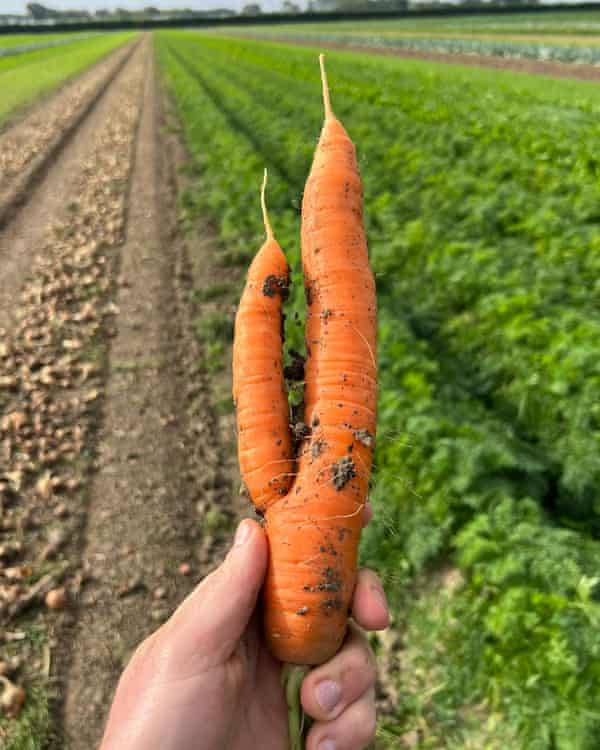
Photo: No Waste Army.
Farmers are linking the climate crisis to wonky vegetables that may not meet modern standards of perfection but are perfectly good to eat.
There used to be a delightful account on Twitter called Ugly Fruit and Veg (@UglyFruitAndVeg), and it posted wonderful, fun photos of misshapen produce that was still edible. Nowadays that person has turned to other topics on other platforms, but I thought of the account when I read today’s Guardian story by Senay Boztas in Amsterdam.
“When 31-year-old Dutch farmer Bastiaan Blok dug up his latest crop, the weather had taken a disastrous toll. His onions – 117,000 kilos of them – were the size of shallots.
“ ‘We had a very wet spring and a dry, warm summer, so the plants made very small roots,’ said Blok, who farms 90 hectares in Swifterbant, in the reclaimed province of Flevoland. … ‘It’s either far too wet and cold, or far too warm and dry, and there’s no normal growing period in between.’
“Blok is one of a number of farmers in Europe’s largest agricultural exporter linking the climate crisis to ever more ‘imperfect’ fruit and vegetables, rejected by a food system based on standardization and cosmetic appearance.
“Last month, a crowdfunding scheme to help him was launched by social business the No Waste Army, which runs a quarterly food box scheme, with soups, sauces, pasta, drinks and jams made from rescued fruit and veg. Thanks to its commission, public donations – some sending onions to food banks – and a pickling order from Amsterdam ‘Gherkin King’ Oos Kesbeke, Blok’s sheds are finally empty and a year’s work wasn’t wasted.
“But Thibaud van der Steen, co-founder of No Waste Army, said farmers are suffering from weather extremes, linked to the climate crisis, making it ever harder to meet modern standards of perfection.
“ ‘One of our founders, Stijn Markusse, was working for 12 years with farmers with a meal box concept, and was astonished that so many vegetables and fruit stayed in the ground or were thrown away because they didn’t fit a kind of beauty ideal,’ said Van der Steen. ‘The average consumer has got used to cucumbers as straight as candles. But anyone who has a vegetable patch knows that for every 10 cucumbers, two or three will be straight and all the others will have all kinds of shapes.’ …
“The wettest autumn, winter and spring on record have threatened the spinach and potato crops, leading to parliamentary questions and warnings from farming union LTO. Evelien Drenth, LTO agriculture specialist, said 61% of Dutch farmers report lost yields due to extreme weather, diseases are up and sowing is late or sometimes missed. ‘Consumers and supermarkets need to get used to empty shelves sometimes for short-season crops like spinach … and also irregular-sized Brussels sprouts and broccoli,’ she added.
“If the plants are stressed, so are the farmers, according to Jaap Fris, of the community-owned farm Erve Kiekebos, in Empe, Gelderland. ‘It is true that things are getting more difficult because of the climate,’ he said. ‘But sometimes I have to challenge my own perception that things have to be perfect, when I know that even if it looks less good, it is just as tasty.’ “
Meanwhile in the US, the Fioneers are consumers who value wonkiy vegetables. At their blog, they have reviewed businesses that make the odd shapes available to the cost conscious. They write, “Through some research, we realized that we spent more money on food than the USDA’s guidance for a (liberal spending) family of four.
“We have taken steps to improve. We’ve focused on not wasting food, meal planning based on what we already have, and buying in bulk. We have reduced our food spending quite a bit, but we felt like it was still high. …
“When I was doing research into this, I stumbled across ugly produce delivery services. I found these services appealing for two reasons. First, these services ship the produce directly to your house. CSAs typically require you to pick it up from a central location. The ugly veggie services also provide the option of customizing the size of the box you want and the products inside. CSA shares provide a lot of food, and I wasn’t sure that we could use it all.
“There are two options for ugly produce where we live: Misfits Market and Imperfect Foods. We decided to try them both, alternating weeks between the two. One week we’d get a Misfits Market box. The next week we’d receive an Imperfect Foods Box. …
“In the United States, approximately 40% of our food is wasted. It isn’t only consumers who are wasting food. Food is wasted for a variety of reasons and at different points along the supply chain. Farms, distributors, stores, and consumers are all guilty of too much food waste. …
“The National Resource Defense Council makes a number of recommendations to help solve this problem. One of their main recommendations is to ‘expand secondary markets for items that do not meet the highest cosmetic standards.’
“This is precisely what companies like Misfits Market and Imperfect Foods are doing. They are the secondary markets. They are buying the produce from farms when there is a surplus or when the produce doesn’t meet cosmetic requirements.” More from the Fioneers, here.
More at the Guardian, here.

 Suzanne's Mom's Blog
Excellent idea. I especially liked “If the plants are stressed, so are the farmers.”
LikeLiked by 1 person
Yes, that is something to think about for a while. Maybe applying it to all living things.
LikeLiked by 2 people
Thanks for sharing! So much food is wasted because of shape or color. Initiatives like these are very important we think.
LikeLike
Good to see one close to home for you!
LikeLiked by 1 person
[…] Ugly Vegetables Finding Homes […]
LikeLike
I’m so glad to hear that there are people doing something about this. I think that “unusually” shaped vegetables really are the norm. I know that when my aunt had a garden all her veggies had interesting personalities. 😄
LikeLike
I like thinking about them as having personalities! Good one!
LikeLiked by 1 person