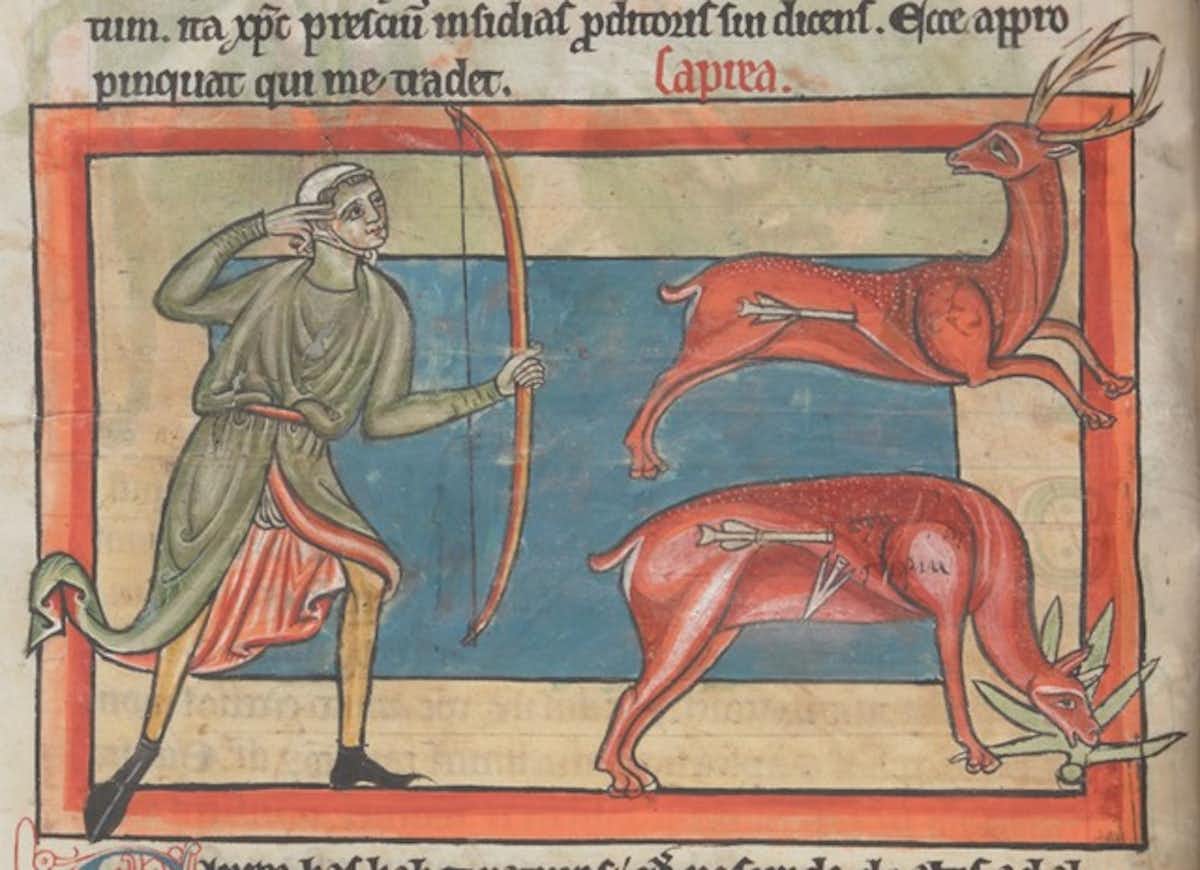
Photo: British Library, Harley MS 4751 (Harley Bestiary).
As a hunter lands several arrows in his quarry, a wounded doe nibbles dittany to heal herself.
I think we don’t give enough credit to ancient wisdom. Researchers of former times may have been ignorant of cars and computers and smart phones, but why do we think they were unintelligent? (I’m a little cranky because I recently attended a talk on reflexology that barely mentioned traditional Chinese medicine.)
Today we learn that art works from centuries ago suggest humans were observing animals self-medicating long before contemporary scientists started publishing papers on the practice.
Adrienne Mayor, a classics, history and philosophy of science scholar at Stanford University, writes in the Conversation, “When a wild orangutan in Sumatra recently suffered a facial wound, apparently after fighting with another male, he did something that caught the attention of the scientists observing him.
“The animal chewed the leaves of a liana vine – a plant not normally eaten by apes. Over several days, the orangutan carefully applied the juice to its wound, then covered it with a paste of chewed-up liana. The wound healed with only a faint scar. The tropical plant he selected has antibacterial and antioxidant properties and is known to alleviate pain, fever, bleeding and inflammation. …
“In interviews and in their research paper, the scientists stated that this is ‘the first systematically documented case of active wound treatment by a wild animal’ with a biologically active plant. …
“To me, the behavior of the orangutan sounded familiar. As a historian of ancient science who investigates what Greeks and Romans knew about plants and animals, I was reminded of similar cases reported by Aristotle, Pliny the Elder, Aelian and other naturalists from antiquity. A remarkable body of accounts from ancient to medieval times describes self-medication by many different animals. The animals used plants to treat illness, repel parasites, neutralize poisons and heal wounds.
“The term zoopharmacognosy – ‘animal medicine knowledge’ – was invented in 1987. But as the Roman natural historian Pliny pointed out 2,000 years ago, many animals have made medical discoveries useful for humans.
Indeed, a large number of medicinal plants used in modern drugs were first discovered by Indigenous peoples and past cultures who observed animals employing plants and emulated them.
“Some of the earliest written examples of animal self-medication appear in Aristotle’s ‘History of Animals‘ from the fourth century BCE, such as the well-known habit of dogs to eat grass when ill, probably for purging and deworming.
“Aristotle also noted that after hibernation, bears seek wild garlic as their first food. It is rich in vitamin C, iron and magnesium, healthful nutrients after a long winter’s nap. The Latin name reflects this folk belief: Allium ursinum translates to ‘bear lily,’ and the common name in many other languages refers to bears.
“Pliny explained how the use of dittany, also known as wild oregano, to treat arrow wounds arose from watching wounded stags grazing on the herb. Aristotle and Dioscorides credited wild goats with the discovery. Vergil, Cicero, Plutarch, Solinus, Celsus and Galen claimed that dittany has the ability to expel an arrowhead and close the wound. Among dittany’s many known phytochemical properties are antiseptic, anti-inflammatory and coagulating effects.
“According to Pliny, deer also knew an antidote for toxic plants: wild artichokes. The leaves relieve nausea and stomach cramps and protect the liver. To cure themselves of spider bites, Pliny wrote, deer ate crabs washed up on the beach, and sick goats did the same. Notably, crab shells contain chitosan, which boosts the immune system.
“When elephants accidentally swallowed chameleons hidden on green foliage, they ate olive leaves, a natural antibiotic to combat salmonella harbored by lizards. Pliny said ravens eat chameleons, but then ingest bay leaves to counter the lizards’ toxicity. Antibacterial bay leaves relieve diarrhea and gastrointestinal distress. Pliny noted that blackbirds, partridges, jays and pigeons also eat bay leaves for digestive problems.
“Weasels were said to roll in the evergreen plant rue to counter wounds and snakebites. Fresh rue is toxic. Its medical value is unclear, but the dried plant is included in many traditional folk medicines. Swallows collect another toxic plant, celandine, to make a poultice for their chicks’ eyes. Snakes emerging from hibernation rub their eyes on fennel. Fennel bulbs contain compounds that promote tissue repair and immunity.
“According to the naturalist Aelian, who lived in the third century BCE, the Egyptians traced much of their medical knowledge to the wisdom of animals. Aelian described elephants treating spear wounds with olive flowers and oil. He also mentioned storks, partridges and turtledoves crushing oregano leaves and applying the paste to wounds.”
Need more proof that modern science sometimes just reinvents the wheel? Read the Conversation, here. No paywall. Fun artworks.

 Suzanne's Mom's Blog
What an eye opening read. Animals may have discovered medicine!
LikeLike
Would love to know how they figured out any one of these cures. Must have started with an accident, maybe many repeated accidents.
LikeLiked by 1 person
Happy accidents I think!
LikeLiked by 1 person