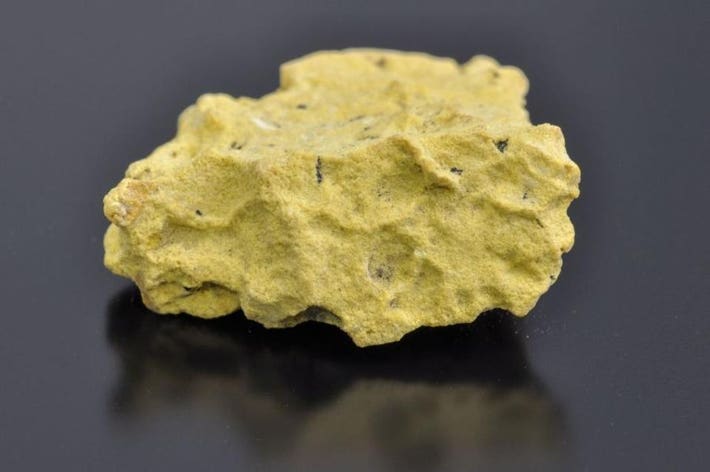
Photo: F.Kemner/LfU Bayern.
The rare mineral Humboldtine is known only from about 30 sites worldwide. This specimen was found unexpectedly in a mineral collection in Germany.
I’ve often blogged about surprise discoveries of plants or animals thought to be extinct and about the unearthing of long-buried human artifacts. Today’s story by David Bressan at Forbes magazine is on the surprise discovery of a rare mineral that was hiding in plain sight. It makes me think there will be an endless supply of of things to discover in the future because we keep forgetting what we have.
“During a survey of an old mineral collection now hosted at the Bavarian Environment Agency or LfU Bayern in Germany,” Bressan writes, “experts discovered fragments of Humboldtine, one of the rarest minerals found on Earth.
“Humboldtine is known from only 30 localities worldwide, including quarries and mines located in Germany, Brazil, the U.K., Canada, the U.S., Hungary, Czech Republic and Italy. It rarely forms tiny crystals and is most commonly found as a yellow, amorphous mass. Humboldtine forms when carbon compounds and iron-oxide react with water and is one of the few ‘organic minerals‘ containing carbon-oxygen-hydrogen groups in their crystalline structure.
“Humboldtine was first discovered by German mineralogist August Breithaupt in a weathered brown coal deposit near the municipality of Korozluky in Okres Most in the Czech Republic. [It was] scientifically described in 1821 by Peruvian geologist Mariano Eduardo de Rivero y Ustariz, who named the mineral after the German 19th-century naturalist and explorer Alexander von Humboldt. …
“In 2023, during the digitization of the archive of the LfU, a letter written by a coal mine owner and sent in 1949 to the agency was found. The letter mentions the presence of Humboldtine in coal seams of the Matthiaszeche near the town of Schwandorf, a town on the river Naab in the Upper Palatinate. The agency asked for some samples for further analysis to confirm the discovery. But no follow-up documentation seems to exist.
“But intrigued by the note, Roland Eichhorn, head of the geological department at the LfU, and colleagues decided to check the vast historic mineral collection — comprising over 130,000 rock and mineral samples — hosted in the agency’s basement. If any samples were ever sent in, they still could be here. In one drawer of the systematic mineral collection, where minerals are ordered according to their chemical composition, they found some fragments of a yellow mineral labeled ‘Oxalit,’ German for organic minerals, still inside an old cardboard box. The label also showed that the samples came from the locality mentioned in the letter.
“Modern chemical analysis confirmed the discovery made 75 years earlier; the six fragments, the largest almost the size of a nut, are indeed Humboldtine. Together with other samples, this doubles the amount of Humboldtine known so far. …
“The Matthiaszeche, a former open-pit mine for brown coal, was closed in 1966 and subsequently flooded. There is no chance of getting any more Humboldtine from this locality.”
More at Forbes, here.
I love that geologist Eichhorn was curious. Bless his heart. That’s how discoveries get made. And I also think curiosity is what keeps us all going.


Hear, hear! Curiosity is certainly what keeps us going.
LikeLike
I really think that’s the most important thing to hold onto.
LikeLike