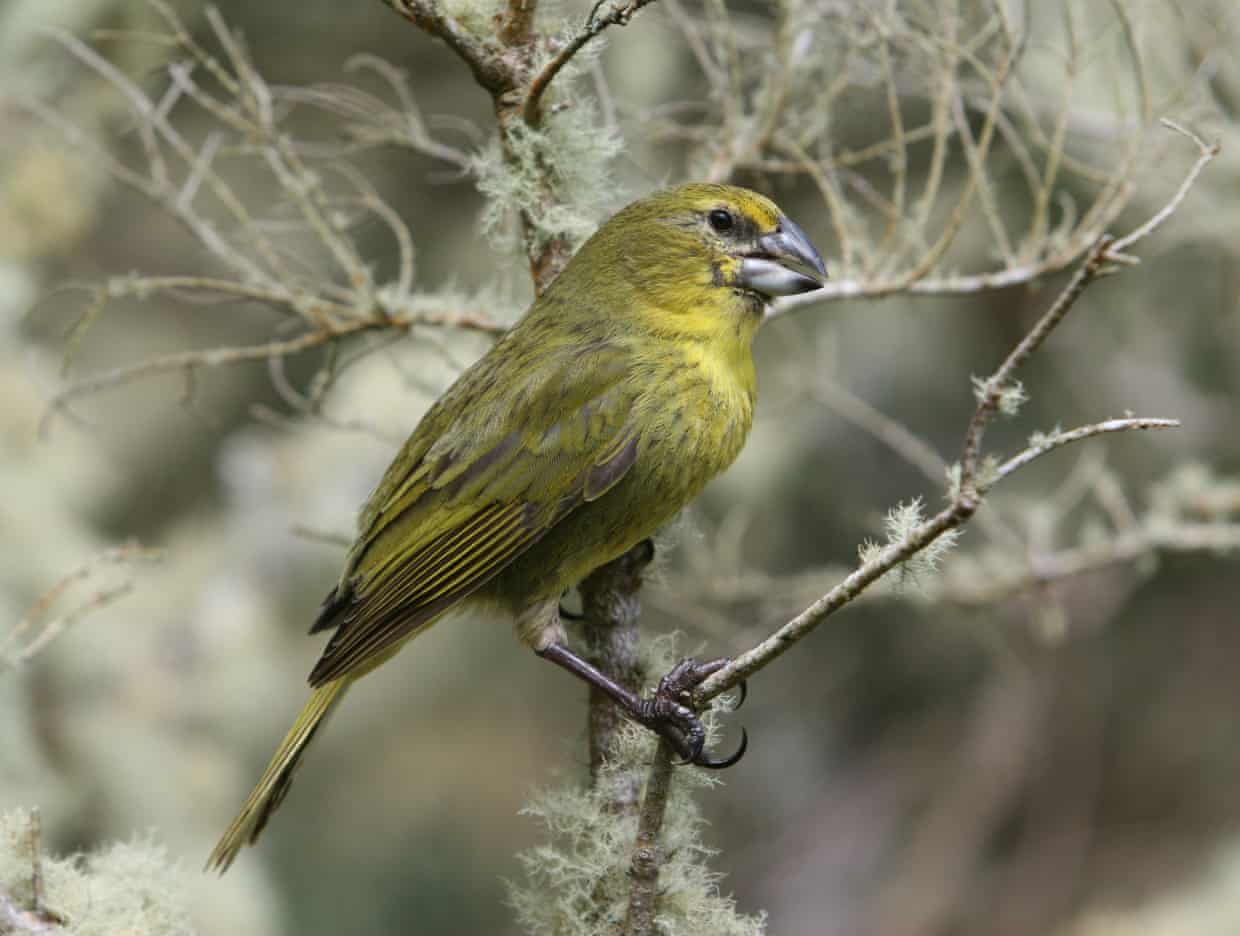
Photo: Peter Ryan.
Surveys before 2019 found that the number of breeding pairs of Wilkins’ bunting was 120 and going down. Then a wasp got involved.
Before I get into today’s story about efforts to save the habitat of a rare bird, I want to explain where this is happening. Nightingale Island is in the South Atlantic, a bit closer to Cape Town, South Africa, in the east than to Buenos Aires, Argentina, in the west.
Wikipedia says, “Nightingale Island is an active volcanic island in the South Atlantic Ocean, 3 square kilometres (1.2 sq mi) in area, part of the Tristan da Cunha group of islands. They are administered by the United Kingdom as part of the overseas territory of Saint Helena, Ascension and Tristan da Cunha.
“Nightingale Island is [uninhabited but] regularly visited for scientific purposes and research. It is one of the only stops for birds in the Atlantic and sees millions of them visit it annually.” More.
I read the following report on saving the island’s threatened Wilikins’ bunting and couldn’t help wondering how we balance two goods: the need to save species and the need to prevent introduced species (in this case a wasp) from creating unanticipated future havoc.
Helena Horton wrote at the Guardian, “A tiny parasitic wasp has given a lifeline to one of the world’s rarest bird species by killing off an invasive insect that was threatening its survival.
“The Wilkins’ bunting lives on Nightingale Island, part of the Tristan da Cunha \ group; the world’s most remote inhabited archipelago. It eats the fruit of the Phylica arborea, the island’s only native tree.
“But around 2011, scientists began to notice signs of an unwelcome visitor. An invasive, sap-sucking scale insect had been, it seems, accidentally introduced on to the island by humans. These insects secrete honeydew, which encourages the growth of a sooty mould that weakens and eventually kills Phylica arborea. Their arrival threatened to destroy the forest, and the tiny bird population among with it.
“This news was devastating to the scientists who study and protect the little yellow bird, as its numbers had been suffering. Huge storms in 2019 destroyed much of the forest, and surveys before the storm found there were only about 120 breeding pairs of the bird remaining.
“The RSPB, Centre for Agriculture and Bioscience International, Food and Environment Research Agency and Tristan da Cunha Government hatched an unorthodox plan to save the buntings, releasing a small parasitoid wasp called Microterys nietneri, which prevents the scale insects from breeding. They would also set up a tree nursery to boost the number of trees and improve the biosecurity on the island to stop invasive species coming in future.
“But first, the wasps had to survive the trip from London – almost a month by land, sea and air. Dr Norbert Maczey, an entomologist at CABI, said: ‘The wasps faced an epic journey. Firstly, a flight from London to Cape Town, in a cool bag, followed by an enforced stay in a hotel room as part of a staff member’s Covid quarantine. Next came a week-long boat journey to Tristan with temperatures sometimes dropping below zero. Finally, there was a further boat trip to Nightingale Island. It seemed like luck and time was against us but some of the wasps made it.’
“Fewer than 10% of the wasps survived the trip, but in April 2021 the first release took place, and there were more over the next two years. Slowly a population of wasps has started to establish itself. …
“Surveys in February this year showed that despite losing approximately 80% of the forest, there are still an estimated 60-90 pairs of Wilkins’ bunting on Nightingale. Although the population has reduced, the forest has recovered in the short period since the wasps were released, and the scientists think numbers of buntings should stabilize and will have a chance to recover over the next few years.
“David Kinchin-Smith, the RSPB’s UK overseas territories project manager, said: … ‘Hopefully we, and the wasps, have given the buntings a much-needed lifeline.’ ” More at the Guardian, here.
Do you have an opinion on this approach?
And from Wikipedia, something curious about the remote islands: “Edgar Allan Poe‘s The Narrative of Arthur Gordon Pym of Nantucket alluded to Nightingale Island, Inaccessible Island, and Tristan da Cunha.”


Leave a comment. Website address isn't required.