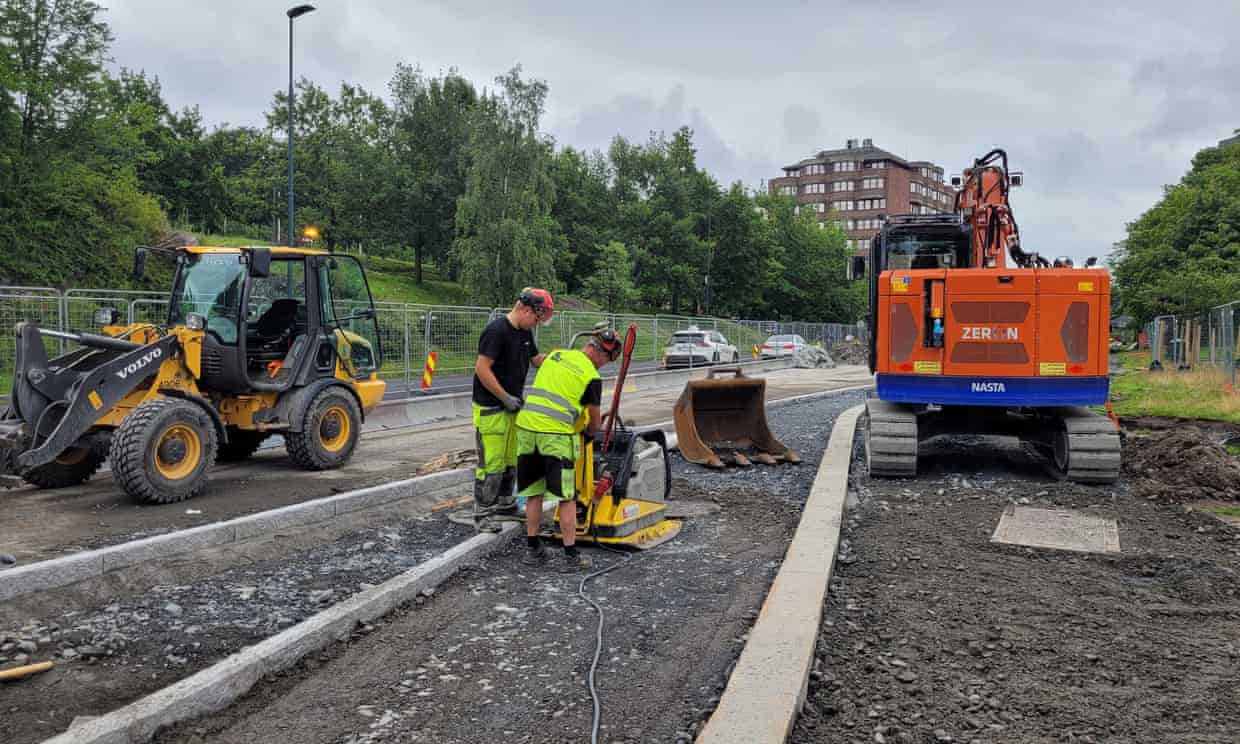
Photo: Ajit Niranjan/The Guardian.
The electric machinery at an emissions-free building site in Oslo, Norway, makes for quieter construction.
Whether we realize it or not, our noisy world is making us a little more jittery than we need to be. It’s not just the clangor and clash of big cities but near airports, hospitals with medivac helicopters, and construction sites.
Despite Norway’s reputation as one of the biggest oil producers, it is leading the way with electric vehicles, even at construction sites.
Ajit Niranjan has the story at the Guardian.
“Tafseer Ali felt no need to raise his voice as the pair of diggers lumbered past him, their treads weighing heavy on the rock and asphalt. Quiet electric machines like these make it easy to work in the city center, the construction manager said – and keep the neighbors happy. …
“The peaceful streets of Oslo are growing even calmer as the city drives noisy machines off municipal building sites. For locals and builders, the drop in decibels is a welcome side-effect of a goal to keep city-managed construction projects free from toxic emissions. The mandate, which is the first of its kind in the world, came into effect on 1 January.
“ ‘I don’t think we’re going to get to 100%, because not all [electric] machines are available on the market,’ said Ingrid Kiær Salmi, an engineer from Oslo’s urban environment agency, speaking to the Guardian at a building site in the city center last year. ‘But I think we’re going to get pretty close.’
“Construction is one of the biggest sources of urban air pollution, but even forward-thinking cities such as Oslo have struggled to clean it up. The Norwegian capital has led the way in replacing the petrol and diesel that powers its construction equipment with biofuels, which do little to heat the planet but still foul the local air. It is now moving to battery-powered machines.
“The latest data shows Oslo’s municipal building sites were 98% free from fossil fuels in 2023; three-quarters were powered by biofuels and less than one-quarter by electricity. For projects run by the urban environment agency, which has more recent data through to October 2024, two-thirds of machine hours were powered by electricity and one-third by biodiesel.
“The proportion of its projects powered by electricity has more than doubled in the past two years as new machines have come on to the market. …
“Electric vehicles are nothing new to Norwegians, who are more likely to drive a car with a big battery than one with a combustion engine, but the market for clean diggers [excavators] and wheel loaders still has a way to go. The building industry has pushed back on Oslo’s pioneering plans for moving too fast. …
“The requirement that all machinery on building sites must be emission-free is ‘at this point, neither effective nor cost-efficient,’ said Stine Marie Haugen, from the Norwegian construction and civil engineering contractors’ association.
“ ‘Currently, very few countries in Europe have a strong focus on emission-free machinery, which means that access to such equipment is somewhat limited,’ she said. ‘Only a few countries bear the development costs of bringing these machines to market.’
“But by taking on these costs, Norway and a handful of other countries are making clean machines cheaper and more attractive for cities around the world. Manufacturers say the early demand from procurement policies like Oslo’s has encouraged them to develop new electric machinery and make existing ones better.
“As the volume of vehicles increases, costs will come down – but ‘like with all new technology, there is a green premium,’ said Tora Leifland, the head of public affairs at Volvo Construction Equipment. A battery-powered machine can cost twice as much as a diesel one, she said, though it will save money on fuel and do little to inflate the overall costs of a construction project.
“There are also benefits that are harder to capture, such as quieter working conditions on-site and reduced disruptions to local communities and businesses.”
More details at the Guardian, here. No firewall. Contributions to support the Guardian‘s reliable journalism are solicited.


Leave a comment. Website address isn't required.