Photo: Mike Wilkinson.
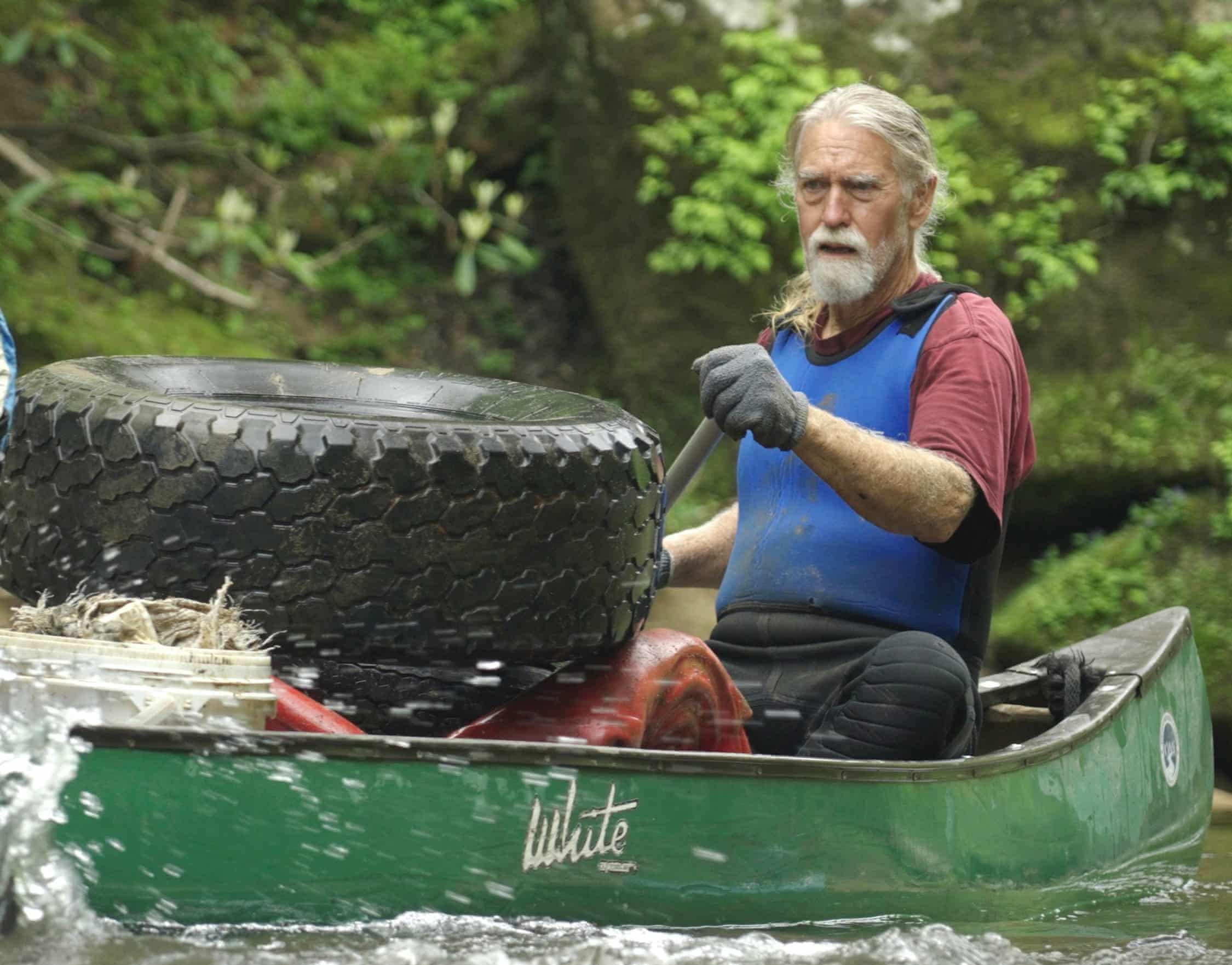
Russ Miller on a cleanup mission of Kentucky’s Red River in 2023. He received the nickname ‘River Cowboy’ after leading efforts to haul tires out of local waterways.
Another story of one person making a difference. And for me, it’s always beneficial to have my preconceptions about different parts of America challenged.
Jessica Baltzersen writes at the Guardian, “I n the 1980s, Russ Miller and his wife moved to a far edge of eastern Kentucky’s Red River Gorge, where they built a homestead on a ridge hugged by three sides of the river. It’s the kind of place you can only get to with a hand-drawn map. A place so remote that the farther and farther you drive to get to it, the more unsure you are that you are in the right place.
“They would spend leisurely afternoons drifting the river in inner tubes, until they started noticing what floated alongside them: heaps of discarded junk.
“ ‘Back then, the river was embarrassing. It was a conveyor belt of trash,’ said Miller as he handed me a photograph showing a tributary choked with broken appliances, tires, plastic kiddie pools and even a rusted blue car. Chief among the junk: tires. …
“When Miller paddled past a tree where a tire had speared itself ‘like an olive on a toothpick,’ he realized that tire would be there forever, unless someone did something. So, he did. That fall, Miller gathered hundreds of tires then recruited friends to corral them downstream. Lacking boats, he devised a way to fill old tires with empty milk jugs to make them buoyant.
“ ‘That’s how he got the “River Cowboy” name,’ said Laura Gregory, watershed program director at Kentucky Waterways Alliance (KWA) and a friend of Miller’s who produced a documentary about his work. ‘He was the guy herding tires down the river.’ …
“Miller … has spent decades pulling a total estimated 3,000 to 4,000 tires from Kentucky’s waterways. He’s also one of the founding members of Friends of Red River (FORR), a grassroots cleanup group formed in 1996.
“Dumping waste tires outside a permitted disposal facility is illegal in Kentucky. Yet tires continue to pile up. Some are dumped out of convenience, others as part of calculated schemes.
“T ‘here are people who are basically professional dumpers,’ said Gregory. ‘They’ll cover their license plates and wear hoods.’ …
“Miller is soft-spoken but is someone whose words you hang on to. In a weathered manila folder bloated with clippings and op-eds he has penned over the last 25 years, his words are fervent.
“ ‘Already the roadsides that people worked so hard to clean up have sprouted a new crop of trash,’ he wrote in a local newspaper. ‘I’m not sure whether I’m more angry with the litterers or the legislators.’
“On a May night, 11 muddied volunteers gather for a tire cleanup early the next morning on the upper section of the Red River, the only river in Kentucky federally designated as ‘wild and scenic.’ Their grueling paddle will take 13 hours, including a quarter-mile portage. …
“Unlike other cleanups, this one isn’t open to the public, and I’m not invited. The challenge of the Red River’s narrow, technical turns is left to those skilled and familiar enough with the potential class three rapids, which can flip a boat without warning.
“Later in June, on the second FORR cleanup this season, we launch early to tackle a four-mile route through some of the gorge’s most scenic stretches. At first, there are few tires in sight, just a rippling channel beneath understories of rhododendron and oak trees.
“But before long, someone spots a tire along the embankment. Then another. Then another.
“Residents simply lack access to legal disposal, especially in rural areas, where hauling them to a certified site costs time and money. Waste tire collection events offer Kentuckians a free way to dispose of old tires, but they only rotate among the state’s 120 counties once every three years.
“There’s also an old embedded mindset of viewing rivers as ‘out-of-sight, out-of-mind’ dumping grounds.
“ ‘You have to understand the culture of this area back in the early days,’ said John Burchett, board member of Friends of the Tug Fork River (FOTTFR), a group that removes tires on the Kentucky–West Virginia border. ‘Garbage service was sparse in regulation. You took your trash out the backdoor and threw it over the creek bank. … Now we’re dealing with the sins of our forefathers.’ …
“Once, KWA board member Travis Murphy counted 400 tires during a single paddle near Floyds Fork. Between Jackson and Beattyville, Miller counted 2,630 tires in 20 miles (32km). Earlier this year, in the most paddled stretch of Daniel Boone national forest, a team pulled 54 tires in three miles. Along the Tug Fork, 16,183 tires have been removed in only six years by FOTTFR.
“However, states are starting to take action. Connecticut passed the EPR law requiring tire manufacturers to take responsibility for their products post-consumer. Florida is removing millions of tires dumped into the ocean as part of the Osborne Reef Waste Tire Removal Project. And the Kentucky legislature recently adopted senate resolution 238, a bipartisan resolution acknowledging the scale of the tire pollution – thanks in large part to advocacy by KWA and its partners.
“ ‘We will be working during the next few months with local stakeholders as well as the division of water’s river basin coordinators to gather input for our report,’ said Robin Hartman, executive director of communications at the Kentucky energy and environment cabinet, in an email. ‘Once complete, the report will include findings, recommended strategies and any legislative recommendations.’ …
“ ‘While I sometimes feel helpless, I am also hopeful it will change,’ said Miller. ‘Once the awareness is there, the journey has begun.’ ”
I’d say that’s true of many things.
More at the Guardian, here. No paywall. Donations needed.

 Suzanne's Mom's Blog
Go, River Cowboy! Disgusting how people just throw trash away.
LikeLike
So often it’s cultural — seeing what family does and not thinking about it. Some folks change when they think about it.
LikeLiked by 1 person
Hurrah for this man and the clean ups he has done! And how deeply frustrating to see places he and his crew of volunteers have cleaned up become polluted again. We human beings are a very odd species. And, yes, “Now we’re dealing with the sins of our forefathers.'”
LikeLike
And if we didn’t keep repeating those sins, maybe we could get ahead.
LikeLike