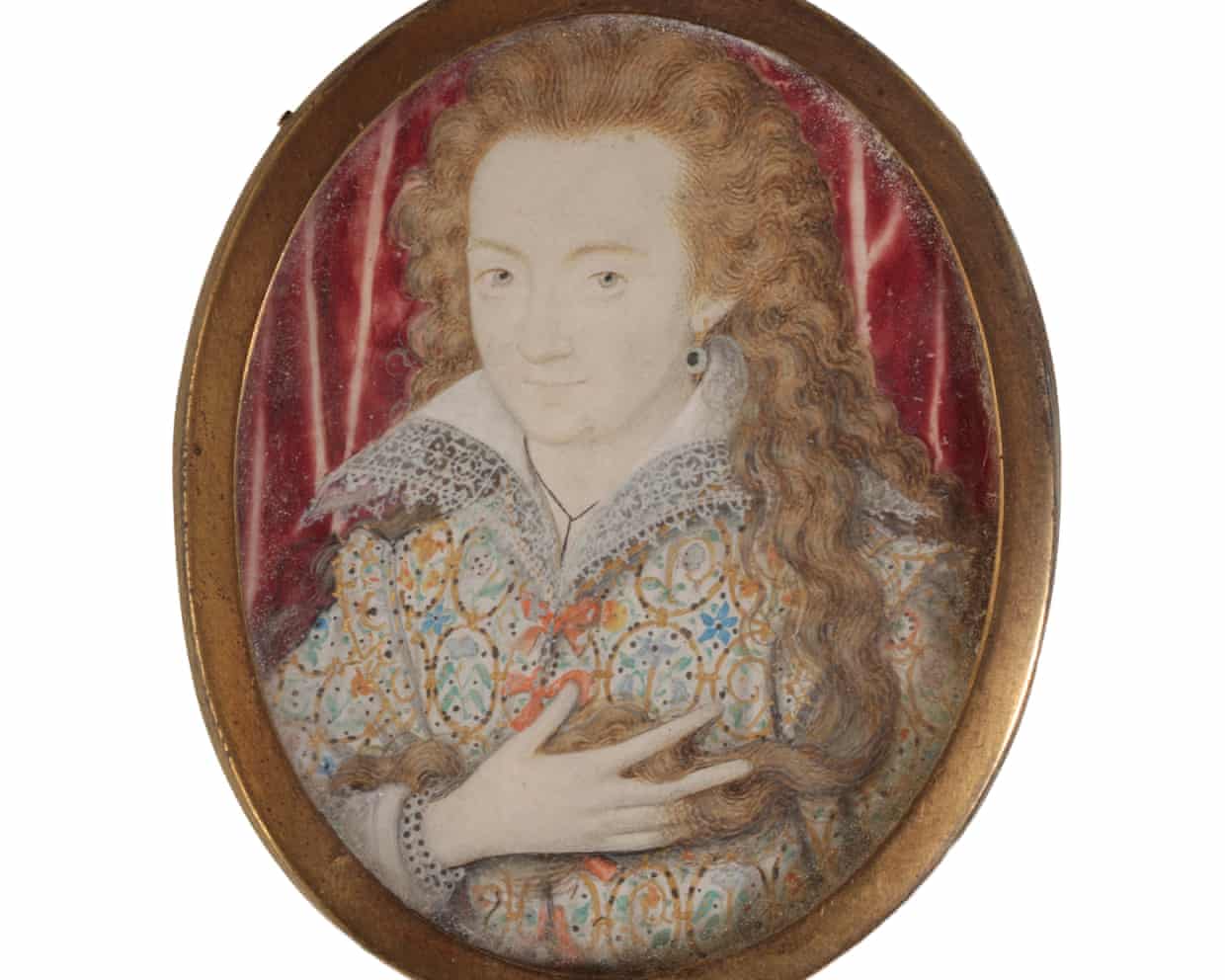
Photo: Handout of a miniature by Nicholas Hilliard.
Shakespeare’s friend Henry Wriothesley, 3rd earl of Southampton, was known for his androgynous beauty and vanity. A newly discovered miniature from his teenage years adds mystery to his story.
There is always something new to learn about Shakespeare. Blogger Carol let us know a while back about her brother-in-law’s research into Thomas North as an important source for Shakespeare. More recently, there was “news” about Shakespeare’s wife.
Now Dalya Alberge writes at the Guardian that “the discovery of a previously unknown portrait miniature by one of Elizabethan England’s greatest artists would be significant enough. But a work by Nicholas Hilliard that has come to light is all the more exciting because it has a possible link to William Shakespeare, and a 400-year-old enigma of a defaced red heart on its reverse, suggesting a love scorned.
“Hilliard was Queen Elizabeth I’s official limner, or miniature painter. His exquisite portraits, small enough to fit in the palm of one’s hand, are among the most revered masterpieces of 16th-century British and European art.
“This example depicts an androgynous, bejeweled young sitter with long ringlets, thought to be the earliest known likeness of Henry Wriothesley, 3rd earl of Southampton, Shakespeare’s friend and patron – and possibly the ‘fair youth’ of the sonnets, as some have speculated.
“Shakespeare dedicated [‘Venus and Adonis’] and ‘The Rape of Lucrece,’ to Southampton, declaring: ‘The love I dedicate to your lordship is without end.’
“Such miniatures were painted on vellum as thin as onion skin that was pasted on to playing cards for a stiff support. This portrait’s reverse reveals a card whose red heart has been painted over with a black spear or spade, seemingly indicating a broken heart.
“The portrait has been identified by the leading art historians Dr Elizabeth Goldring and Emma Rutherford, who were taken aback by the defacement.
“Goldring, an honorary reader at the University of Warwick and author of an award-winning Hilliard biography, told the Guardian: “You always know that there’s a chance that there could be a clue on the back or tucked inside the frame, but there almost never is. On this occasion, there was – and it was absolutely thrilling. Shivers down the spine. Someone had gone to great effort to spoil the back of this work.’
“Rutherford, the founder of the Limner Company, a consultancy and dealership, said … ‘Everybody would have known that a miniature would be backed by a playing card, but the playing card back was never visible. Originally, this would have been encased in a very expensive, possibly jeweled locket. You’d have to get the miniature out of the locket in order to vandalize the back like this.’ So it is an extraordinary discovery, a 400-year-old mystery.”’ …
“Their research, jointly written with Prof Sir Jonathan Bate, a leading Shakespeare scholar, is published in the Times Literary Supplement on 5 September.
“They write: ‘The fact that the heart has been painted over with a spade, or spear, inevitably calls to … mind thoughts of Shakespeare, whose coat of arms, drawn up c1602, incorporated a spear as a pun on his surname. …
“The historians suggest there is the possibility that this portrait was a gift from Southampton to Shakespeare who returned it, perhaps in 1598, the year that he married. …
“The portrait’s owners have a family connection to Southampton, but they were unaware of Hilliard’s hand or the work’s significance, having long kept it in a box. They contacted Goldring and Rutherford after reading of [the researchers’] discovery of another Hilliard miniature. …
“They write: ‘Again and again, the sonnets return to the fair youth’s androgynous beauty. So, for example, in sonnet 99 his hair is compared to “marjoram,” the tendrils of which are long and curly: could this be an allusion to Southampton’s distinctive long ringlets?’
“They argue that everything about this miniature, including the sitter’s gesture of clasping his cascading ringlets of auburn hair to his heart, suggests an intimate image.
“Long hair was unusual at the late Elizabethan court, Rutherford said. ‘We know there was some criticism of how long hair made men “womanish.” ‘
“Two pearl bracelets adorn the sitter’s wrist. Rutherford said bracelets, though frequently encountered in portraits of women in this period, were rarely seen in portraits of men.”
More at the Guardian, here. And check out the post on Carol’s brother-in-law and his hunt for a little-known Shakespeare source, here.

 Suzanne's Mom's Blog
Fascinating. I’m passing the story on to Dennis in case he hasn’t yet learned of this.
LikeLike
And *what* a picture, huh? It tells so much!
LikeLiked by 1 person
Perhaps I shouldn’t be surprised but Dennis says he has a new book coming out soon that in part reveals the identity of the Fair Lady. Ha! I’ll keep you posted.
LikeLike
Well, please do!
LikeLike