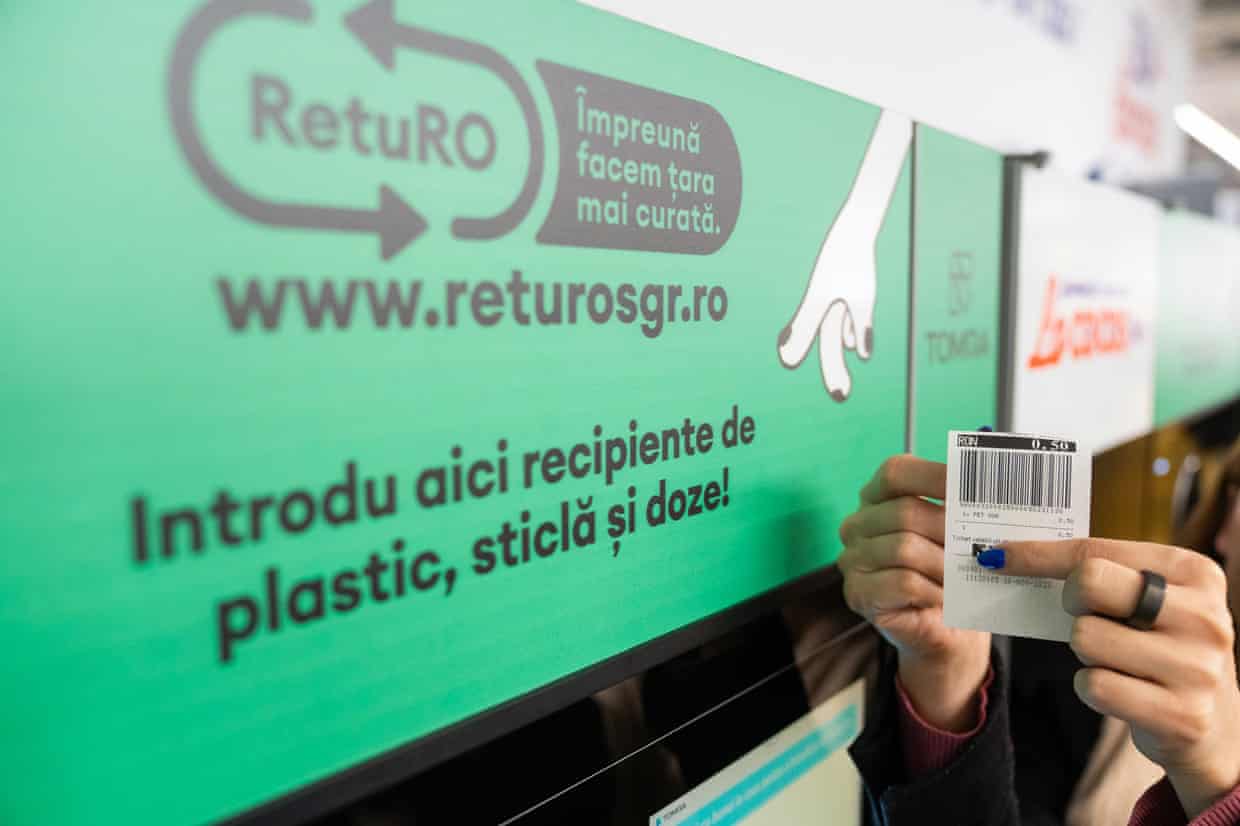
Photo: RetuRO SGR.
A notice for the RetuRO scheme, above. In the two years since launch, beverage-packaging collection and recycling has frequently hit 94% in Romania.
Romania was for the longest time behind the rest of Europe in initiatives like recycling. But once the stakeholders there saw how a modern system could benefit everyone, it made surprisingly fast strides.
Andrei Popoviciu writes at the Guardian, “In the Transylvanian village of Pianu de Jos, 51-year-old Dana Chitucescu gathers a sack of empty polyethylene terephthalate (PET) bottles, aluminum cans and glass every week and takes it to her local shop.
“Like millions of Romanians across cities and rural areas, Chitucescu has woven the country’s two-year-old deposit return system (DRS) into her routine.
“It is a simple scheme: when buying soft drinks or alcoholic beverages, the customer pays an extra 0.50 Romanian leu [$0.11] per bottle and gets the money back when returning the packaging, cleaned and in its original shape, to a collection point (usually the same shops where the goods were bought).
“Chitucescu makes about 40 leu a week from recycling her and another family’s bottles. ‘That covers the food for my seven cats,’ she said.
‘It’s a great system, everyone in our village uses it, there’s always a queue at the shop.’
“Her weekly walk is one tiny part of a national shift that, until recently, seemed impossible. Romania’s recycling rates were among the lowest in the EU, but in the two years since the scheme launched, beverage-packaging collection and recycling has skyrocketed to as high as 94% in some months.
“ ‘It is a zero to hero story,’ said Gemma Webb, the chief executive of RetuRO, the company running the system in a public-private partnership with beverage packaging manufacturers and the state. ‘The products are clean, there is little contamination, they can be recycled easily and we have full traceability as well, so we know every bottle that goes on the market.’
“[Between] the system’s launch in November 2023 and the end of September 2025, according to the company … more than 500,000 tons of high-quality recyclable materials have been collected. ‘We are the largest fully integrated deposit return system globally.’
“The scale of Romania’s turnaround is even more striking given where the country started. For more than a decade, the country has sat at the bottom of Europe’s recycling statistics. …
“But in 2018 the government began discussions about the scheme; in 2022 RetuRO began work, and on an extremely tight timeline including the construction of nine counting and sorting centers nationwide, the scheme launched in late 2023. …
“Starting later than other countries may have been an advantage, says Raul Pop, the secretary of state in the environment ministry and a waste policy expert because Romania could use modern software and traceability tools.
“It is on a return-to-retail model: shops that sell the containers must either install reverse vending machines or process the packaging manually. There is also a financial incentive for them, which helps them cover processing costs, and RetuRO reinvests all profits back into operations. … A recent study found that 90% of Romanians say they have used the system at least once and 60% return packaging regularly.
“Other countries, Pop explained, ‘suffer from their own inertia’ because they introduced their systems decades ago and are now stuck with outdated models. For them, shifting to new systems risks confusing consumers, even if it could improve collection rates. …
“Romania has also introduced a supportive legal framework, which means retailers can be penalized if they refuse returns – even the smallest village shops must accept containers if they sell the products or they risk fines, while big chains have automated return points.
“After the success with beverage containers, there are plans to expand the system to cover other types of packaging. ‘If you can put a bottle of water, you can also put a bottle of vinegar, a jar or a milk carton,’ said Alexandra Țuțuianu of Ecoteca, Romania’s first waste management NGO. …
“Environmental groups have praised Romania’s system, but warn that it covers only a small slice of the country’s overall waste stream. ‘It’s the largest environmental program, an example of good practice, we praise it, we like the system a lot, but it is not enough, it does not solve the waste problem in Romania,’ said Țuțuianu. …
“Even with a hypothetical 100% return rate for beverage containers, the overall waste recycling rate would only rise marginally. Re-use, Elena Rastei of the NGO Zero Waste Romania argued, needed to be looked at more closely.
“ ‘Collection solves the problem of visible waste, but re-use changes its nature. When packaging circulates – returned, washed, refilled – it becomes a resource, not waste. A single, reusable bottle can replace 20 to 50 single-use bottles, cut carbon emissions, and support a truly circular economy.’ “
More at the Guardian, here.


The best way to become aware of the garbage issue is to go to a Caribbean island where lots of Western expats live.
LikeLiked by 1 person
Nice! Maine has a great deposit return system, with drinks of almost every kind included. Back in the day when I went for long walks, I used to bring a bag and collect bottles. Nowadays, we just return our own.
LikeLike
It’s really kind of great to think about the change. When I was a kid, no one had even heard the word “recycling.” We humans sometimes do improve things.
LikeLike
Recycling and reusing material (glass) is an excellent way to improve sustainability. I wonder if the return for deposit programs in states in the US have been similarly successful.
LikeLike
Massachusetts is trying to expand its program to include all kinds of bottles, not just beverage bottles. But the speaker of the house is opposed and has a lot of power because he pays lawmakers’ stipends.
LikeLiked by 1 person
The deposit system has been successful for generations in 10 states. I’d say changing 33% to 70% recycling rates is very worth it.
LikeLiked by 1 person