Feeds:
Posts
Comments

Posts Tagged ‘intergenerational’

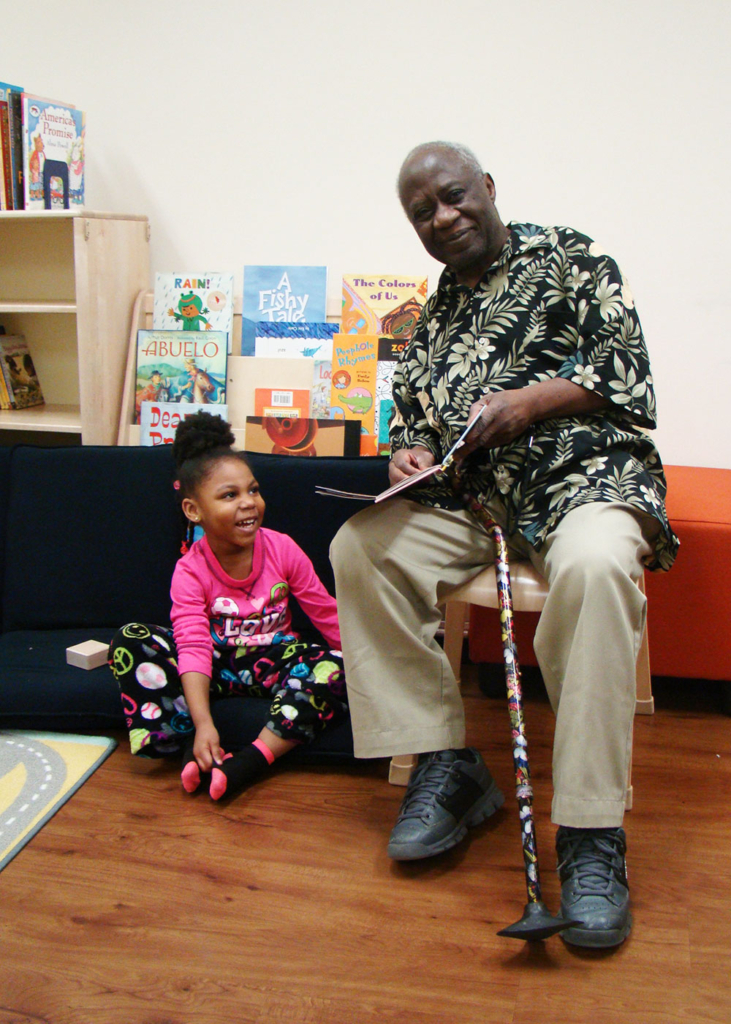
Photo: Nicole Asbury/Washington Post.
Ellie Salb, a first-grader at Fields Road Elementary School in Gaithersburg, Maryland, works on an activity alongside retiree Bobbi Sandrin.

When I was researching retirement communities, I was impressed the Hebrew Life’s Newbridge on the Charles in Dedham, Massachusetts, had a school on the campus where interested residents could volunteer. The Rashi School’s website says, “Over the course of their Pre-Kindergarten to Grade 8 education, every student experiences multiple touchpoints with NewBridge residents, and many form lasting relationships with their senior neighbors.”

I was reminded of that in reading Nicole Asbury’s article at the Washington Post on a similar arrangement.

“Six-year-old Ellie Salb was about to have one of her favorite days of the week: the day when ‘Granny B and ‘Granny M’ come to her first-grade classroom with stickers and sweets.

“Bobbi Sandrin and Marcia Klein are two former teachers who live in a retirement community about a half-mile away from Fields Road Elementary School in Gaithersburg [Maryland]. They’re part of about a dozen other seniors who volunteer at the school each week, a project that one of the community’s residents pitched earlier this year.

“Stephani Sausser, who teaches Ellie’s first-grade class, said the effort has had a positive impact in her classroom.

“Klein, known as ‘Granny M,’ has a background in reading recovery, Sausser said, and will read with students one-on-one to help them build skills like sounding out words and putting sounds in words together. Sandrin, or ‘Granny B,’ typically focuses on reading comprehension assignments.

“Sausser said their presence has been a big help, since she can spend more time in the classroom digging into students’ skills and tailoring lessons for them. … The partnership between the school and senior living community started in January with a cold email.

“Bob Karp, 86, had recently moved to Gaithersburg to be closer to his daughter and grandson after spending about 30 years in Boston. But after a few months of getting settled, he said — with a slight chuckle in his voice — he was starting to get ‘impatient about doing something.’

“Karp, the son of a former principal in Boston, grew up hearing conversations about public schools at the dinner table. So when he learned there was an elementary school close to his new home, he wrote to principal Joshua Williams with a request: ‘I would very much like to meet with you to discuss volunteering options for our residents including several who taught in the Montgomery County Public Schools.

“Karp was uncertain about how the request would land. But about three days later, Williams replied. He loved the idea.

“Karp, Williams and another resident named Jim Pattison met later that week to discuss how to make it work. … Before the current school year started in August, the principal asked teachers what support they needed, and in return, the volunteers said what they thought they could help with. Karp said they had a “match day,” like residents do in medical school.

“The school hasn’t had a partnership like this before, said Williams, who is in his second year leading the Gaithersburg school. The school serves a diverse population of about 450 students, and about half receive free or reduced-priced meals. Since the initiative started, the senior community has also raised about $4,000 to buyT-shirts for the students to wear on field trips and a school tree and garden beautification project. …

“Pattison usually comes every Friday, but recently missed a shift because he was in the hospital. He sent an email to second-grade teacher Mandy Huang explaining his absence. To his delight, several of the second-graders sent him ‘get well’ cards — some of which made him laugh.

“During his most recent visit, he was chuckling again after some children tried guessing how old he was. Some of the kids guessed he was over 100 years old.

“Pattison, who is 74, said those interactions are meaningful to him. … ‘It’s a way for us to get out of ourselves, not to be so wrapped up with our aches and pains — complaints that come with old age.’

“Most of the volunteers rotate around the building’s three third-grade classrooms, a grade level that experts say is critical for students to master reading skills. Five of the retirees help with small group reading.

“Quinn Liston, 8, said she’s gotten better with some of her words since she has started to read aloud with the volunteers. … ‘It’s really fun to read with them, because you think you’re scared to read and mess up the words,’ she said. ‘But actually, when you mess up the words, the people help you.’

“On a recent visit, Janice Faden was in the middle of reading a graphic novel with third-grader Dereck Romero Núñez. ‘He’s so expressive. We’ve talked a little bit about crash, bang and the words that sound like they mean,’ Baden said. She explained to him that those words were a use of onomatopoeia in stories.

“As if on cue, Dereck’s finger landed on a block of text that depicted a rocket flying off. He sounded it out: ‘Ka-ka-boosk!’ “

More at the Post, here.
Read Full Post »

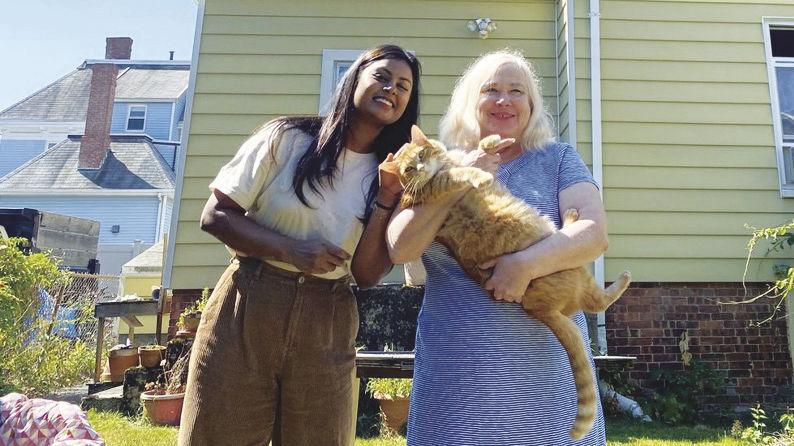
Photo: Nadia Abdullah via Sentinel Source.
Nadia Abdullah, 25, with Judith Allonby, 64, holding Mango the cat, have been roommates in Malden, Mass., since 2019.

Pretty much all my friends are investigating what Roz Chast calls Places or else at-home services — especially if they expect to need assisted living or memory care eventually. According to today’s story, there’s an interim step, particularly for seniors who live alone, and it’s gaining in popularity.

Cathy Free reports at the Washington Post, “Nadia Abdullah was on the hunt for an affordable apartment in the Boston area a few months before she graduated from college.

“ ‘It was a little frustrating because I couldn’t find anything in my budget,’ said Abdullah, 25, who was sharing on-campus housing with four other students until she graduated from Tufts University.

“At the same time, Judith Allonby, 64, was debating whether to move out of her family’s old home in Malden, Mass., after her parents died. Her two-story house seemed too large for one person and it required a lot of upkeep, but she liked the neighborhood.

“ ‘I rely on public transportation,’ said Allonby, an attorney.

“Then she and Abdullah discovered an alternative: an intergenerational housing arrangement that would benefit them both. While researching their options, they each learned about Nesterly, an online home-sharing agency that matches young renters with not-so-young people looking to supplement their incomes and share their space.

“Abdullah and Allonby each passed the agency’s background check, then they were paired in an arrangement designed to fit their specific needs: Allonby would rent the first floor of her home to Abdullah for $700 a month in exchange for help with the housework and gardening and occasional grocery runs. And Abdullah would get a safe and spacious place to live just six miles from Boston and a 30-minute drive from her robotics engineering job in Beverly, Mass. …

“Allonby said she was surprised at how compatible they turned out to be. ‘It’s really nice to have somebody else around, and Nadia brings a different atmosphere and energy than I had with my 88-year-old mother,’ she said. ‘Nadia is definitely not listening to Frank Sinatra.’

“About 18 percent of Americans live in multigenerational households — meaning two or more adult generations — according to a study from Pew Research Center published this year. Such arrangements have quadrupled in the United States since the 1970s, with about 60 million U.S. residents now living with adults who are of a different generation, according to the study.

“Contributing to that trend is that more young people are priced out of the housing market and more seniors want to age in place, said Donna Butts, executive director of Generations United, a D.C.-based organization that focuses on programs and policies that connect generations. …

“In the United States, several universities foster such arrangements, including Winona State University in Minnesota, Quinnipiac University in Connecticut and the University of California at Berkeley, which has an intergenerational housing program that started in 1986.

“At Drake University in Des Moines, music students are given the opportunity to live rent-free at a local senior living center in exchange for performing several times a month for the residents.

“Molly McDonough, a 22-year-old vocal performance major, recently moved into Wesley Acres, a senior living community that offers everything from independent apartment life to long-term care. …

“She said she was happy to find a pleasant, one-bedroom apartment waiting for her last month on the center’s fourth floor. ‘It came fully furnished, with towels, dishes and anything else I needed,’ McDonough said. ‘They also allowed me to bring my two cats.’ …

“McDonough now often shares meals with senior residents in the communal dining room and she enjoys hearing their life stories. …

“Shortly after she moved in, she found a note on her door from Arlene DeVries, 81, who lives at Wesley Acres with her husband, Fred DeVries, 83.

“ ‘Arlene wanted to give me a tour of Wesley Acres and I found out she’d also been a voice major at Drake,’ McDonough said. ‘Right away, we became good friends.’ …

“In Canada, college students and seniors are moving in together, too.

“Michael Wortis, 85, a retired physics professor from Burnaby, B.C., near Vancouver, said he was intrigued when he received an email last year from Simon Fraser University, where he’d taught for 15 years.

“The university had recently started an intergenerational housing program with Canada HomeShare. Wortis, whose wife died of Alzheimer’s disease in 2015, decided that he could use a little help around the house, in addition to someone to chat with.

“He was matched with Siobhan Ennis, 27, a health sciences graduate student who had been living with three roommates and was looking for some quiet study space.

“In exchange for $400 a month to rent the bottom level of Wortis’s home, Ennis now mows the lawn and helps clean up around the house, and she and Wortis dine together several times a week. They also garden together and have movie nights. …

“As a bonus, Ennis makes terrific stir-fries, he said, and she’s better at figuring out problems with high-tech equipment than he is.

“Ennis said she believes that she actually benefits the most from the arrangement.

“ ‘Michael is such a great person — I love having him as my roommate,’ she said. ‘There is always something to talk about and he’s always direct and thoughtful. We’ll be friends for life.’ ”

More at the Post, here. See my 2019 post on Nesterly here.

Read Full Post »

Photo: Mi Casa.
At Genesis , an intergenerational community in Washington, DC, older adults provide care and social support to individuals and families facing vulnerabilities, who in turn, promote the well-being of the elders as they age.

Because we don’t know the future, we need to make a plan. Catch-22: we can’t make a plan because we don’t know the future.

If we will always be able to handle the usual things that grown-ups handle, we may want to stay in our homes. For couples, if only one of us needs extra care, we may want to be where two lifestyles are possible. If we want to take interesting walks, we need to be where there are interesting walks. If we can’t walk or operate a wheelchair, a walkable neighborhood may not be as important as, say, being around good conversationalists or having easy access to books.

And what about being able to interact with people of other generations?

As Matt Fuchs reported at the Washington Post in September, “Research has shown that older and younger adults need one another: Mixed-age interactions make seniors feel more purposeful, and young people benefit from their elders’ guidance and problem-solving skills. ‘They fit together like pieces of a jigsaw puzzle,’ said Marc Freedman, chief executive of encore.org, a nonprofit group dedicated to uniting the generations.

“But in practice, such closeness can be hard to come by. Many young adults flock to cities, while older people often isolate within the walls of 55-and-over communities. Parts of the country are as segregated by age as race, fewer people are having children, and people live by themselves in record numbers, including 27 percent of adults over 60. …

“One solution is establishing residential communities that are designed to nurture these bonds.

“ ‘There’s a trend toward intergenerational living,’ said Elin Zurbrigg, deputy director of Mi Casa, a D.C. nonprofit that provides mixed-age housing through its Genesis program, in collaboration with city officials. Demand may be rising because of the pandemic, which has exposed loneliness as a serious health issue and has prompted many Americans to move for fresh starts. …

“[Here are some ways] mixed-age communities benefit their residents.

“[First] they cultivate purpose. A shared purpose with neighbors is what Estelle Winicki, a 78-year-old retiree, always envisioned for herself, but finding that wasn’t easy. In Boulder, Colo., she rarely crossed paths with neighbors. … Her therapist suggested Bridge Meadows, which operates two complexes of townhouses in Oregon that bring together seniors, former foster-care children and their adoptive parents. Residents are encouraged to spend time with their age opposites.

“Winicki, who lives at Bridge Meadows in Portland, doesn’t need persuasion. She starts many of her days helping her neighbors’ children get ready for school. ‘It gives me such pleasure to see these kids grow with a strong foundation,’ she said. ‘They know they can rely on me, and I like helping.’

“[Second] they provide mental health support. ‘The first thing you see among all the generations [at Bridge Meadows] is the sense of “I belong” and “I matter,” ’ said Derenda Schubert, Bridge Meadows’ founder and a clinical psychologist. Such an environment allows mixed-age communities such as Bridge Meadows to provide safety nets that protect residents’ mental health. …

“[Third] they offer professional advantages. In other communities, the generational glue is professional. PacArts, a mixed-age building in the San Pedro area of Los Angeles, provides affordable housing to artists. Luis Sanchez, a 53-year-old painter, said he can count on his neighbors whether he’s having a rough patch with health — he’s had two kidney transplants — or his work. An older neighbor has hired him repeatedly to assist with large painting projects. ‘I’ve learned a tremendous amount,’ Sanchez said. ‘She knows techniques and materials I would’ve never used.’

“Eva Kochikyan is a musicologist and teacher residing at Ace 121, a similar building in Los Angeles County. … She grew up in Armenia, where residents socialized regardless of age, but after relocating to Los Angeles, she barely saw her neighbors. In moving to Ace 121, the 41-year-old re-created the experience of a big extended family. …

“Kochikyan recalled her 4-year-old wandering into the building’s communal art studio, sitting right next to an accomplished painter in his 70s and picking up a brush. ‘No lecturing, just working together,’ she said. ‘These connections happen naturally.’

“[Fourth] they may keep older people active. Seniors may get more movement when inspired by the vigor of youth. … Kochikyan thought of a neighbor as an ‘old grandma’ after watching her frown during a solo workout. Since then, though, the baby boomer has befriended a group of children who enjoy kicking her yoga ball with her. During these sessions, her intensity picks up and her face lights up, Kochikyan said, ‘like she drops 20 years off her age.’ ”

Read about other potential benefits and check the most recent research at the Post, here.

Read Full Post »