Feeds:
Posts
Comments

Posts Tagged ‘dublin’

Photo: Rory Carroll/The Guardian.
Aoibheann Boyle and Andrew Collins inspect oysters at the Green Ocean Foundation’s project in Dún Laoghaire harbor. 

I don’t have a traditional Irish story to offer for St Patrick’s Day, but today’s article may get you singing about sweet Molly Malone and her “cockles and mussels, a-live, a-live-o.”

That’s because Ireland is doing some interesting work with shellfish. Rory Carroll of the Guardian reports from Dublin’s Fair City about an oyster graveyard rising from the dead.

He begins, “The dinghy slowed to a stop at a long line of black bobbing baskets and David Lawlor reached out to inspect the first one. Inside lay 60 oysters, all with their shells closed, shielding the life within. ‘They look great,’ beamed Lawlor. So did their neighbors in the next basket and the ones after that, all down the line of 300 baskets, totaling 18,000 oysters.

“They are, however, never to be eaten. Instead they are tasked with reproducing and restoring oyster reefs to Dublin Bay more than two centuries after they were wiped out. …

“Similar restoration projects are unfolding elsewhere in a continent that once had sprawling reefs of the European flat oyster (Ostrea edulis) until overfishing, dredging and pollution wreaked obliteration.

Reefs create rich ecosystems, provide a habitat for almost 200 fish and crustacean species and play a vital role in stabilizing shorelines, nutrient cycling and water filtration.

“ ‘These oysters are amazing climate heroes,’ said Lawlor, co-founder of Green Ocean Foundation, a nonprofit that is driving efforts in Dublin. ‘They are natural filter feeders. Each oyster filters at a rate of 190 liters [~200 quarts] of seawater a day.’

“By feeding on plankton and nitrates, the oysters clear algae and help sunlight to reach the seafloor, boosting sea grass – a carbon sink – which in turns helps other species and improves coastal biodiversity and marine habitat.

Ireland’s inhabitants cultivated oysters in the middle ages but in the 1800s industrialization and overfishing killed off the Dublin Bay reefs – a phenomenon replicated from Scandinavia to the Mediterranean.

“Inspired in part by New York’s Billion Oyster Project [see my blog post here] Lawlor enlisted volunteers and business sponsors for pilot projects that moved oysters from Tralee Bay in County Kerry to sites in Malahide, Howth, Poolbeg and Dún Laoghaire, which ring Dublin bay, and in Greystones, in County Wicklow.

” ‘You’re building your understanding of why things work well or don’t work well. You want to make sure they survived, to see what the growth was like, and to see if they spawn,’ said Lawlor. The transplanted oysters fared especially well in Dún Laoghaire so it was chosen for the next phase of the project. …

“Scientists from Dublin City University’s Water Institute analyzed the water last year for baseline indicators and will monitor the oysters’ impact with sensors and chemical and biological assessment.

“The baskets are connected along a 100-metre line and are flipped by hand every few weeks to let Arctic terns, gulls and other birds peck away fouling that might otherwise curb the flow of water through the baskets.

“In Northern Ireland, the charity Ulster Wildlife used a different technique recently to place 2,000 adult oysters and 30,000 juveniles, sourced from Scotland, on the Belfast Lough seabed.

“The Luna Oyster Project, a collaboration between Norfolk Seaweed and Oyster Heaven, aims to restore 4 million oysters to the North Sea by using the first mass deployment of clay structures called mother reef bricks.

“The Dublin initiative is far smaller but will hopefully grow, said Lawlor. ‘The temptation is to think massive but you need to take one step at a time. A lot of the challenge is bringing people with you,’ he said, citing government departments, local councils, wildlife groups and harbor authorities.”

More at the Guardian, here.
Read Full Post »

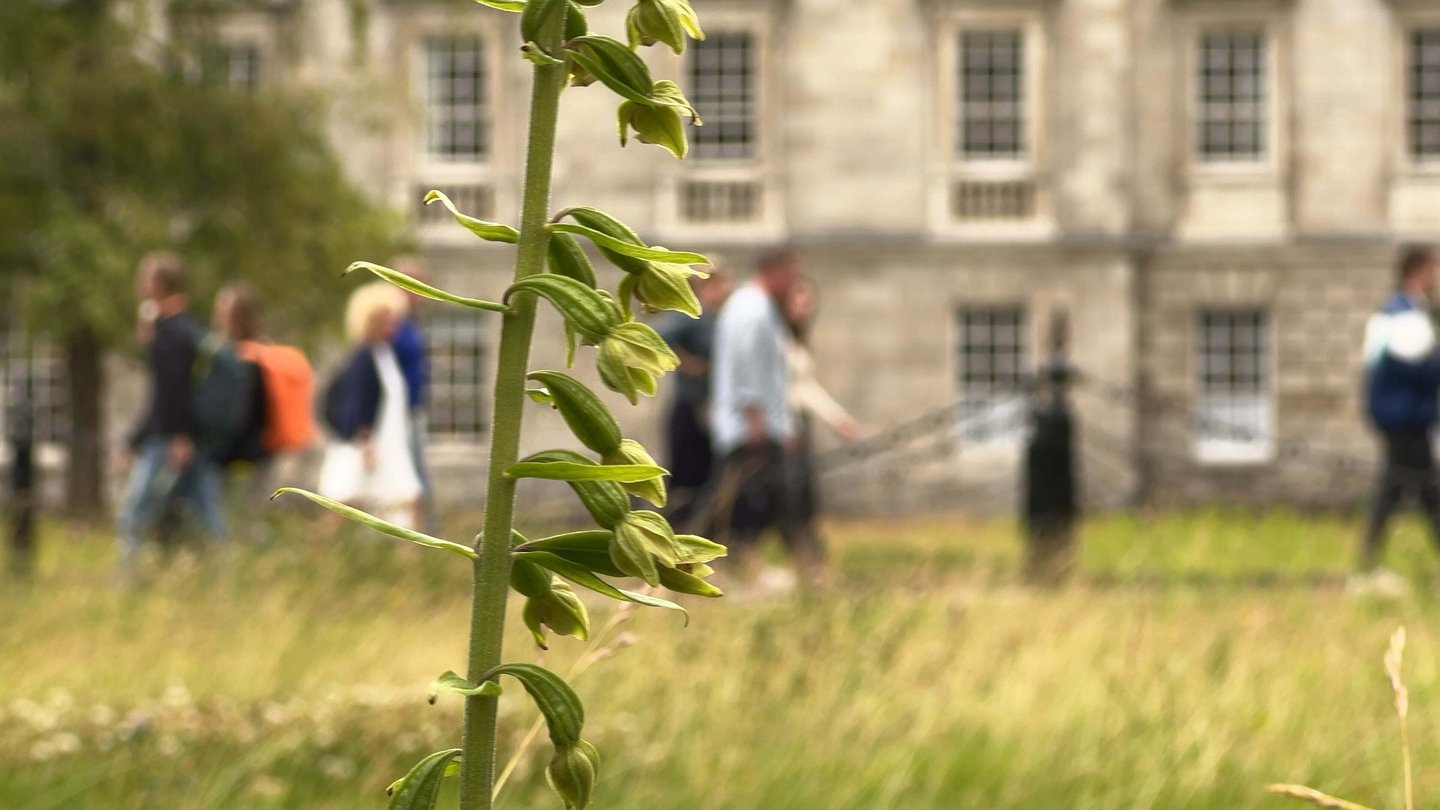
Photo: RTÉ.ie (Raidió Teilifís Éireann), Ireland’s National Public Service Media.
One of the broad-leaved helleborines near the front arch of Trinity College in Dublin. Good things are growing in the city after No Mow May.

John made a good point about No Mow May the other day. The initiative to give a chance to plants that pollinators love has been growing, but why destroy the improved ecosystem by mowing in June?

Philip Bromwell writes at RTÉ (Ireland’s National Public Service Media) about an approach in Dublin.

“Two species of orchids have been discovered growing on the campus of Trinity College in Dublin city centre, much to the surprise and delight of botanists.

“The wild plants — a broad-leaved helleborine and a pyramidal orchid — have popped up in a lawn next to Trinity’s iconic Front Arch.

“Inspecting the 60cm [~2 foot] broad-leaved helleborine, Professor Jennifer McElwain, from TCD’s School of Natural Sciences, said … ‘It’s really unusual to find this orchid anywhere. It’s rare. It’s extra unusual to find it in the middle of Trinity, right in Front Square, in the middle of the city.’

“There are around 30 different species of wild orchids in Ireland. Some thrive in fields, others prefer bogs, woods or mountains.

“Professor McElwain believes the appearance of the orchids in Trinity are the result of the university’s participation in ‘No Mow May’ – the annual campaign that encourages gardeners to not mow their lawn during the month of May so that plants and pollinators benefit.

” ‘We wanted to implement a positive measure for biodiversity. So, we just simply stopped mowing this lawn in May. And that was difficult to do, because a lot of people really like finely cut lawns. But we stopped mowing, and this wonderful orchid began to emerge. And there’s not just one — there are three orchids, including another species. So, we actually have an orchid-rich meadow.

‘That’s a botanist’s dream and our only intervention has been to stop mowing the lawns.’

“Orchids have the smallest seeds of all flowering plants, with a typical seed the size of a speck of dust.

” ‘A seed could have blown in by wind. It could have come in on the feet of people, or been brought in by a bird,’ Professor McElwain explained. ‘Alternatively, this seed could have been in this lawn for decades. Underground, just waiting for the right conditions to allow nature to thrive. And the right conditions in this case happened to be not mowing the lawns.’

“Flower-rich, grassland habitats are rapidly disappearing from the island of Ireland and one third of our wild bees are threatened with extinction.

“Trinity installed wildflower meadows on College Green in 2020 after thousands of students, staff and members of the public voted to replace the manicured lawns at the front entrance to the university with the more nature-friendly alternative. …

” ‘I think this a really hopeful demonstration that biodiversity and nature can thrive if we just give it time and space. We are in the midst of biodiversity and climate crises. It can seem overwhelmingly complex to solve it, but it’s our responsibility to show what’s possible.

” ‘In this lawn alone, more than 35 plant species have come up. And if you think each one of those plant species supports one or two species of pollinators, that’s 90-odd species. If this lawn was a mown, clipped lawn, you would have a species diversity of one.

” ‘This demonstrates how simple measures can lead to really spectacular results. Never in our wildest dreams did we expect this,’ she said.”

More at Ireland’s National Public Service Media, here. No firewall. For more insight on the importance of meadows, see my friend Jean’s Devine Native Plantings, here.

How do you feel about giving up lawns? We have not had one for years, initially because neighborhood dogs kept destroying ours, but nowadays because we like the look of vinca. I do think that while a family’s kids are young, a lawn for outdoor games is pretty necessary, but not with weed- and bug-killers.

Read Full Post »

In environmental news, Lloyd Alter at Treehugger reports that an Irish county now requires new homes to meet the very high standard of energy efficiency called passive.

“In Ireland’s Dún Laoghaire-Rathdown County, a near suburb of Dublin, it’s now the law. …

“The building codes there are pretty tight already. And it’s not completely a done deal; the national Minister of the Environment, of all people, may challenge it out of concern that it might raise the cost of housing. However the local Passive House Association says that it’s not necessarily true, and showed case studies demonstrating that in fact they could build passive houses ‘at or below conventional build costs.’

“Writing in Passive House Plus, Pat Barry of the Irish Green Building Council noted that really, it’s all about just trades having the skills and doing the job right. …

“As many as 20,000 houses could be built in the county, houses that cost almost nothing to heat, produce almost no CO2, and are comfy as can be day or night, sun or no sun.”

More here.

Photo: Kelvin Gillmor
Irish passive house built on a budget
. Hmmm. Does it burn wood?

Read Full Post »