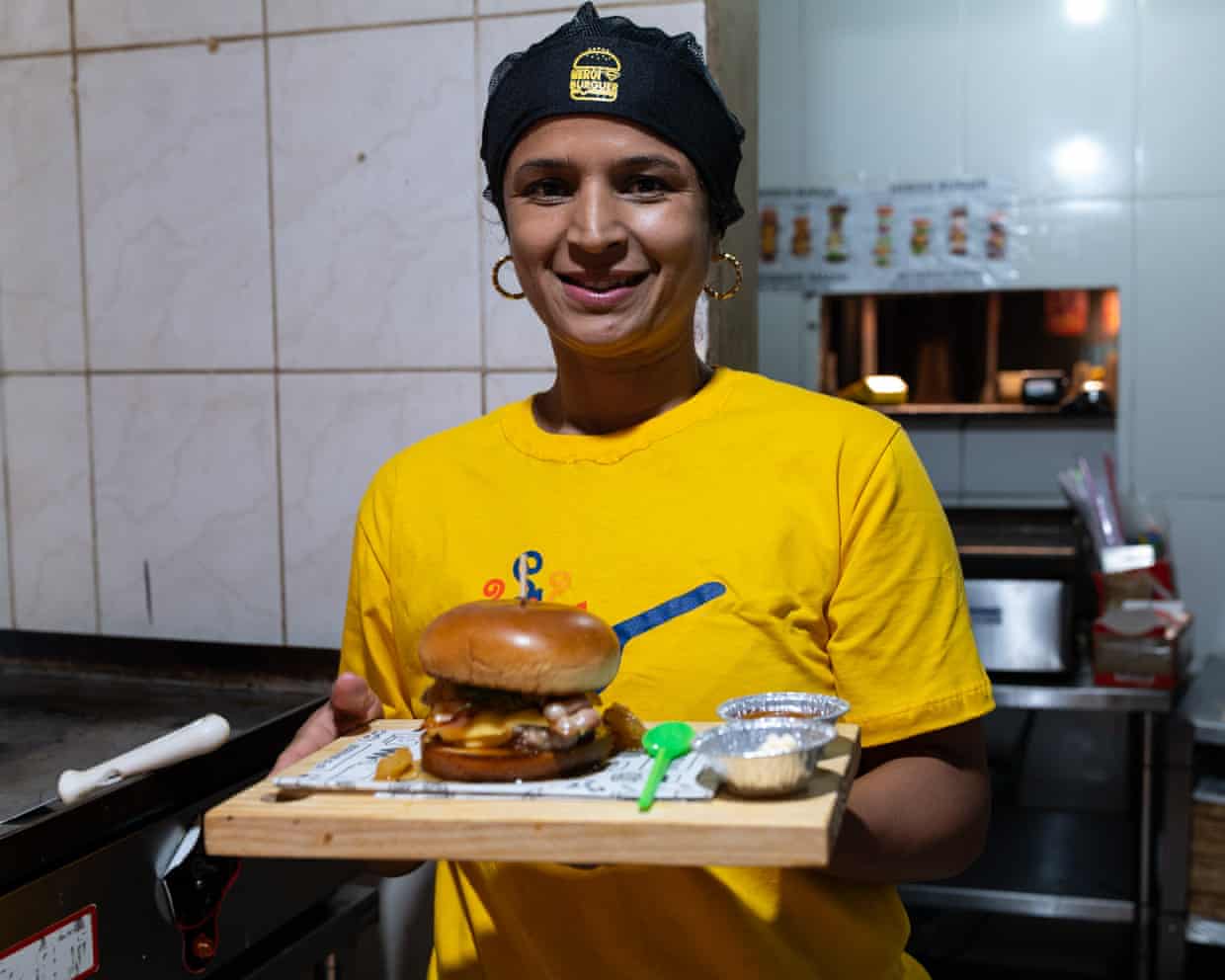
Photo: Alan Lima/Guardian.
Maria Cristiane de Sales says, “The doors that aren’t open to us in the rest of the city, we open for ourselves here.” She launched her Rio de Janeiro burger restaurant inside a complex of 16 favelas, home to 140,000 people.
I was reading the other day that Brazil President Lula’s triumph when a far-right candidate was expected to win had a lot to do with social media and organizing on the street. Ordinary people are starting to feel their power.
Today’s article on a different kind of awakening in Brazil’s notorious favelas shows that many people are taking the need for change into their own hands.
Tiago Rogero wrote for the Guardian. “Even at the age of nine, Maria Cristina de Sales knew exactly when to ask her mother’s colleagues at the slaughterhouse for a piece of the pig they were butchering: when they got close to the pork leg, her favorite part.
“When she grew up, Sales followed the path of many others from Brazil’s deprived north-east and moved south in search of better work opportunities. She arrived in Rio de Janeiro and, unable to afford a home in tourist-heavy south zone, moved to a favela further north.
“She crossed the city every day to work as a receptionist and secretary, but only really found her footing 15 years later when she and her husband opened a burger restaurant, inside the favela.
“ ‘The doors that aren’t open to us in the rest of the city, we open for ourselves here,’ said Sales, 39, inside her restaurant in Maré, a favela complex that emerged in the 1940s in a vast mangrove area, settled by workers who could not afford to live in – or had been evicted by the state from – the wealthier parts of the city.
“What usually dominates the headlines about Maré, a complex of 16 favelas home to 140,000 people, are problems such as poverty, armed drug traffickers and bloody police operations, but Sales’s restaurant has joined an effort to change that perception.
“From 1 October, local bars and restaurants will take part in a month-long competitive food trail made up entirely of Maré establishments, hoping to attract visitors from across the city who are often afraid to visit a favela.
“ ‘We face prejudice simply for saying that we live in a favela, but there are a lot of good things here,’ she said.
“Were it not for the surrounding alleys so narrow that sometimes only one person can pass at a time, the tangled web of electrical wires crowding the utility poles and the occasional young man riding a motorcycle with a rifle, Sales’s restaurant could be anywhere else in the city – a family-friendly, air-conditioned burger joint. The superhero-themed decor was a request by Sales’s sons, and includes a life-size Spider-Man.
“Her entry for the food trail will be, of course, a pork leg. … One sweet-and-slightly-spicy element of the dish – a pineapple jam with chili and ginger – she learned to make at Casa das Mulheres da Maré, a centre set up by a local NGO, Redes da Maré, to support women and which organizes the food trail, called Comida de Favela, or Favela Food.
“ ‘When we improve the quality of life of a woman in Maré, we’re improving the whole community,’ said Mariana Aleixo, 38, the centre’s coordinator, herself a chef who was born and raised in Maré and has worked in the kitchens of Rio’s luxury hotels,. … The food trail is now in its fourth edition – the first was held in 2015 – and is one of four finalists in the Best Culinary Festival in Latin America category at the 2026 World Culinary Awards.. …
“The 16 restaurants – selected from more than 150 applicants, most of them Black-owned – receive management and marketing training. … ‘Gastronomy is the biggest economic sector in the community,’ said Aleixo. … She had approached sponsors of other food festivals across the city and had never succeeded in securing their support. ‘I believe it’s because of prejudice against favelas,’ she said.
“Although the aim is for visitors to experience the favela from a ‘perspective other than violence,’ Aleixo acknowledges that some may witness something that the thousands of people who live there have to contend with: the occasional presence of armed drug traffickers. Police generally do not patrol favelas unless carrying out operations. …
“Favela Food’s social media pages often advertise shuttle vans to bring visitors from other parts of the city and take them back again – another aim is to encourage the circulation of people and money between the complex’s own favelas.
“While Sales’s burger restaurant is in the Parque União favela, the snack bar run by Beatriz Santos Antônio, 39, is in the Nova Holanda favela, a 15-minute walk away.
“Born in another city in Rio de Janeiro state, Antônio arrived in Maré 16 years ago because she could not afford to live elsewhere. She and her children went through periods of hunger, but neighbors helped them, and she drew on cooking skills learned from her mother to start selling cassava fritters. …
“ ‘Today it’s a story of happiness and of being able to encourage other women to start their own businesses too. There is also a lot of happiness in the favela.’ ”
More at the Guardian, here.


