Image: 3QuarksDaily.
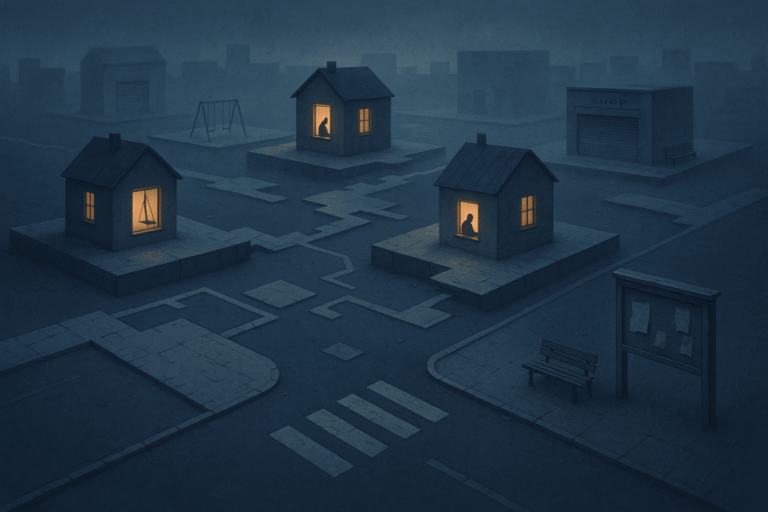
I saved this image from 3QuarksDaily for a long time until I could find an article that deserved it. It says so much without a single word. What word sums it up for you?
Winnie Hu at the New York Times had a word for it: isolation.
“Thousands of New Yorkers come through the doors of this Jewish community center in the East Village of Manhattan for its gym, classes and plays, but many don’t stick around. So the center embarked on a big effort to get them to do just that.
“The Sol Goldman YM-YWHA, which is known as the 14th Street Y, has spent tens of thousands of dollars to make itself into a social gathering place in order to build a closer community in the aftermath of the coronavirus pandemic, which curtailed activities and isolated so many.
“In 2024, the 14th Street Y transformed its underused lobby into an inviting cafe and art gallery with $1 cups of coffee, comfortable seats and lush plants. Though it already offered paid classes in mahjong and painting, it recruited local community members to lead clubs that would be free and open to everyone.
“Since then, the ‘Downtown Together’ clubs have hosted more than 420 people to connect over shared interests and passions, like cooking, knitting and movies. …
“Maribel Gomez, 66, a retired social worker who has occasionally used the gym, has now become a regular at the salsa club. ‘If I wasn’t here, I’d be home watching Netflix the whole day so it gets me out of the house — it gets me to meet people,’ she said.
“But this exercise in community building has also been a learning experience for the 14th Street Y. Several clubs, like the Mixtape Listening Party, never attracted much interest. A Spanish club faded away after no one stepped up to keep it going. … Other clubs brought people into the same room, but they have not fostered many close friendships outside of those meetings, at least not yet.
“On a Sunday afternoon in April, Ms. Gomez joined 30 other people who stepped and turned as salsa music filled a dance studio at the community center. … Ms. Gomez, who has bad knees, could not keep up and later sat down against a wall. She was soon joined by other dancers. Ms. Gomez, a Cuban immigrant, spoke Spanish to a woman, Florina Chuy, who she had met the month before. Ms. Chuy is also from Cuba and they were still talking when the music stopped.
“ ‘We closed down the joint,’ Ms. Gomez said as they walked out together.
“The 14th Street Y is part of the Educational Alliance, a nonprofit that sees community-building ‘in the DNA of the organization,’ said Rich Baum, its chief executive officer.
“The alliance was founded in 1889 to create a settlement house on the Lower East Side to provide social services to impoverished Jewish immigrants. In the mid-1990s, it took over the 14th Street Y, which traced its roots to another settlement house from 1905.
“The alliance spent about $50,000 to remodel the 14th Street Y’s lobby into a ‘third space’ where people could gather outside of their home, work or school. ‘They’re just coming in and out when they could stop, sit down for a minute, have a cup of coffee or hang out before they go for a swim,’ Mr. Baum said.
“But just sharing space was not enough, Mr. Baum said, pointing out that people can sit together on a bench, or shop in a grocery aisle, without ever saying a word. ‘If you look at New York City, it is a place where people, a lot of people, live side by side,’ he said. ‘But they don’t really live together.’
“So the next step was to give people something to connect over. Alexis Offen, the 14th Street Y’s executive director, and Julie Gayer Kris, its senior director of adult and wellness programs, emailed a list of ideas for clubs to thousands of local residents, asking them to check off the ones they were interested in, or to suggest their own. One woman lobbied for a bridge club and agreed to lead it.
“They whittled down the ideas and introduced a half-dozen clubs, including bridge, at an open house in October 2024.
“The 14th Street Y’s clubs have become part of the city’s ‘social infrastructure,’ like libraries, parks and playgrounds that can foster connections and strengthen communities, said Eric Klinenberg, a New York University sociology professor and author of Palaces for the People.
“ ‘When we do things we enjoy together, regularly, with the same set of people, we start to develop friendships and a feeling of belonging and a sense of trust,’ he said.”
More at the Times, here.

 Suzanne's Mom's Blog