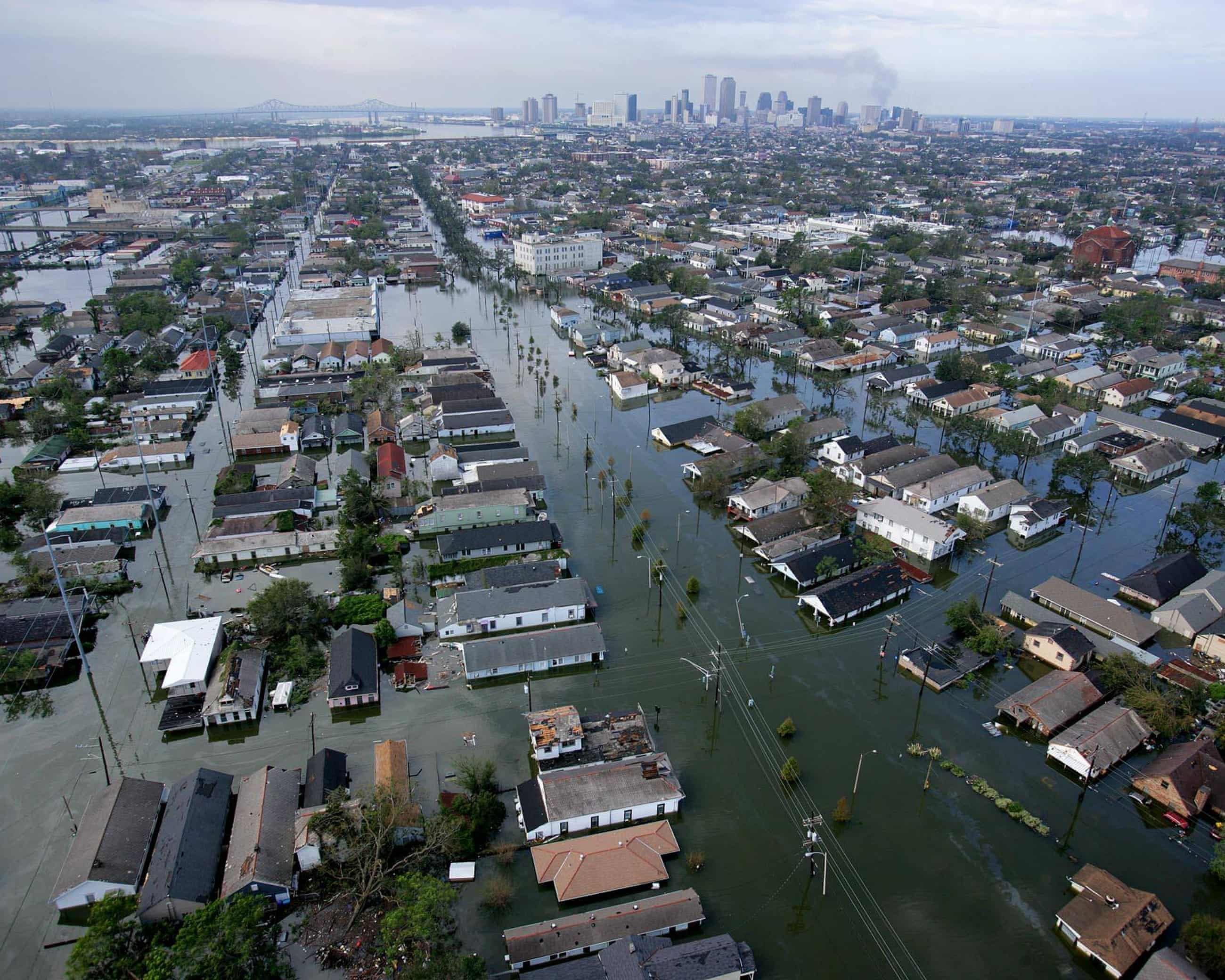
Photo: Reuters.
A new study warns that erosion of wetlands in southern Louisiana will swallow up New Orleans in a few generations.
Today’s article asks the question “Can We Move a Major City?” Although it’s about about New Orleans, it could apply to Boston and other cities with a tendency to flood.
The most dramatic moving project I have witnessed was moving the New Shoreham Lighthouse back from a cliff edge, and that was the kind of task no one takes lightly.
Oliver Millman writes at the Guardian, about an even bigger task.
“The process of relocating people from New Orleans should start immediately,” he writes, “as the city has reached a ‘point of no return’ that will see it surrounded by the ocean within decades due to the climate crisis, a stark new study has concluded.
“Ongoing sea-level rise and the rampant erosion of wetlands in southern Louisiana will swallow up the New Orleans area within a few generations, with the new paper estimating the city ‘may well be surrounded by the Gulf of Mexico before the end of this century.’
“Low-lying southern Louisiana faces multiple threats, with rising sea levels driven by global heating, compounded by strengthening hurricanes, also a feature of the climate crisis, and the gradual subsidence of a coastline that has been carved apart by the oil and gas industry.
“Southern Louisiana is facing … the loss of three-quarters of its remaining coastal wetlands, which will cause the shoreline ‘to migrate as much as 100km (62 miles) inland,’ thereby stranding New Orleans and Baton Rouge, according to the study. … This scenario makes the region the ‘most physically vulnerable coastal zone in the world,’ the researchers state, and requires immediate action to prepare a smooth transition for people away from New Orleans, which has a population of about 360,000 people, to safer ground. …
“ ‘While climate mitigation should remain the first step to prevent the worst outcomes, coastal Louisiana has evidently already crossed the point of no return,’ added the perspectives paper, published in the Nature Sustainability journal. A perspectives paper is a scholarly article that provides an assessment, rather than new data.
“Billions of dollars have been spent to fortify New Orleans with a vast network of levees, floodgates and pumps erected after 2005’s catastrophic Hurricane Katrina. But the growing threats to the city mean the levees, which already require hefty upgrades to remain sufficient, will not be able to save the city in the long run, the new paper warns.
“ ‘In paleo-climate terms, New Orleans is gone; the question is how long it has,’ said Jesse Keenan, an expert in climate adaptation at Tulane University and one of the paper’s five co-authors. …
“City, state and federal leaders should begin work to help support people moving away from the New Orleans region in a coordinated way, starting with the most vulnerable communities, such as those in Plaquemines parish who live outside the levee system, Keenan said …
“New Orleans faces obvious challenges – situated in a bowl-shaped basin below sea level, the city already has 99% of its population at major risk of severe flooding, the worst exposure of any US city according to a separate study released last week.
“ ‘Even compared to all other US cities, New Orleans really stands out, which is alarming,’ said Wanyun Shao, a co-author of this study and a geographer at the University of Alabama.
” ‘There is no specific timeline to how long New Orleans has left but we know it’s in big trouble. They are facing one of the highest sea level rises in the world and I don’t know how long human effort can fight against that tide. It’s like a time bomb.’ …
“A major pressure upon this southern cultural hotspot is that its surrounding land is briskly receding. Since the 1930s, Louisiana has lost 2,000 sq miles of land to coastal erosion, equivalent to the size of Delaware, with a further 3,000 sq miles set to vanish over the next 50 years. The rate of land loss is so rapid that a football pitch-sized area is wiped out every 100 minutes.
“To help counter this, Louisiana last decade settled upon a new sort of plan that eschewed building yet more flood defenses and instead sought to harness the Mississippi River’s natural ability to rebuild land. Levees and other infrastructure have, until now, straitjacketed the naturally meandering Mississippi and pushed the sediment it carries straight into the Gulf of Mexico, rather than replenish the coastal wetlands.
“The so-called Mid-Barataria Sediment Diversion project, which broke ground in 2023, would help restore a more natural flow in the Mississippi Delta and allow sediment to build up in coastal areas where it has been lost. More than 20 sq miles of new land would be created over the next 50 years under the plan, the project estimated.”
Read more at the Guardian, here.

 Suzanne's Mom's Blog