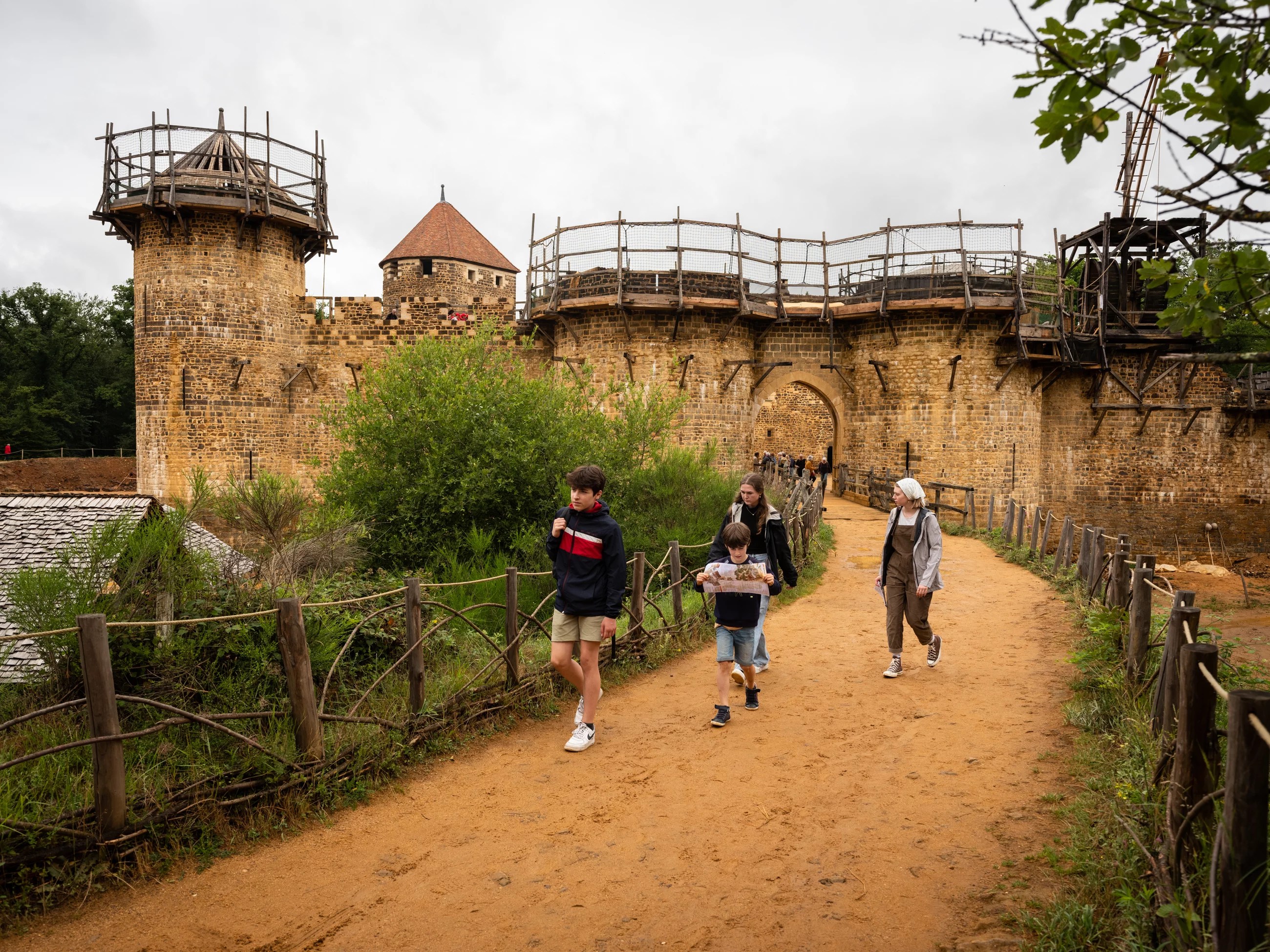
Photo: Cristina Baussan for NPR.
Visitors walk near the construction of Guédelon Castle, dreamed up as an exercise in “experimental archaeology” 25 years ago.
The Plimoth Patuxet Museums in Massachusetts used to be called Plimouth Plantation, and at Thanksgiving lucky visitors got to share in whatever version of the First Thanksgiving was in vogue at the time. Today the history involves the indigenous people in a much more balanced way. But a visit to the site is still a step into another century, a century without cellphones.
Not unlike a visit to a certain castle in France.
Eleanor Beardsley reports at National Public Radio, “Deep in a forest of France’s Burgundy region, a group of enthusiasts is building a medieval castle the old-fashioned way — that is, with tools and methods from the late 13th century.
“Some of those working here are heritage trade craftspeople, others are ardent history buffs, but all say they share a deep respect for nature and the planet, and a desire to return to simpler times.
” ‘This is a place you experience with all your senses,’ says Sarah Preston, communications director and guide of these grounds known as Guédelon Castle. ‘As soon as we walk onto the site you smell the woodsmoke. There’s something so evocative about these sights and sounds.’ …
“Once beyond the entrance barn doors, visitors plunge into a bygone age. There are no mechanical sounds, no motor engines — and cellphones must be turned off. The idea to build Guédelon was born in 1995 among three friends, residents of the area, who are also history buffs and nature lovers. One of the three owned a nearby 17th century château and was involved in work to restore different castles in the area.
” ‘But we thought, how amazing would it be to actually build a castle from scratch?’ Maryline Martin, CEO and a co-founder of Guédelon, told public radio station France Culture last year.
“After finding and purchasing the original 27 acres of land in a forest near a centuries-old abandoned quarry and water (necessary ingredients for any medieval construction site), the co-founders got a construction permit and, in 1997, laid the first stones. …
“Martin said Guédelon is an example of experimental archaeology — which is a way to research how people did things in the past by trying to imitate them. … The builders use the examples of other medieval castles in the area, as well as descriptions in old manuscripts and books.
“The workers are all dressed in medieval clothing, except for sturdy contemporary footwear and sometimes helmets mandated for a modern construction site. The smell of fire and a clanking sound are coming from a nearby blacksmith’s shop. That’s where 20-year-old Matisse Lacroix is forging the tools needed to build the castle. Sparks fly as he pulls a cord that operates a large bellows.
“Lacroix says the furnace temperature is around 2,000 degrees Fahrenheit, ‘so the iron is soft and malleable and I can make these nails.’ He bends and shapes pieces of iron into nails. …
“During NPR’s visit, a group of fourth-graders are at the site. They watch Lacroix pound the glowing red rods. The craftsmen stop their work to explain what they’re doing to visitors as well as train young craftsmen in heritage skills. …
“That learning aspect of Guédelon is one reason its construction is taking so long. The owners say the project is meant to discover and pass along skills and knowledge from a 13th century work site. Workers stop their tasks several times a day to answer questions from visitors — as part of the job. There are six turrets completed as well as a protective wall and inner living castle with a chapel. …
“Preston said they initially financed their work through donations and some European Union funding. Now the château is financed through more than 300,000 visitors a year (paying between 12 and 15 euros each). …
“There are all kinds of projects to recreate the kind of village that would have existed beside a castle like this 800 years ago. A garden grows plants indigenous to the area in the Middle Ages.
” ‘We grow only medieval plants,’ says Antoine Quellen, who works in the garden two days a week. ‘So that means we don’t have tomatoes, we don’t have potatoes, because those came from South America much later.’ He says people ate a lot of grains back then. The indigenous plants are hardier and help preserve the land and soil, as they have a kind of genetic memory of place in their germ cells, he says. …
“Half a dozen stone masons work near the quarry. Tendra Schrauwen, a 29-year-old from Belgium, says Guédelon is one of the few places in the world you can practice this craft using traditional methods and old tools.
” ‘Our job is to cut stones in perfect geometrical shapes,’ he says. ‘For window, doors, chimneys, staircases, stone by stone.’ He says it’s all about teamwork. ‘The stones are very heavy. It’s very dangerous, you can damage your body. So the most important thing is to work in a team.’ …
“To lift the tons of wood and stone needed to finish the castle’s outer walls, two men walk inside a contraption that looks much like a giant hamster wheel. It’s a kind of medieval crane with a central axle and ropes. Known as a treadmill crane, it can pivot and raise or lower materials, depending on which way the workers walk inside it. The only modern addition at Guédelon is a safety brake.”
More at NPR, here. No paywall. Great photos.

 Suzanne's Mom's Blog