Feeds:
Posts
Comments

Posts Tagged ‘80’

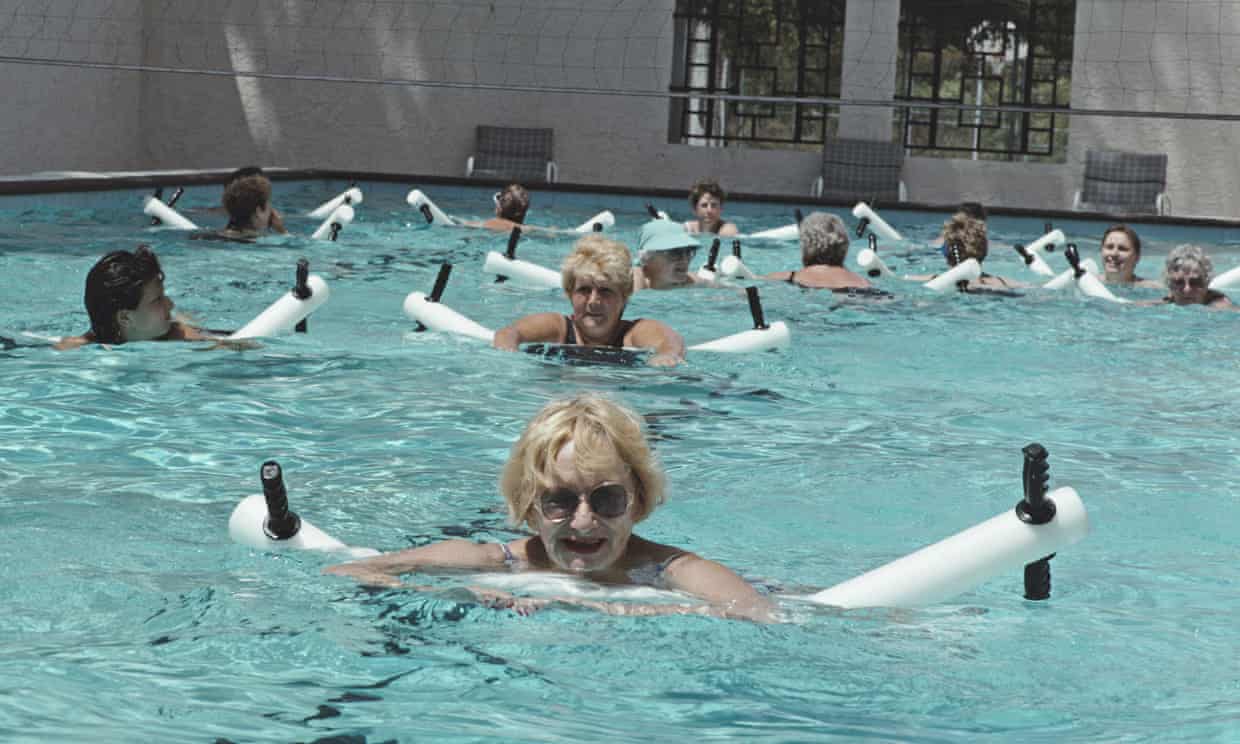
Photo: Barbara Alper/Getty Images.
Aqua aerobics is pitched at those who are ‘young at heart, recovering from pregnancy, or rehabilitating,’ writes Kate Leaver.

Since I moved to a retirement community with many excellent exercise instructors, I’ve been impressed to see how many seniors are really serious about staying in shape — even people close to 100. Today’s story is about a particular kind of class for older people, but not just older people. It comes from Sydney, Australia, via the Guardian.

Kate Leaver writes about her experience with a water aerobics class.

“At my first class, we sang Barbara ‘Happy Birthday.’ She was turning 80, doing fly-kicks underwater with the rest of us. …

“That’s the main demographic for aqua aerobics at the Manly’s Andrew Boy Charlton aquatic center in Sydney: women born in the era of Barbaras, Margarets and Gladyses, many of them wearing a full face of makeup and gold earrings. They keep their faces immaculate by extending their necks and keeping their heads above water (I’ve asked).

“Each week, 30 people turn up for 45 minutes of guided exercise, half-submerged in a heated, chlorinated lap pool. It’s popular: tickets go on sale three days in advance and it’s sold out within hours. …

“Aqua aerobics is pitched at those who are ‘young at heart, recovering from pregnancy, or rehabilitating.’ My mum and I are in that third category: rehab. She, from cancer; me, from long Covid (I contracted the virus at a Harry Styles concert in June 2022 and am yet to fully recover). Having spent a displeasing number of days/months/years lying down, we felt ready for some gentle exercise.

“It’s probably the most fun I’ve ever had in the pursuit of mild fitness. … The vibes are unmatched – it’s all ‘Very nice, Susan’ and ‘Lift those legs, Carol,’ never ‘No pain, no gain.’ One time, a young man with a six-pack walked the length of the pool in Speedos and I watched as a wave of giggles spread across the pool in his wake. …

“It’s a great workout, too, especially for anyone easing back into movement. The buoyancy of the water reduces strain on your joints and makes injuries less likely than routines on dry land. It’s adaptable in that you can glide your limbs for a mobility exercise or you can work up a sweat against the resistance of the water. I have to take it slow, but if you went hell for leather with some of these moves, you could really get your heart pumping.

“We do knee raises, lunges, kicks, punches and bicep curls. We jog back and forth in the water. We hold on to the edge of the pool and kick, kick, kick. We dance underwater to get our heart rates up and alternate between cardio and strengthening. Our leader is a loud, fit, flexible, brilliant middle-aged woman who has a special place in my heart because of the way she speaks to anyone who looks as though they might be struggling with her choreo. ‘You OK there, Maggie?’ she’ll say. ‘Don’t make me come in there and get you.’ She remembers people’s names, gently reminds the gossipers down the shallow end to concentrate, and winks at anyone who needs encouragement.

“She has a Britney microphone and a killer playlist of hits from the 70s and 80s. I don’t think I had truly lived until I’d done a kick-jump-kick sequence underwater while singing ‘There lived a certain man in Russia long ago / He was big and strong, in his eyes a flaming glow’ (Rasputin by Boney M, 1978).

“I will never again take a spin class run by a shouting bodybuilder or think of exercise as punishment. Not when this is an option. It’s a joy from start to finish, a truly adorable mother-daughter activity.” More at the Guardian, here.

I’m zeroing in on the soundtrack. In one of my classes we’ve had the same ’50s-’60s mix twice a week for 10 months. As much as I love music from those decades, would welcome a change to almost anything!

Read Full Post »

Photo: Ahmed Gaber for the New York Times.
“I figured I was probably winding down,” the soprano Lucy Shelton said of her career. “But then I got wound up again.” Shelton’s latest opera is Lucidity, about identity and dementia.

Today’s story is about an 80-year-old opera singer whose career took a new lease on life. I’m always impressed by things like that, especially as I know that memory starts playing tricks. In fact, today I nearly posted a story that I posted a couple weeks ago. Of course, I’ve been blogging every day for about 13 years, getting older all the time. Bound to repeat a post by accident.

Back to the opera singer. Corinna da Fonseca-Wollheim reports at the New York Times, “When the soprano Lucy Shelton opened a recital at Merkin Hall in 2019 with ‘Adieu à la vie,’ a song by Rossini, she was about to turn 75. And though she was not bidding farewell to life as the song’s title suggests, she felt she was done with performing. For decades, she had been one of the most sought-after interpreters of contemporary vocal music. But she had reached a point where ‘I couldn’t sing the things that I used to sing,’ she said in an interview. …

‘It’s kind of a riot,’ she said. ‘It probably thrills everybody else more than it thrills me.’

“Today [last November], Shelton, 80, takes center stage at the Abrons Arts Center in the world premiere of Lucidity, an opera about identity and dementia, composed by Laura Kaminsky, with a libretto by David Cote. With a score that calls for a multitude of expressive registers, including floated lyricism and sprechstimme, musically notated recitation, the work is tailored to Shelton’s undiminished dramatic strengths. It’s also a testament to her continuing dedication to her craft. …

“After five decades making her name primarily on the concert scene, Shelton finds her engagement calendar increasingly filled with opera. In 2021, she performed in the critically acclaimed premiere of Kaija Saariaho’s Innocence in Aix-en-Provence, France. Next season, she will reprise the role at the Metropolitan Opera, making her house debut at 82. ‘It’s kind of a riot,’ she said. ‘It probably thrills everybody else more than it thrills me.’ …

“One challenge of staged roles is memorization, which can be made harder by age. In discussing Lucidity with Kaminsky, she raised her concerns that she might not be able to perform the whole show from memory. In this production, she will always have either a newspaper or sheet music to hold (her character is an aging musician), so that she has all her lines at hand. …

“Opera, though, was never the focus of Shelton’s ambitions. Growing up in Claremont, Calif., she developed a love for playfully experimental singing at home with her siblings and parents, who had met in an amateur choir. ‘We would do crazy things with our rounds or Christmas carols or Bach chorales,’ she said. ‘We might slide from tone to tone and wait until everybody got to the chord and then hold it and slurp around.’ Along the way, she said she developed a taste for ‘the thrill of dissonances.’

“She was drawn into contemporary music when she studied with Jan DeGaetani, a champion of the avant-garde known for her virtuosic facility with unorthodox techniques. Among those was DeGaetani’s dramatic use of sprechstimme in Schoenberg’s Expressionist chamber drama Pierrot Lunaire, which would also become a signature role for Shelton.

“Working primarily in contemporary music, Shelton developed an instrument that prized rhetorical impact and sound color over the high gloss favored by opera. She often performed with a microphone (including in Saariaho’s Innocence), saving her voice from the strain of projecting full-throttle to the last row of a large auditorium.

“She worries that concentrating too much on opera can stymie young singers’ curiosity about the full spectrum of expressive colors in their voices. She said she often reinvented her technique to match the dramatic demands of a given piece. By contrast, an aspiring opera singer hustling for work is forced into a loop of preparing for and performing at auditions. ‘That’s not making music,’ Shelton said. ‘It’s making an impression.’ …

“Still, Shelton knew she needed help with her singing when her 75th birthday came and went and the invitations to perform kept coming. She had lost some of her upper extension, and struggled to keep her tone even across her range. Her intuitive approach to technique no longer served her.

“For the past two years, she has been taking lessons from Michael Kelly, a baritone she met at the Tanglewood Institute when she was his mentor. He remembers being in awe of her. ‘She was probably the vocalist who had collaborated with the most composers ever,’ he said in a video interview. …

“Kelly said that aside from helping Shelton unlearn some habits that had crept into her technique in reaction to physical changes, there was a psychological dimension that had to be addressed. ‘Not being able to do what she could do at one point in her career made her hesitant,’ he said. ‘A lot of it was getting her out of her head about it and saying: “You don’t have to sing this the way you would have when you were 25 years old. This is the voice you have which is still very beautiful and capable.” ‘ “

More at the Times, here.

Read Full Post »