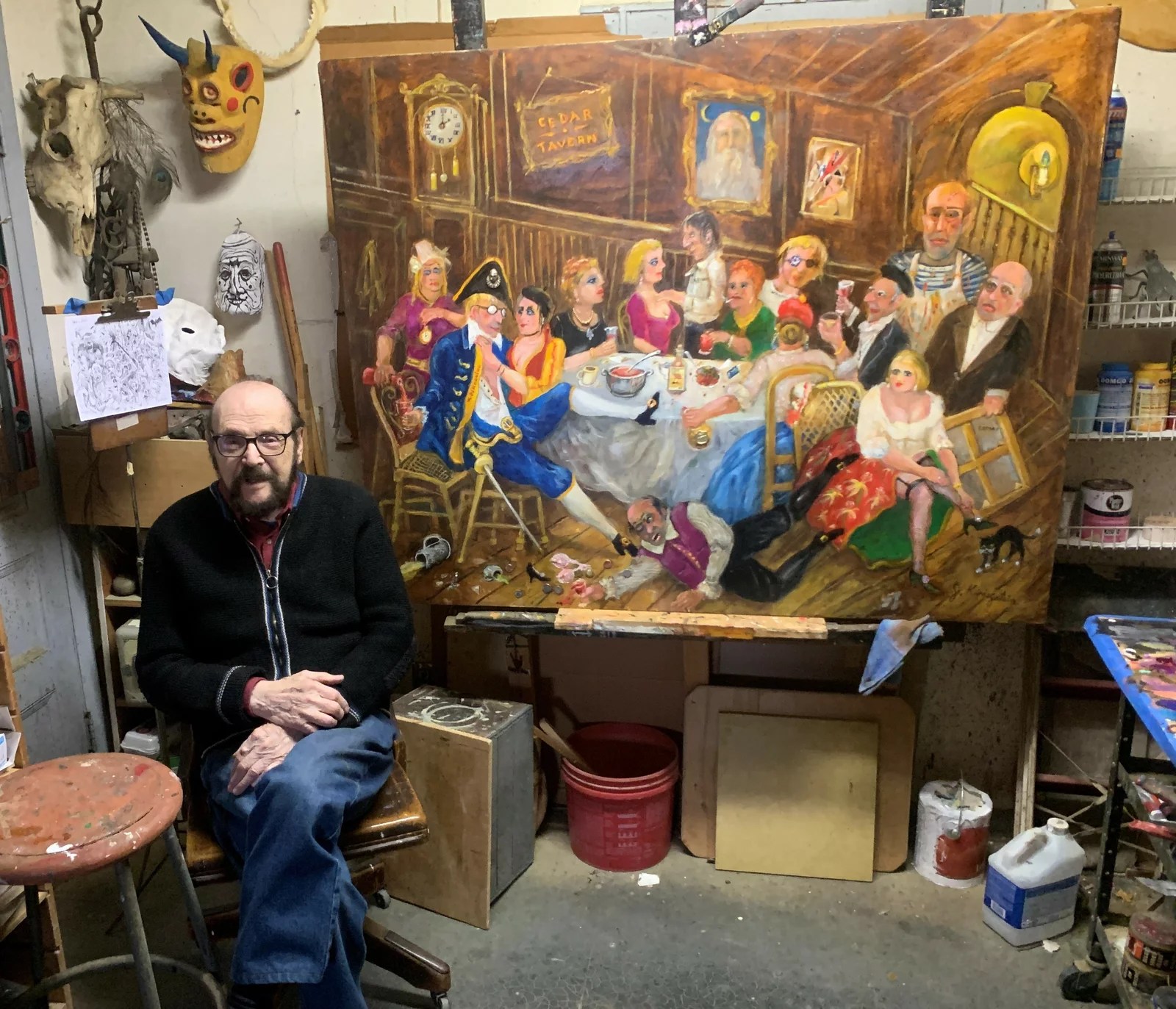
Photo: Matthew Schuerman/NPR.
“Jonah Kinigstein, 99, has been making art since he was a teenager,” says NPR. “Some of his work satirizes modern artists such as Andy Warhol and Jackson Pollock, visible in the painting behind him.”
Although I am personally a big fan of abstract art, I find it interesting to consider that that former rebellion against convention spurred its own rebellion. When abstract art was the accepted best, what happened to artists whose inspiration lay elsewhere?
Matthew Schuerman reported at National Public Radio (NPR) about one artist working in the heyday of abstract expressionism who swam against the tide.
“In the 1950s, Jonah Kinigstein was on the verge of making it big in New York’s art world. He won a Fulbright to Rome. His paintings got into the Whitney Museum’s annual show of contemporary art (the precursor to the Whitney Biennial). And he was taken in by one of the biggest gallerists in the city, Edith Halpert. …
“Once, when Life magazine ran a profile of Halpert and nine of the artists she was promoting titled, ‘New Crop of Painting Protégés,‘ Kinigstein was among them. In fact, in the main photo, he stood directly behind Halpert. But then, as a result of changing tastes in the art world, he fell into obscurity and could not convince anyone to give him a gallery show.
“He nonetheless kept painting … and painting … and painting some more. Even today, at age 99, he said he spends two to three hours a day. …
“His painting style has gone through a lot of changes throughout his life, but he calls himself a ‘figurative expressionist.’ That is, he paints people, but they are often distorted and grotesque, set against backgrounds that are surreal and fantastical. His subjects are saints, rabbis, impresarios and showgirls — people who [seem] to be suffering or seem to be enjoying other people’s suffering. …
” ‘I was born in Coney Island, and I remember certain things,’ he said. ‘These large figures and people waiting in line.’ …
“Born in 1923 in Brooklyn, Kinigstein was raised in the Bronx by Jewish-Russian-Polish immigrants. As a teenager, he learned he had a knack for art by drawing with chalk on the sidewalk. His father, a house painter, used to brag about him to his co-workers.
” ‘I used to go with him to help paint the apartments. And he would say, as he introduced me, “Hey, I’m painting with a real artist,” ‘ Kinigstein said with a laugh.
“After high school, Kinigstein attended The Cooper Union. … But before he could finish, he was drafted into the Army for World War II, where he worked in a photo topography unit. …
“For years after World War II, the type of figurative art that Kinigstein practiced co-existed with abstract expressionism — e.g., the drip paintings of Jackson Pollock or the color field art of Mark Rothko. But as the 1950s wore on, abstract expressionism won the day. …
“To Kinigstein, though, the twilight of figurative art meant it was less and less likely that he would ever make a living as a painter. The rejection stung.
” ‘I made painting after painting. And I always felt, you know, I was doing my best,’ he said.
“Kinigstein married and had two children while continuing a career in commercial art. He designed store windows and also Bloomingdale’s first-ever collectible shopping bag. (He was later inducted into the National Academy of Design.) And he kept painting.
“He also began to draw cartoons: satirical and biting, like something out of a 19th century political magazine, except his lampooned the art establishment that promoted abstract painting.
“One of them is based on a famous Rembrandt painting, The Anatomy Lesson of Dr Nicolaes Tulp. Except the cadaver on the bed is labeled ‘figurative painting’ and the men around him, cutting him up, are members of the art establishment that promoted abstraction in the 1950s.
“A few times, Kinigstein took these cartoons to New York’s gallery district, SoHo, and pasted them onto building walls and lamp posts. Some passersby would get into arguments with him, while others would take them down and ask him to sign them. …
“To Kinigstein, abstract painting took no talent, no skill, no ability to observe the world. There was also a moral component — he refused to change the way he painted simply because it wasn’t popular.
” ‘I saw a guy right in my front of my eyes going from real, real painting to, you know, he laid the painting down on the floor and he started to splash around,’ he said. ‘I couldn’t talk to that guy. I really couldn’t talk to him.’
“Recently, though, Kinigstein is finally getting some recognition. In 2014, Fantagraphics, arguably the foremost art comics publisher in the U.S., came out with a collection of his cartoons, The Emperor’s New Clothes: The Tower of Babel in the ‘Art’ World. Editor Gary Groth knew he wanted to publish them the day he opened Kinigstein’s submission.
” ‘They were clearly not drawn by a young person because they displayed a level of craft,’ Groth said. ‘They were all so extraordinarily well-drawn. And then I looked at the content, and every single one of them was a ferocious attack on abstract expressionism.’
“Groth visited Kinigstein in Brooklyn and took a tour of his studio, which is packed with hundreds of paintings standing on their ends, like playing cards. That’s when he decided to do a second book, this one focused on Kinigstein’s paintings.
“The result, Unrepentant Artist: The Paintings of Jonah Kinigstein, appeared in June [2022]. …
” ‘What I paint is what I like to paint,’ [Kinigstein] said. ‘And I don’t paint for anybody.’ “
More at NPR, here. No firewall.

 Suzanne's Mom's Blog