Photo: Walaa Buaidani.
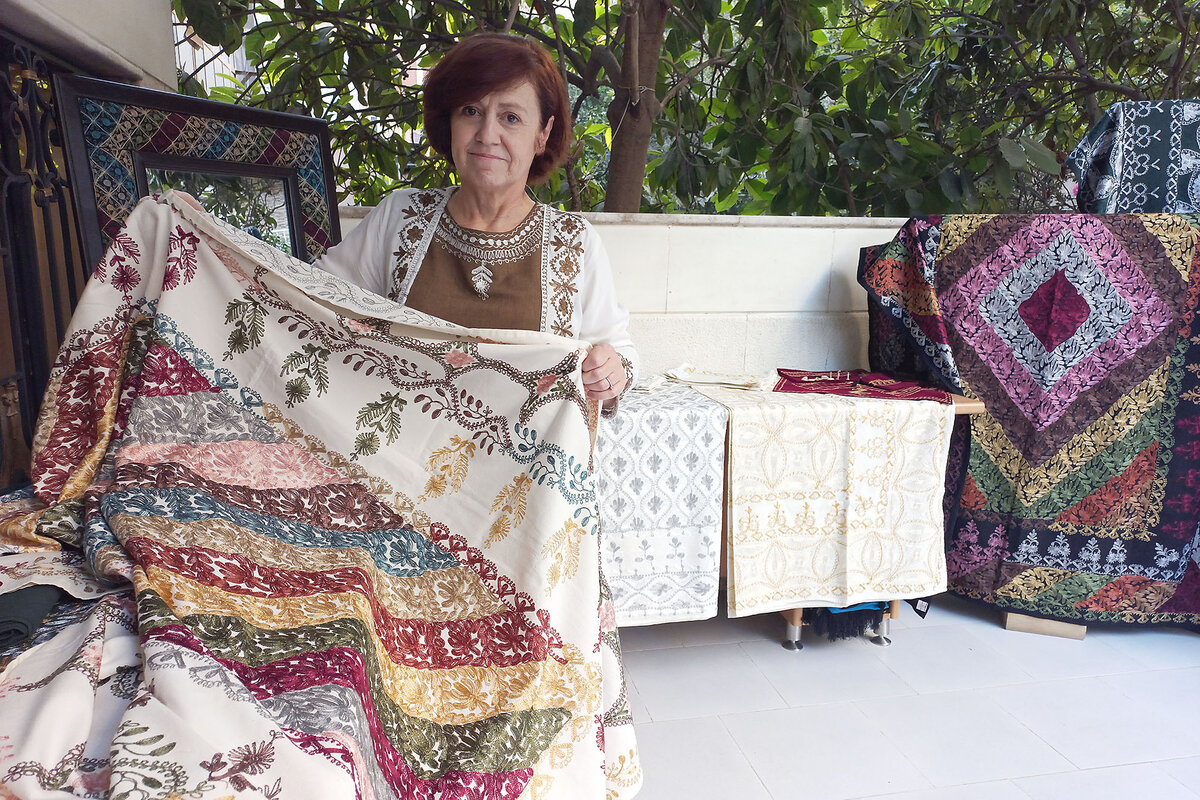
Mona Araghili showcases aghabani embroidery at the Threads of Hope exhibition in Damascus, Syria. Post-Assad, she sees an opportunity for serious investment in traditional crafts.
“Threads of Hope” is a phrase that seems to cover a lot of what is going on in the world. Hopes may be hanging by threads, but every day they can strengthen. In today’s article from the Christian Science Monitor, the words are applied to the reemergence of traditional Syrian embroidery after the fall of the Assad regime.
Dominique Soguel writes, “By the time Ameera al-Hammouri was 10, her hands were dancing across the taut fabric beneath her grandmother’s aghabani embroidery machine. She was too short to sit, so she stood, working the foot pedal to coax floral patterns from metallic thread and her own memory.
“Decades later, in a rundown apartment building on the outskirts of Damascus, her machine now runs on an erratic supply of electricity. The building’s elevator no longer works and many of its windows are broken, but inside the sanctity of Ms. Hammouri’s spotless home, the artistry lives on. ‘Working on the embroidery machine for me is like drawing on paper,’ she says. … ‘Whatever I imagine, I bring to life with my hands.’
“Aghabani embroidery originated in Damascus more than 150 years ago, blending Ottoman, Arabic, and Persian design influences. Traditionally, patterns were hand-printed in Damascus onto fabrics that were then sent to Douma, about 8 miles from the capital, where women embroidered them at home. Their work, displayed on tablecloths and other household items, became a hallmark of Syrian hospitality.
“Today, the survival – indeed, the revival – of this craft tradition rests in the hands of women from Douma, a city synonymous with both resistance and ruin. The women behind these works are not only artisans. They are mothers, widows, and survivors of siege, displacement, and economic collapse.
“Ms. Hammouri herself endured all of it. Her husband and eldest son were arrested in 2012 and never returned. Douma was subjected to a five-year siege, when government forces surrounded the city, cutting it off from food, medicine, and fuel. Ms. Hammouri’s house was destroyed. As the bombs fell, she moved her children from house to house, basement to basement.
“The siege ended in 2018. With no income and no husband, Ms. Hammouri turned to the one thing that had always grounded her: her original aghabani machine, bought in 1988 with money she scraped together by selling her wedding gold and other treasures. It still stands in a corner of her bedroom, alongside a newer model.
“ ‘I talk to this machine,’ confides Ms. Hammouri, who is known in the community as Umm Meriee. ‘It holds my secrets. I’ve cried over it.’
“At first, she worked quietly from home, taking orders from traders who remembered her family’s reputation and bought pieces for export. Over time, she began training other women.
“If Syria’s current political opening brings more trade and tourism, she says, crafts like aghabani could once again become a source of stable income rather than just a means of survival.
“Now, twice a week, her apartment fills with the chatter and laughter of industrious women. … This gathering of women is not a formal enterprise. There is no signboard or registration, no website to market their work. But family reputations endure in a country where word of mouth is the norm.
“ ‘They know my name in the market,’ says Umm Meriee, recalling how she revived ties with shopkeepers in the Al-Hariqa market, in Damascus’ old city, because her aunts and grandmother had put the family name on the map. …
“For Mona al-Masri, a Tuesday regular, embroidery is her identity. … While her colorful pieces earn heartfelt ‘wows’ from her daughters, it is next to impossible to eke a living from this craft. In a good week, working three hours a day in between bouts of housework, Ms. Masri earns just over $6. … Despite the skill and time aghabani requires – a single detailed motif can take hours, and a full tablecloth might take a week or more to complete – handmade aghabani cannot compete with cheaper, machine-made imitations that dominate the local market, such as those imported from China.
“ ‘Right now, aghabani has no future,’ says Ms. Masri. But with government support, she feels that future could ‘be a very bright one.’
“Mona Araghili shares that optimism. … More than a decade ago, Ms. Araghili set up Threads of Hope – Aghabani with little more than a social media page and materials she borrowed from friends. With her college friend Basheera Baghdadi, who had grown up in Douma, she smuggled fabric and thread into the besieged city, using tunnels and roundabout routes through the countryside. …
“Ms. Araghili never shut down her group’s Facebook page, she says. ‘I always hoped that we could restart someday.’ ”
More at the Monitor, here.

 Suzanne's Mom's Blog