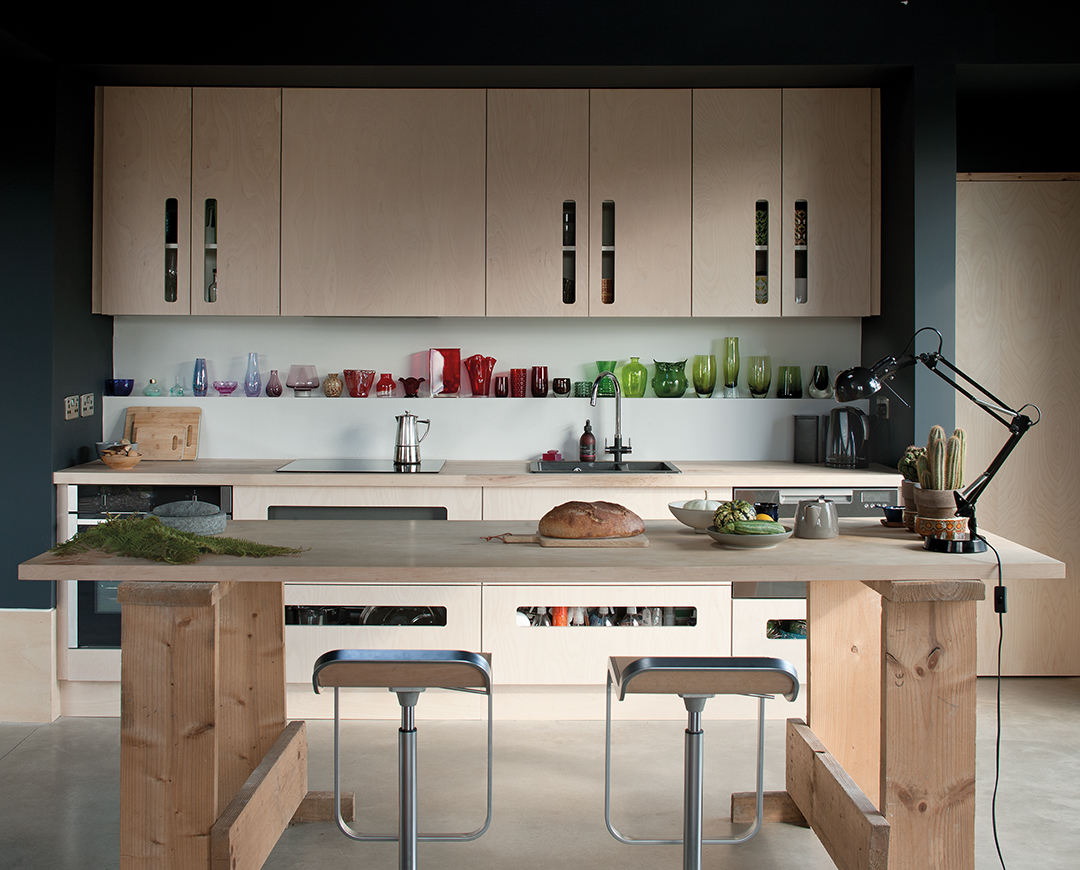
Photo: Ann Nisbet Studio designed the house above to make it dementia- and age-friendly. In the kitchen, “there are large letterbox-type slots in the drawers and cupboards to allow someone with dementia to see that there are cups, plates, cutlery and food inside,” Homes and Interiors Scotland reports.
When I was at the Fed, I attended a couple Harvard conferences on housing for the aging. I learned about something called “universal design” and thought how sensible it would be if architects would always ensure that housing features worked for people at any stage of life. Why go to the expense and disruption of putting in wider doorways, higher toilet seats, shower grab bars, ramps, and the like down the road?
In today’s article, architects considered these issues, even taking into account the possibility of someone developing dementia.
Caroline Ednie writes at Homes and Interiors Scotland, “ ‘We lost all our belongings in the fire and were left homeless,’ recalls Kathy Li, an architect who teaches at Glasgow School of Art. ‘It was pretty traumatic. But after the initial shock wore off, we realized that what was important to us wasn’t necessarily the house itself but its location. It’s close to a beautiful reservoir where you can swim or fish, and forests that are perfect for mountain biking or road cycling.’ …
“So Kathy and her partner Richie Elliot decided to stay on the site, initially in a tiny caravan and then in a larger one-bedroom static caravan. ‘It took five years to resolve with the insurance company and we lived in the caravan the entire time,’ recalls Kathy. …
“Eventually, with the situation settled in their favor, she and Richie could begin to think about replacing their home on the site. …
“ ‘We knew we didn’t want lots of little rooms. There are fantastic views right down the valley, and we wanted to take advantage of these and of the woodland at the front. There is a southerly aspect too, which then got us thinking about a low-energy building. It was time to start again. We had this chance to create a house for life.’
“She approached architect Ann Nisbet. …The brief was essentially for an energy-efficient one-bedroom house, flexible enough to suit both living and working, to be constructed using ‘harmless’ materials.
“An unusual but crucial part of the brief was that the house should be dementia- and age-friendly. Kathy’s mother and stepfather both had dementia, and she was keen to explore and incorporate design features that would make it easier for sufferers to live in the house.
In response, Ann Nisbet attended a dementia design course at Stirling University – one of the world’s leading centers for research into the syndrome.
“ ‘We were keen to take this information, which mostly looked at care homes and hospitals, and apply it to a domestic house in a design-led, non-institutional manner,’ the architect explains.
“ ‘Research shows that you read your surroundings differently if you have dementia – for example, two materials of similar monotonal color when read together will be viewed as the same object. We used this knowledge to try to create a navigation system throughout the building, while still keeping the material palette modern and minimal.’
“As a result, the door and window frames, floors, skirtings and walls are all tonally different. As for circulation, all the key areas of the building are visible from the connection lobby, which helps you navigate the floor plan and prevents confusion.
“Thought was given to the kitchen units too: there are large letterbox-type slots in the drawers and cupboards to allow someone with dementia to see that there are cups, plates, cutlery and food inside.
“ ‘Many people have experienced a close friend or family member being diagnosed with dementia, and as we live longer, the number of sufferers is increasing,’ says Fay Goodwin, project architect at Ann Nisbet Studio.
“ ‘This house demonstrates that buildings can and should be designed to enable people with the condition to live longer in their own home and to help them overcome the day-to-day challenges they face.’ “
More at Homes and Interiors Scotland, here. Check out the close-up of the ktichen cabinets with the see-through slots. No paywall.



 Suzanne's Mom's Blog