Feeds:
Posts
Comments

Posts Tagged ‘air circulation’

Photo: Zakir Hossain Chowdhury/Anadolu Agency/Getty Images/Anadolu.
In Bangladesh, there’s hope that stacking bricks in a new way in kilns — in a zig-zag pattern that increases airflow — will ensure that coal-fired kilns operate more efficiently and with less pollution.

Too often I think in black and white terms, right and wrong, good and bad. There are plenty of times times when things are that clear, but not always. Life is complicated.

Take the issue of burning coal in a poor country. At this point in its history, Bangladesh, for example, doesn’t have many choices. Bricks house the population, and coal-fired kilns are what’s available. So although coal is bad, just reducing some of the pollution will have to be good enough for now.

Jonathan Lambert reports at National Public Radio, NPR, “During the dry winter months in Bangladesh, thousands of workers shovel millions of tons of coal into kilns across the country. As columns of hand-packed bricks bake and harden, dark plumes of smoke pour out of more than 8,000 smokestacks that mark the skyline of both rural and urban areas.

” ‘It’s a lot of black smoke, impacting the workers and nearby villagers, but also the overall air quality of the region,’ said Sameer Maithel, an engineer with Greentech Knowledge Solutions, a consulting firm in Delhi, India.

“Bangladesh’s air consistently ranks among the most polluted on Earth. Brick kilns contribute anywhere from 10 to 40% of the tiny particles that make up that pollution. Those particles can enter our lungs and even our bloodstream, causing health problems, including respiratory diseases, stroke and even cognitive problems.

“But something as simple as stacking the bricks a different way could put a significant dent in that pollution, according to a new study of over 275 kilns published in Science by Maithel and his colleagues.

” ‘This is wonderful evidence of how simple low cost interventions can have a big impact on energy use,’ said William Checkley, an epidemiologist at Johns Hopkins University who wasn’t involved in the study. ‘If we can implement these, we could have a significant impact in energy use and emissions, improving air quality throughout southeast Asia.’

“Bricks are the main building block for Bangladesh. The densely populated and rapidly urbanizing country produces nearly 30 million bricks a year – more than 90% from loosely regulated, coal-burning kilns.

” ‘It’s quite simple and inexpensive to set up traditional-style brick kilns, so they’ve just proliferated,’ said Nina Brooks, a global health researcher at Boston University.

“The process goes something like this: First, dun-colored clay bricks are molded with a wooden box and stacked in the sun to dry. Next, hundreds of thousands of bricks are stacked in the firing chamber and covered with ash. Then, workers shovel lots and lots of coal as the bricks fire, firming them up.

” ‘The combustion efficiency of these brick kilns is really low,’ said Brooks, meaning they end up burning a lot more coal than they need to, ‘Which is why they’re so heavily polluting here.’

“Each kiln can employ up to 200 workers. They’re the most directly impacted by the smoke, with one study finding nearly 80% report some kind of respiratory problems. But they’re not the only ones. Kilns are often close to densely populated areas, adding to the smog that comes from city life.

“While there are regulations on where kilns can and can’t operate, they’re not always followed, said Brooks. ‘We found that 77% of brick kilns are illegally located too close to a school.’

“Modern, high-tech kilns produce substantially less pollution, but they’re up to 25 times more expensive to build and operate. ‘They’ve not really taken off,’ said Brooks.

“Instead, the team looked for solutions that would be easier and cheaper for the average brick producer to adopt.

“In his decades of working with brick kiln owners in India as a consulting engineer, Maithel has noticed questionable practices.

“Many kiln operators pack too many bricks in the kiln too tightly, he said. That tight spacing chokes out oxygen flow, which is needed for efficient burning. It also means hot coals get stuck at the top of the stack instead of falling to the bottom, leading some bricks to be overbaked and others not fired enough. …

“As an energy systems engineer, Maithel knew that a few simple changes could really help. Simply stacking the bricks in a zig-zag pattern that increases airflow and ensuring coal gets delivered more consistently should help the kilns operate more efficiently, he said. ‘The better you are able to provide fuel and air mixing, the probability of black smoke will be less.’

“To see if such simple interventions could help reduce air pollution and boost profits, the team planned a massive experiment across 276 kilns. One group of kiln owners and workers were taught how to implement these interventions. Another group got the same training plus info on how the changes would save money. The control group got no training.”

Read about results that benefited both the air and the kiln operators at NPR, here.

Learn how to protect NPR and other public media here.
Read Full Post »

Photo: Singapore Chinese Orchestra.
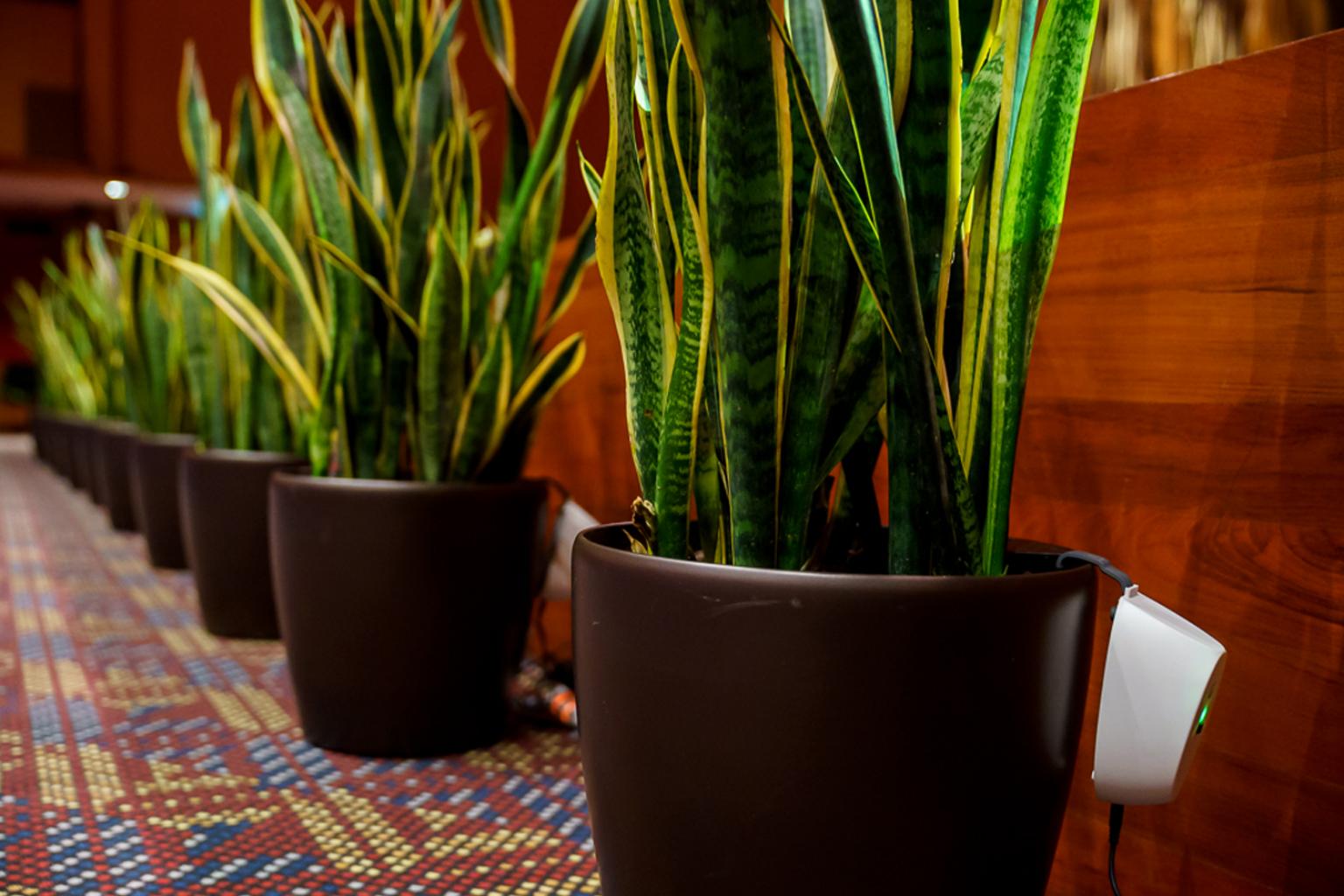
Ionisers attached to ornamental snake plants in front of the stage improve air circulation with an “ionising curtain” between the performers and audience at a Singapore Chinese Orchestra concert. The idea is to keep people safe from Covid.

I was saddened and surprised the other day when I offended a woman wearing a mask by asking her if she was also vaccinated. We were in a small room where there was little air circulation, and she was there to give me a hearing test.

Sadness was my primary reaction as the question really upset her. But I was also surprised because so many clinics, performance spaces, restaurants, etc. bend over backwards to make patrons feel safe, even if their requests seem unreasonable.

Consider the introduction of snake plants at the Singapore Chinese Orchestra. Toh Wen Li reports for the Straits Times about their role in an unusual air-quality initiative.

“The air was charged with more than just emotion when the Singapore Chinese Orchestra (SCO) staged its first wind concert in months last Saturday (Sept 25).

“As the rousing sounds of the dizi, sheng and suona filled the concert hall, high-tech devices attached to 20 ornamental snake plants in front of the stage created an ‘ionising curtain’ between the performers and audience.

“The ionisers, designed to reduce the spread of Covid-19, induce a negative charge in the air particles around the plants. This pulls positively charged aerosols, droplets and particulate matter towards the leaves of the plants.

“The devices were introduced following a six-month collaboration between the orchestra and the Agency for Science, Technology and Research (A*Star).

“SCO’s executive director Terence Ho hopes these — and a slew of other measures, such as a filterless high-volume air purifier developed by A*Star to be used in the foyer — will give people peace of mind and encourage them to attend live concerts.

” ‘We have to work towards bringing audiences back to the hall and more musicians back on stage,’ he tells The Straits Times, adding that the plant-based ionisers will remain for future concerts at Singapore Conference Hall, home to the SCO. …

“SCO’s suona and guan principal Jin Shiyi, 56, says in Mandarin: ‘Wind players are now a “high-risk” occupation, and we have had fewer opportunities to go on stage. I’m so happy we can perform on stage again.’

“Last Saturday’s wind concert, also available online for streaming, was part of the recently concluded Singapore Chinese Music Festival. It had drawn a physical audience of about 100 people, less than half the permitted capacity of 250 for that venue.

“Mr Ho says audiences are worried about the recent spike in Covid-19 cases. … For now, he is keeping his fingers crossed as the orchestra prepares for two concerts in early October to celebrate the SCO’s 25th anniversary, while taking precautions to reduce the risk of Covid-19 transmission. It has split performers  into separate ‘teams,’ cut down on rehearsals and roped in understudies in case performers are hit by the virus or with a 10-day quarantine order. …

“The orchestra would have launched it even without the pandemic, [Chief executive Chng Hak-Peng ] adds, as a way to maintain ties with local and overseas audiences. Before the pandemic, as many as 10 per cent of SSO’s live audience members were tourists.

“Home-grown charity the Foundation For The Arts And Social Enterprise has also launched a 10-year Music Commissioning Series to support Singapore composers and build up a canon of local contemporary music — from Chinese orchestra and cross-cultural works to jazz and musicals. …

“Founder Michael Tay says: ‘While we have had Singapore composers write works for wind bands and orchestras in the past, we don’t see a systematic plan to encourage the writing of major works (of at least 30 minutes).’ The series, he adds, ‘is meant to plug this gap.’ …

“Despite the resumption of live concerts … life has not returned to normal for orchestras. While live performances with up to 1,000 audience members, subject to conditions, are allowed, most venues can accommodate only a fraction of this after factoring in safe distancing measures. …

“[Mr Chng] adds: ‘Even though we are having concerts, we still have not, for the last year and a half, been able to have our entire orchestra perform together.’

“Then there is the impact on freelancers, who in pre-pandemic times would often perform with the orchestra and give pre-concert talks. …

“Countertenor and freelance choral director and educator Phua Ee Kia, 41, had no income for eight months last year and has not performed since 2019. He has been doing his rehearsals online during the pandemic.

” ‘Conductors are really struggling,’ he says. ‘Not all of us are tech-savvy and we don’t just have to cope with our own (issues), but also have to deal with situations when our students say, … “My screen went blank.” ‘

“Phua, who tapped a training grant to take a course in audio production software Logic Pro, hopes there will be more upskilling opportunities and financial support for freelancers. …

“Phua says: ‘A choir is not formed of just five people. I hope in the near future, we are allowed to gather and sing in a bigger group, albeit with masks on. Some of us are forgetting what it’s like to be able to perform in a bigger group.’ “

More at the Straits Times, here.

Read Full Post »

Photo: Peter Means.
Linsey Marr’s unusual set of skills puts her in high demand for insight into Covid-19 aerosol dangers.

With new Covid-19 data coming out every day, I am a bit less anxious about potential germs on the groceries and a bit more concerned about how long a contaminated droplet can last in the air and how many droplets it takes to get sick. Even the experts don’t know. But it sure is reassuring to read about people who are on the case. Dr. Linsey Marr, for example.

Tara Parker-Pope wrote about her recently at the New York Times. “When Linsey Marr’s son started attending day care 12 years ago, she noticed that he kept getting sick with the sniffles and other minor illnesses. But unlike most parents, Dr. Marr, an aerosol scientist at Virginia Tech, tried to figure out why. …

“Dr. Marr was uniquely equipped to tackle the problem [of airborne illness]. She had graduated with an engineering science degree from Harvard University, where she developed an interest in air pollution during her daily runs breathing car exhaust on nearby Boston streets.

“She earned a doctorate in civil and environmental engineering from the University of California at Berkeley, and completed post-doctorate work at the Massachusetts Institute of Technology, with Mario J. Molina, a Nobel laureate recognized for research into ozone damage caused by chlorofluorocarbon gases.

“But it was during that first foray into day care germs that she discovered how little was known about airborne transmission of viruses.

‘I was surprised to find out we don’t even know how much of the flu is spread through the air or through touching,’ Dr. Marr said. …

“Now, Dr. Marr’s maternal and scientific curiosity and her multidisciplinary background have made her one of the world’s leading scientists on airborne viruses. Her research led to the publication of a groundbreaking study that found flu virus in microscopic droplets that were small enough to remain floating in the air for an hour or more. …

“Public health officials in the United States and with the World Health Organization have called on Dr. Marr for her expertise, and scientists from all over the world have asked her to review their papers. Her lab has focused on testing new materials to solve shortages of personal protective equipment for medical workers. Working with her colleagues and graduate students, Dr. Marr’s lab found that a large stockpile of expired respirator masks were still effective but that 3-D printed masks unfortunately were not.

“ ‘There are not many people who are trained engineers who also study infectious disease,’ said Dr. X.J. Meng, a Virginia Tech professor who studies emerging animal viruses. … ‘Linsey is one of very few scientists who has this ability to study aerosol transmission because she can use the engineering tools to study the dynamics of viruses and bacteria in the air.’ …

“Part of the reason Dr. Marr has become so popular in public forums is her ability to explain difficult scientific concepts in easy-to-understand terms. She uses the visual of cigarette smoke when explaining viral plumes. To explain a concept called Brownian motion — and why masks can more easily filter the smallest microscopic particles — she uses the analogy of a drunken person stumbling into chairs and walls while trying to cross a room. ‘The particle is the drunk person, and the chairs are the fibers of the masks,’ she says. ‘The fibers stop the particles.’

“When people began asking whether their clothes could be covered in virus after going to the store or walking outdoors, she gave us all a lesson in aerodynamics.

Just as bugs don’t smash into the windshield of a slow-moving car because they’re carried by air currents alongside the car, lingering viral particles also slip by the human body as we move, and don’t smash into our clothes, she explained. …

“She used mathematical models to determine the safety of hugging during a viral outbreak, taking photos with her daughter in various hug positions to explain how to lower risk. She collaborated with Dutch researchers on how we can safely return to the gym. And her team is in the midst of research on the benefits of homemade masks.

“But the demand for Dr. Marr’s expertise also highlights an alarming problem in the study of viruses and respiratory illness. There are, perhaps, fewer than a dozen scientists around the world with extensive expertise in aerosol transmission of viruses, but funding for their research often falls between the cracks of different disciplines. Basic science grants tend to view airborne viruses as a topic to be supported by health funds. But health agencies tend to focus on how a virus behaves inside the body, not how it gets there. Environmental scientists may study waterborne pathogens or air pollution, but they don’t typically focus on airborne transmission of disease. …

“Despite knowing more than most of us about the risks posed by the coronavirus, Dr. Marr exudes a sense of calm about managing risks. She has access to top-rated N95 medical masks, but she chooses to wear a cloth mask, like the rest of us. … ‘For the things we don’t know, it’s good to err on the safe side, but also to not be paranoid.’

“Dr. Marr said she personally focuses on a ‘top four’ for lowering risk — social distancing, avoiding crowds, wearing a mask and washing hands.”

More at the New York Times, here.

Read Full Post »