Feeds:
Posts
Comments

Posts Tagged ‘air conditioning’

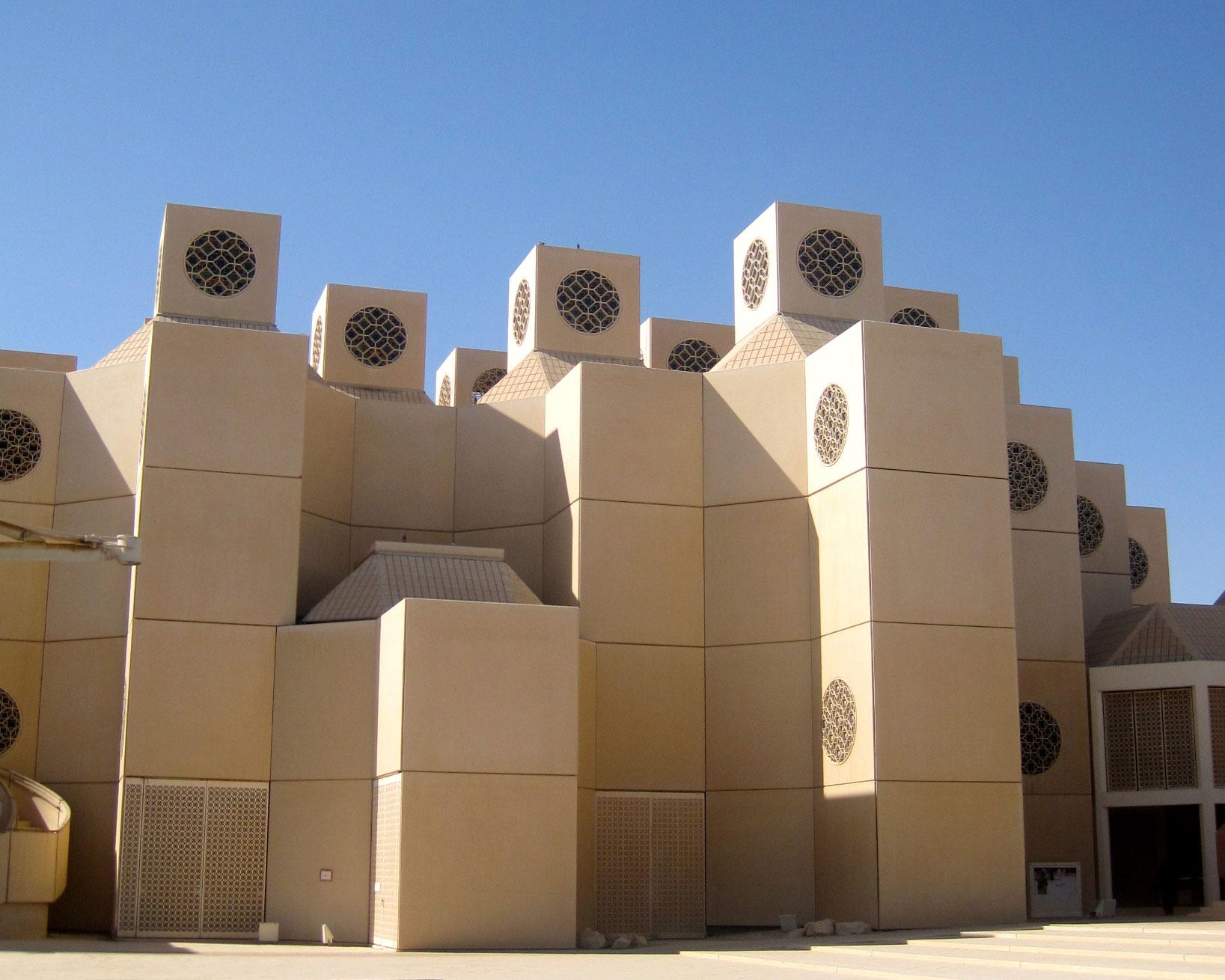
Photo: Sky2105, CC BY-SA 3.0/Wikimedia Commons.
Qatar University campus features a new wind catcher design built into the architecture. The science behind it is borrowed from 12th C Iran.

Here’s a “cool” air-conditioning concept that was new to me but apparently known in Iran for centuries.

Durrie Bouscaren reports at radio show The World, “As a kid, radio producer Sima Ghadirzadeh spent her summers in one of the hottest places on earth — the desert city of Yazd, Iran. … Here, intricate wind-catching towers rise above the alleyways — they’re boxy, geometric structures that take in cooler, less dusty air from high above the city and push it down into homes below. 

“This 12th-century invention — known as badgir in Persian —  remained a reliable form of air-conditioning for Yazd residents for centuries. And as temperatures continue to rise around the world, this ancient way of staying cool has gained renewed attention for its emissions-free and cost-effective design. 

“Wind catchers don’t require electricity or mechanical help to push cold air into a home, just the physical structure of the tower — and the laws of nature. Cold air sinks. Hot air rises. 

“Ghadirzadeh said she can remember as a child standing underneath one in her uncle’s living room in Yazd. 

“ ‘Having been outside in the heat, and then suddenly, going inside and being right under the wind catcher and feeling the cool breeze on you, was so mysterious,’ Ghadirzadeh said. 

“Temperatures in Yazd can regularly reach 115 degrees Fahrenheit. But somehow, it was bearable, Ghadirzadeh said. … Historians say wind catchers are at least 700 years old. Written records in travelers’ diaries and poems reference the unique cooling structures. 

“ ‘From the 13th century, we have references to the wind catcher — by some estimates, they were in use in the 10th and 11th centuries,’ said Naser Rabbat, director of the Aga Khan program for Islamic architecture at MIT. 

“Most wind catchers only cooled the air by a few degrees, but the psychological impact was significant, Rabbat said. They soon appeared all over the medieval Muslim world, from the Persian Gulf to the seat of the Mamluk empire in Cairo, where they are called malqaf. 

“In Iran, the wind catcher is a raised tower that usually opens on four sides because there’s not a dominant wind direction, Rabat said. The ones in Cairo are ‘extremely simple in form,’ usually with a slanted roof and a screen facing the direction of favorable wind, he added.

“Over time, wind catchers became symbols of wealth and success, growing increasingly elaborate. Homeowners would install intricate screens to keep out the birds. Water features and courtyard pools could bring the temperature down even more.  

“ ‘They would even put water jars made out of clay underneath — that would cool the air further,’ Rabbat said. ‘Or, you can put a wet cloth and allow the breeze to filter through, and carry humidity.’ 

“Many of the older techniques that kept life comfortable in the Persian Gulf fell out of favor after World War II, said New York and Beirut-based architect Ziad Jamaleddine. …

“Those shaded walkways, created by overhanging buildings and angled streets so beloved in historic cities like Yazd, were no longer considered desirable. 

“ ‘What they did is they substituted it with the gridded urban fabric city we are very familiar with today. Which perhaps, made sense in the cold climate of western Europe,’ Jamaleddine said.  But in a place like Kuwait or Abu Dhabi, mass quantities of cool air are necessary to make this type of urban planning comfortable. 

“Attempts to re-create wind catchers occurred during the oil crisis of the 1970s and 1980s in cities like Doha, where the Qatar University campus incorporates several equally distributed wind towers. But these projects became less common when oil prices returned to normal. Wind catchers are not easy to replicate without a deep understanding of the landscape and environment, Jamaleddine said. …

“Today, air conditioners and fans make up more than 10% of global electricity use, according to the International Energy Agency. The air conditioners are leaking refrigerant into the atmosphere, which acts as a greenhouse gas. And they no longer function when the power goes out — as seen this summer during extreme heat waves across the world. 

“Architect Sue Roaf thinks it’s ‘almost criminal’ to build structures that continue to rely on air-conditioning, knowing its impact on the climate. Roaf focuses on climate-adaptive building and chose to build her home using the same principles of ventilation and insulation that she learned while studying the wind catchers of Yazd.”

More at The World, here. No paywall.
Read Full Post »

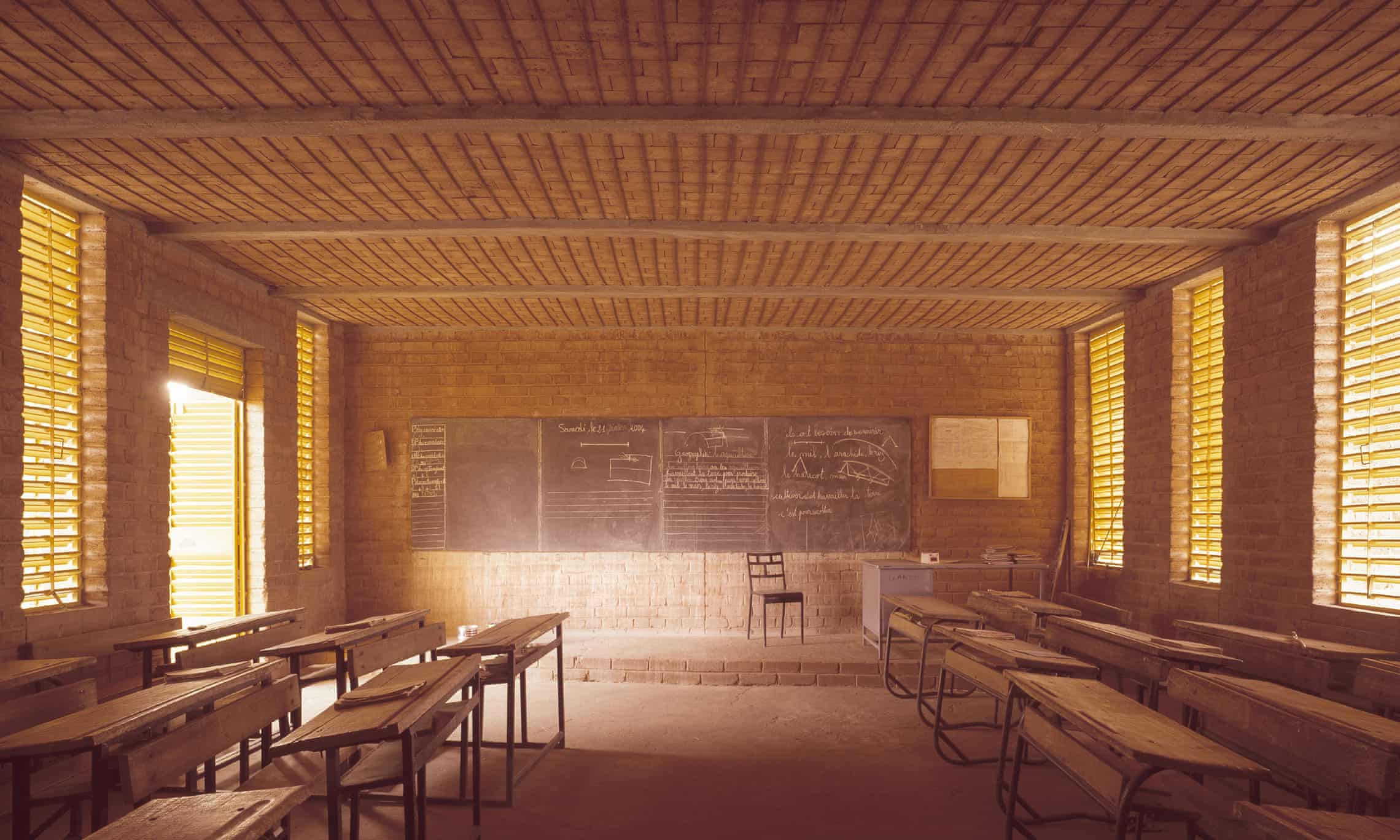
Photo: Siméon Duchoud/Kere Architecture.
Gando primary school in Burkina Faso, Diébédo Francis Kéré’s first construction project after finishing his studies in Germany.

In some cases, ingenuity will help people live with climate change. And the best ideas will come from those who have lived the life. Consider an architect who grew up in a very hot part of Africa.

Èlia Borràs  writes at the Guardian, “If architects are people who like to think their way around challenges, building schools in Burkina Faso must be the dream job. The challenges, after all, are legion: scorching temperatures in the high seasons, limited funds, materials, electricity and water, and clients who are vulnerable and young. How do you keep a building cool under a baking sun when there is no air conditioning?

Finding ingenious ways to use cheap materials to make sure that the schools and orphanages that they have built around Burkina Faso are cool, welcoming places.

“Architect Diébédo Francis Kéré grew up in the small village of Gando and knows the challenges well. He and other architects such as Albert Faus are finding ingenious ways to use cheap materials to make sure that the schools and orphanages that they have built around Burkina Faso are cool, welcoming places.

Kéré, who won the Pritzker prize in 2022, has spoken movingly about the support he was given as a child by the whole community, with everyone giving money towards his education as he left the village and eventually gained a scholarship and studied in Germany. ‘The reason I do what I do is my community,’ he said.

“Gando primary school, built in 2001, was Kéré’s first construction after completing his studies. ‘At first, my community didn’t understand why I wanted to build with clay when there were glass buildings in Germany, so I had to convince them to use the local materials,’ Kéré has said. Men and women came together to build the school, merging traditional techniques such as clay floors, beaten by hand until they were ‘smooth as a baby’s bottom’ with more modern technology to seek better comfort.

“The Noomdo orphanage was another of his projects. ‘The Kéré building provides us with good thermal comfort because when it’s hot, we’re cool, and when it’s cold, we’re warm inside,’ says Pierre Sanou, a social educator at the orphanage near the city of Koudougou in the Centre-Ouest (centre-west) region of Burkina Faso. ‘We don’t need air conditioning, which is an incredible energy saving,’ says Sanou. Temperatures in this region of the world remain at about 40C (104F) during the hottest season.

“ ‘Kéré builds with local materials from our territory like laterite stone and uses very little concrete,’ says Sanou. Kéré’s buildings in Burkina Faso are earthy. They start from the ground and take into account that concrete is a material that needs to be transported to the site, is much more expensive and generates waste. ‘They are permeable buildings that seek the movement of natural air and protection from the sun. For example, they are built with very strong walls and very light roofs so that the cool air that enters from below pushes the hot air out from above,’ says Eduardo González, a member of the Architecture School of Madrid.

“One particularly ingenious innovation is his use of the ancient idea of raised and extended metal roofs. The rooms of Noomdo are covered by a shallow barrel vault resting on a concrete beam but with openings. Above, a metal plate protects the roof from direct sunlight and rain. Additionally, it lets out the hot air. …

“Nearby, the Bangre Veenem school complex designed by Faus in the village of Youlou uses similarly ingenious ways to cool the building. Ousmane Soura works as an education adviser at the school. ‘Before building the school, [Faus] came to speak with the traditional authorities to obtain permission to build and to find out if there were sacred places that are sometimes not obvious or visible to people who don’t know them,’ says Soura.

“The school complex accommodates everything from nursery to high school, including a professional school. ‘The students don’t say: “It’s really hot” and want to go home because they’re comfortable and can concentrate with the class,’ adds Soura.

“It is built with bricks made from laterite stone native to the area. Laterite is shaped with a mould, dried in the sun, and becomes a brick of very intense red colour. ‘They are more resistant to bullets than concrete blocks, which have two holes in the centre,’ says Soura.

“Faus also managed to minimize material transportation and use the territory’s own materials. Even the quarry workers were from the area. ‘It’s a very beautiful material. When families see the buildings, they want their children to go to school,’ says Soura. There are even teenagers who meet inside the classrooms to talk after class or during vacation periods. The complex is an open space.”

More at the Guardian, here. No paywall. Donations encouraged.

Read Full Post »

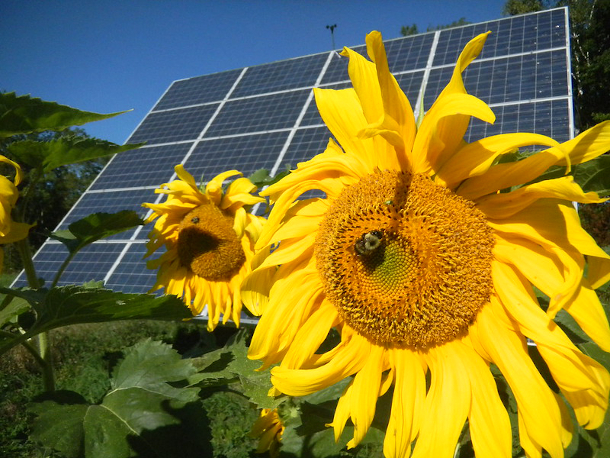
Photo: Sterling College, Flickr, CC BY-S.
Solar panels and sunflowers, the national flower of Ukraine. Solar energy and renewables can help keep oil tyrants from invading other countries.

One of the challenges Ukrainian allies have had in fighting back against Putin’s war is that so many of them have been dependent on Russian oil.

Bobby Bascomb at Public Radio International’s Living on Earth interviews environmentalist Bill McKibben on ways to get serious about renewables and free ourselves from the power of the fossil fuel industry.

“BOBBY BASCOMB: The horrors of Russia’s war in Ukraine are funded in large part by fossil fuels that it sells to the tune of half a billion dollars every day. Nearly half the federal budget for Russia comes from oil and gas revenue and the European Union is their biggest customer. … But the EU recently unveiled a plan to cut Russian gas imports by two-thirds this year and eliminate imports entirely by 2027.

“To help speed that phase out the Biden White House is reportedly considering a plan to use the Defense Production Act to rapidly manufacture and send electric heat pumps to European homes, many of which are currently heated by Russian gas. This idea to make Heat Pumps for Peace was first raised by writer and activist Bill McKibben, who co-founded 350.org and Third Act. … So first remind us, what exactly is a heat pump? …

“BILL MCKIBBEN: Think of it as an almost reversible air conditioner, made often by the same people. It takes ambient heat from the air, and uses that to heat the inside of your house, and does it pretty well, down to quite cold temperatures, because it turns out there remains some latent heat in the air even on a cold day. It’s wonderful technology because it’s able to produce heat with far, far less emissions than if you were running the gas furnace or the oil furnace in the basement. It runs off electricity, which means that the cleaner you get the grid, the cleaner the emissions result. And in the case of the current war in the Ukraine, it’s particularly significant because deployed in sufficient number across Europe, it would rob Vladimir Putin of his longtime weapon, the threat to turn off the gas supply to Western Europe. …

“What you really want, of course, is to connect them to a grid that gets steadily, steadily cleaner. … Not just in order to save the planet’s climate, though that would certainly be nice. But also because [fossil fuel] is the fuel of choice for autocrats.

“BASCOMB: Well, why push for heat pumps then and not say, expanded rooftop solar, for instance?

“MCKIBBEN: That works too, go to work on any of these things. In fact, some of the things are super easy. There’s a lot of spare capacity in the US, apparently, for producing insulation right now. And anybody who’s spent time say, in a British house knows that insulation was not a big feature of a lot of the housing stock. So let’s get bundles of that across the ocean as fast as we can. The point is that if we’re able to make use, say, of the Defense Production Act, which every president since the Korean War has used, and which both Trump and Biden used to speed up vaccine production, then we can take advantage of this spare capacity and get some of this stuff over to Europe before next October, when I would predict it’s going to start getting cold again. …

“BASCOMB: Well, how quickly can manufacturers ramp up production of heat pumps on the massive scale that would be needed to quickly phase Europe off of gas?

“MCKIBBEN: Well, the people that I’ve talked to in the federal government think that it can happen pretty fast, that there’s spare capacity at the big air conditioner manufacturers, companies like Carrier or Trane, that would allow them to start pretty quickly putting this stuff into operation — and that talking about the course of the next six months for getting a lot of these installed is not crazy. But again: heat pumps, insulation, whatever we can think of that help reduce the power of Vladimir Putin’s energy weapon. …

“BASCOMB: I looked into getting heat pumps in my house here in New Hampshire a couple years ago; we put up solar panels at the time and considered heat pumps to go along with them. But it was basically going to double the cost of our solar installation. What kinds of policies can be put in place to help bring down those costs, so they’re more affordable for many Americans?

“MCKIBBEN: Well, first of all, this is precisely, you know, one of the advantages of getting the government involved quickly in doing this. Once you start building things en masse, you get better at it, and they get cheaper, and more and more people know how to install them. And that’s already happening. You know, we have them installed here in [Vermont]. The local contractors are increasingly conversant with the technology. But that needs, as you say, to spread out fast. … There’s no way that we’re going to do what the IPCC has asked and cut emissions in half by 2030 if everybody’s still got a gas furnace blazing away in the basement.

“BASCOMB: Well, heat pumps are basically air conditioning systems in reverse, as you mentioned earlier, so they provide heat in the winter, and they cool homes in the summer. Around 5% of European homes currently have air conditioning. So to what extent can heat pumps [have] the added benefit of helping Europe prepare for the extreme heat waves that are going to be coming with climate change? …

“MCKIBBEN: A very significant point. It’s not just Europe, either. I mean, the demand for air conditioning is going to grow exponentially as this century goes on. And it’s going to grow most in the hottest and poorest places. Countries like India are forecast a huge growth in air conditioner usage. … Efficient, good technology like this is desperately needed around the world.”

More at Living on Earth, here. No firewall.

Read Full Post »