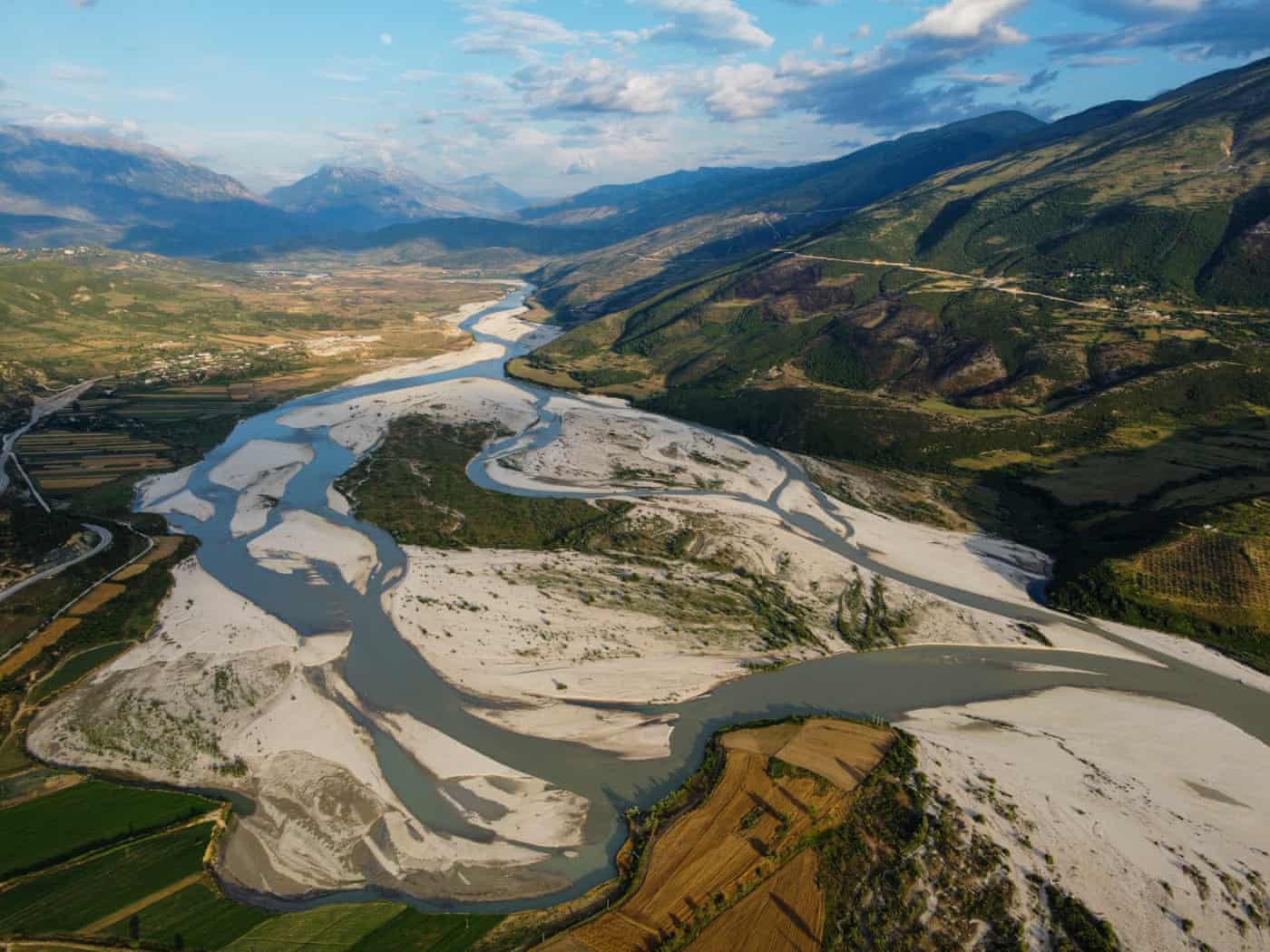
Photo: Nick St Oegger/The Guardian.
The Vjosa River near Qesarat, southern Albania. The river and its three main tributaries in the country have been declared a national park.
In the 1980s, when I was active in the Esperanto movement, I managed the New England group’s post office box. One day I took out a letter on flimsy paper with a Tirana postmark. Tirana is the capital of Albania. The Berlin Wall had yet to fall, and Albania was still firmly behind the Iron Curtain. I felt like I had received a message from the other side of the moon.
Nowadays Albania is not so different from the rest of Europe, and today’s story is about its participation in European efforts to save wild rivers.
Karen McVeigh writes at the Guardian, “One of the last wild rivers in Europe, home to more than 1,000 animal and plant species, has been declared a national park by the Albanian government, making the Vjosa the first of its kind on the continent.
“The Vjosa River flows 168 miles (270kms) from the Pindus mountains in Greece through narrow canyons, plains and forests in Albania to the Adriatic coast. Free from dams or other artificial barriers, it is rich in aquatic species and supports myriad wildlife, including otters, the endangered Egyptian vulture and the critically endangered Balkan lynx, of which only 15 are estimated to remain in Albania.
“For years, the Vjosa’s fragile ecosystem has been under threat: at one point as many as 45 hydropower plants were planned across the region.
“But [in March], after an almost decade-long campaign by environmental NGOs, Vjosa was declared the first wild river national park in Europe. Environmentalists described it as a historic decision that has placed the tiny Balkan nation at the forefront of river protection.
“Albania’s prime minister, Edi Rama … described the creation of the national park as a ‘truly historic moment’ for nature as well as social and economic development. ‘Today we protect once and for all the only wild river in Europe,’ he said. ‘This is about to change a mindset. Protecting an area does not mean that you enshrine it in isolation from the economy.’ …
Mirela Kumbaro Furxhi, Albania’s tourism and environment minister, said the creation of the park was part of the country’s evolution and continuing emancipation three decades on from communist rule. …
“She said, ‘Maybe Albania does not have the power to change the world, but it can create successful models of protecting biodiversity and natural assets, and we are proud to announce the creation of this first national park on one of the last wild rivers in Europe.’ …
“A collaboration between the Albanian government, international experts, NGOs from the Save the Blue Heart of Europe campaign to protect Balkan rivers, the International Union for Conservation of Nature (IUCN) and Patagonia, the outdoor clothing company and environmental organization, the 12,727 hectare (31,500 acre) park aims to ensure the Vjosa and its unique ecosystems are safeguarded. It has been given IUCN category II park status, a high level of protection similar to that of a wilderness. The categorisation covers ‘large-scale ecological processes,’ species and ecosystems, crucial to ensuring dams and gravel extraction are banned. It is expected to be operational in 2024.
“Boris Erg, director of the European office at IUCN, paid tribute to the government of Albania for its leadership and ambition. ‘Today marks a milestone for the people and biodiversity of Albania,’ he said. ‘We invite other governments in the region and beyond to show similar ambition and help reach the vital goal of protecting 30% of the planet by 2030.‘ …
“The Albanian government is starting a joint process with the Greek authorities to create the Aoos-Vjosa transboundary park, aiming to protect the entire river across both countries, who agreed in January to sign a memorandum of understanding specifying the next actions.
“Europe has the most obstructed river landscape in the world, with barriers such as dams, weirs and fords, estimated to number more than a million, according to a 2020 EU study in 28 countries. Such fragmenting of rivers affects their ability to support life.
“Ulrich Eichelmann, a conservationist and founder of Riverwatch and part of the Save the Blue Heart of Europe campaign, said: ‘Most people in central Europe have never ever seen a wild, living river, free from the impacts of human interference, that isn’t diverted or dammed or built up with embankments and where biodiversity is low as a result. But here, you have a wild river, full of complexity and without interference.’ …
“Ryan Gellert, Patagonia’s CEO, said the collaboration proved the power of collective action. ‘We hope it will inspire others to come together to protect the wild places we have left, in a meaningful way,’ he said, adding that the park was proof that the ‘destruction of nature did not have to be the price of progress.’ “
Man, I love Patagonia. Did you know the company takes no Chinese cotton from Uighur slave labor? I bought the most luxurious cotton towels at Patagonia, guilt free.
More at the Guardian, here. No firewall.


 Suzanne's Mom's Blog