Feeds:
Posts
Comments

Posts Tagged ‘alps’

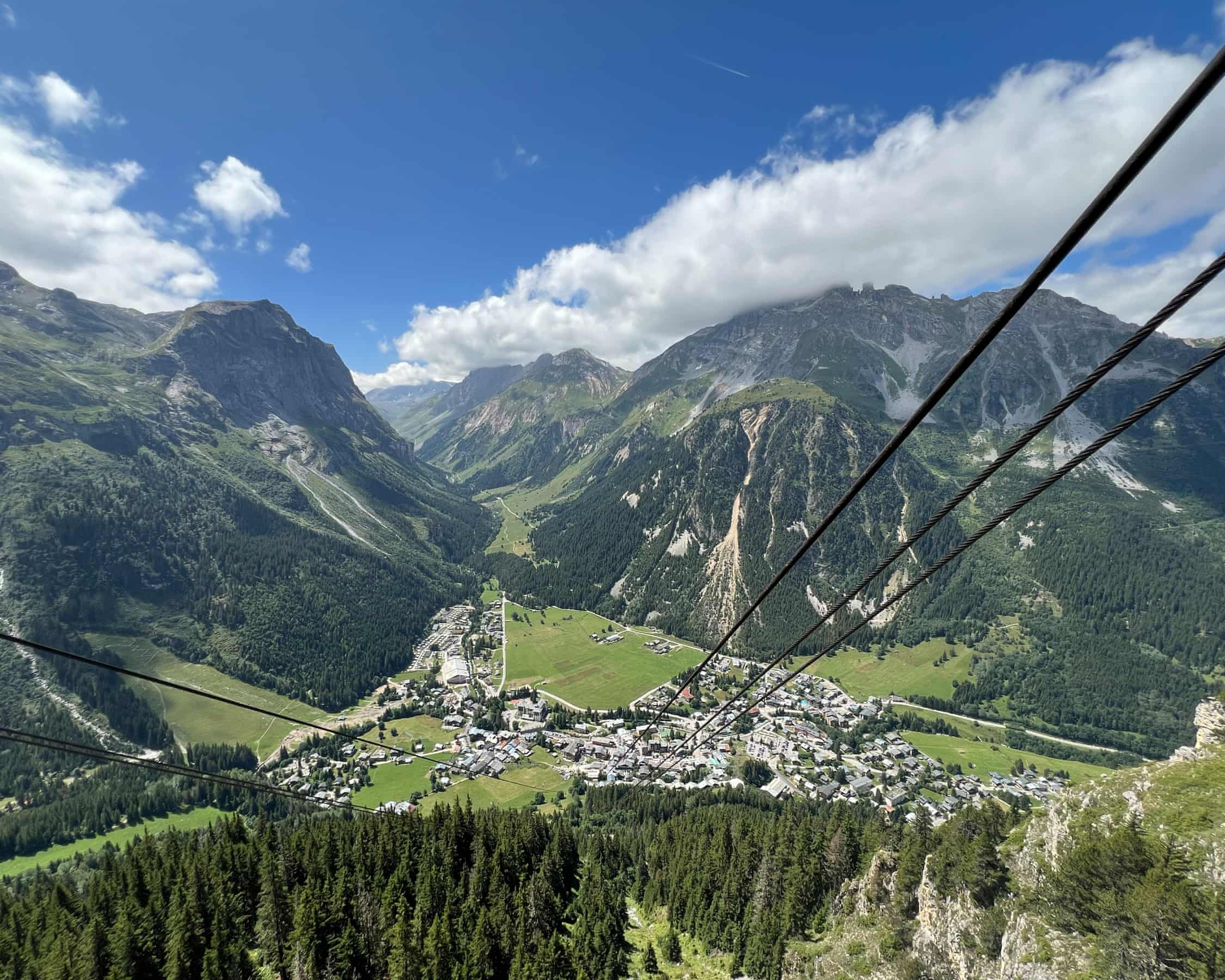
Photo: Kim Willsher/The Guardian.
Pralognan-la-Vanoise in the French Alps is in danger from global warming. An engineering operation to prevent catastrophic flooding will cost about €400,000 ($465,000). 

As discouraging as it is to read another story about global warming, one has to feel a little hopeful that human ingenuity keeps tackling its effects.

Kim Willsher reports at the Guardian about how engineering is fighting back in France. I leave it to you to decide whether putting humans first or the glacier first would be best.

The villagers of Pralognan-la-Vanoise in the French Alps know well the perils posed by the mountains that encircle them. Avalanches, rockfalls, mudslides, sudden crevices and torrents of water are within the living memory of most villagers, and every day the climate emergency throws up new dangers.

“Less than a year ago, an enormous lake formed by a melting glacier was discovered high above Pralognan that experts feared could inundate the village with more than 60,000 cubic metres [15,850,000+ gallons] of icy water. …

“As used to natural hazards as local people are high up in the Alps, they are not, however, an idle threat. The Swiss village of Blatten was wiped out by a rock and ice avalanche in May and last year a mountain lake swollen by heavy rainfall caused torrential flooding in La Bérarde in the Isère, forcing inhabitants to flee the hamlet. They have not returned.

“Today, an engineering operation is under way to prevent such a catastrophic scenario in Pralognan. Three workers have been helicoptered to the Grand Marchet glacier at an altitude of 2,900 metres [1.8 miles] to gouge a [narrow] ‘overflow channel’ in the ice. …

“ ‘The aim is to help the water find its way down the mountain gradually and avoid a rapid emptying of the lake,’ said David Binet, the director of the mountain land restoration service (RTM) for the northern Alps, part of the national forestry commission tasked with identifying and preventing natural hazards.

“ ‘What causes the problems and damage with torrents in the mountains is not the water but the stones, gravel, sand and even large rocks it brings down with it.’

“The glacier blocks the lake from spilling down the mountain but it is shrinking at a rate of 2 to 3 metres [6.6 to 9.8 feet] a year. There is also the risk that that the warmer waters of the lake could form a channel gush from underneath.

“Binet said his agency was examining 300 of the estimated 600 lakes in the Alps and Pyrenees one by one for such hazards. The Pralognan operation will cost about €400,000 [$465,000)]. …

“The idea of taking mechanical shovels to glaciers already shrinking at an alarming rate was deemed the least environmentally damaging option. Olivier Gagliardini, a glacier expert at Grenoble University, described it as ‘unfortunate, but necessary.’

“Martine Blanc, the mayor of Pralognan, said … ‘We asked ourselves could it wait but on the principle that prevention is better than cure we decided to go ahead,’ she said. ‘We decided to anticipate events rather than suffer them. Nature is nature and there’s no such thing as zero risk.’ …

“Local shopkeepers say the number of tourists and hikers this summer is down, possibly because the campsite is closed, but Silvere Bonnet, the director of the tourist office, said he had had very few calls from potential visitors concerned about the lake. …

“On a sunny day, the giant rock faces etched with shimmering cascades that rise almost vertically have a benevolent beauty. An hour later in a rapid change of atmosphere, the peaks are cloaked in dark clouds and loom intimidatingly.

“ ‘They can appear rather menacing at first to visitors because they are so sheer,’ [Bernard Vion, a 66-year-old Alpine guide who has watched the expanse of water grow and the mountain change over his lifetime] said. The 66-year-old knows these mountains ‘like his pocket,’ as the French say. He made his first high-altitude climb aged eight with his father, also a guide. Both his grandfathers were Alpinists.

“Vion first spotted what he describes as ‘a puddle’ of water on the Grand Marchet glacier in 2019. Every year since he has watched it grow; it now measures almost 2.5 acres. …

“ ‘We are on the frontline of climate change here. We know it is happening,’ he said.

“Blanc agreed. … ‘People here are used to natural hazards. We’re used to avalanches, falling rocks, torrential floods and mudslides because we’ve seen them and lived with them since we were young. Local people understand there are things we can control and then those we cannot.’ ”

More at the Guardian, here.

Read Full Post »

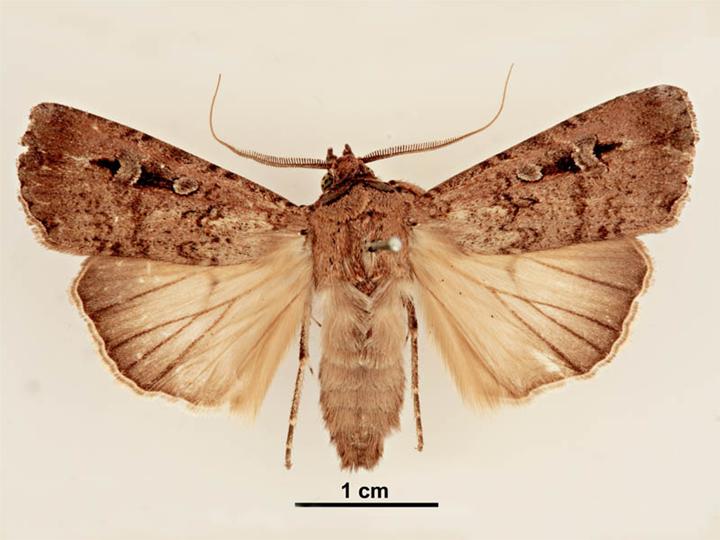
Photo: Lucinda Gibson and Ken Walker/Museum Victoria.
The endangered bogong moth can travel great distances to a place it has never been to before. It uses the stars to navigate.

Some of the least prepossessing critters in nature often have interesting attributes that could teach us a lot if we pay attention.

Ari Daniel reports at National Public Radio (NPR), “The Bogong moths of Australia aren’t much to look at, says Andrea Adden, a neurobiologist at the Francis Crick Institute. ‘They’re small brown moths with arrow-like markings on the wings. They’re pretty nondescript.’

“But these insects undertake an epic migration twice in their lifetime, traveling hundreds of miles in each direction.

“Researchers have shown that the Earth’s magnetic field helps the moths orient, but that alone wasn’t sufficient. ‘They needed something visual to go with it,’ says Adden.

“She wanted to know what that cue might be over such a vast landscape — especially at night when there’s little light.

“In a paper published in the journal Nature, Adden and her colleagues show that the cue comes from the heavens. That is, the starry sky allows the Bogong moths to both orient and navigate.

“Bogong moths follow an annual rhythm. They hatch in their breeding grounds in the spring in southeast Australia where it gets really hot in the summertime. ‘So if they were to reproduce immediately, their larvae would starve because there is not enough food,’ says Adden.

“Instead, the moths migrate over multiple nights more than 600 miles south to the Australian Alps where they settle in cooler caves, entering into a dormant phase called estivation (like hibernation but in the summer), by the millions. …

“In the fall, they return to their breeding grounds, mate, lay their eggs, and die.

” ‘Then the next year, the new moths hatch,’ says Adden. ‘And they’ve never been to the mountains. They have no parents who can tell them how to get there.’ And yet they make it.

“She suspected the stars might offer just the cue they need. To test her theory, Adden, who was doing her Ph.D. at Lund University in Sweden at the time, and her colleagues caught moths in the Australian Alps and ran them through one of two experiments in the dead of night.

“The first was a behavioral test. It involved placing a moth inside what was basically a mini-planetarium that contained a projection of the night sky and no magnetic field. … The result surprised the researchers.

” ‘They didn’t just circle and do twists and turns, but they actually chose a fairly stable direction,’ she said. ‘Not only that, it was their migratory direction.’ In other words, the moths were using the starry sky as a compass cue to orient and navigate.

“Adden’s next question involved what was happening in the moth’s brain. She recorded the electrical activity of individual neurons while rotating a projection of the Milky Way.

“When she looked in the brain regions that process visual information, the majority of neurons were active when the moth was facing south. This specific direction suggests that the moths’ brains encode direction by processing visual cues of the Milky Way. …

“The moths’ ability to use both visual and magnetic information to navigate can be essential for survival — in case it’s cloudy, say, or the magnetic field is unreliable. ‘If one fails, they have a backup system,’ says [biologist Pauline Fleischmann at the University of Oldenburg].

“The Bogong moths are endangered. Adden says her findings could help conserve these insects — and everything that relies on them for food.”

More at NPR, here.

Read Full Post »

Who knew the Swiss were so jolly? The headline said they celebrated the opening of the world’s longest, deepest tunnel with alphorns and modern dance. I pictured Thorin Oakenshield joining a conga line.

Here’s what Camila Domonoske had to say at Rhode Island Public Radio/NPR.

“Swiss engineer Carl Eduard Gruner first imagined it in 1947: a massive tunnel, unprecedented in length, buried a mile and a half under Switzerland’s symbolic Gotthard mountain range.

“Nearly seven decades later, after redesigns, political disagreements and the long, slow work of drilling beneath the Gotthard massif, as it’s called, Gruner’s dream is complete.”

We pause here to remember John as Grumpy in Snow White singing, “We dig dig dig dig dig dig dig in our mine the whole day through …”

Back to Domonoske: “The Gotthard Base Tunnel — a record-setting 35.4 miles long, and farther below ground than any other tunnel — was inaugurated [June 1]. The occasion was marked with a celebration that promoted ‘Swiss values such as innovation, precision and reliability,’ as the tunnel’s website puts it.

“The $12 billion project was completed on time, The Associated Press notes.

“The most eye-catching part of Wednesday’s ceremony was an extended modern dance sequence — featuring stony-faced dancers dressed in orange construction gear and boots, dancing on and around a flatcar.

“Another sequence featured dancers in white briefs and one figure with wings and an oversize head, while yet another sequence had people covered in suits resembling a cross between a pompom and a hay bale. …

“The inauguration of the tunnel also featured alphorns, an interfaith blessing of the tunnel and a tunnel theme song. Leaders from across the EU — including German Chancellor Angela Merkel, French President Francois Hollande and Italian Prime Minister Matteo Renzi, according to the AP — were in attendance.” More here.

So, I’m looking at this picture and realizing the Swiss aren’t so jolly after all. But then again, Thorin Oakenshield was about as jolly as Grumpy. But I’m sure they would both have liked the deepest. longest tunnel.

Photo: Peter Klaunzer/AFP/Getty Images

Artists perform in Erstfeld, Switzerland, at the opening of the Gotthard rail tunnel. The show was directed by German director Volker Hesse.

Read Full Post »