Photo: Snowiology
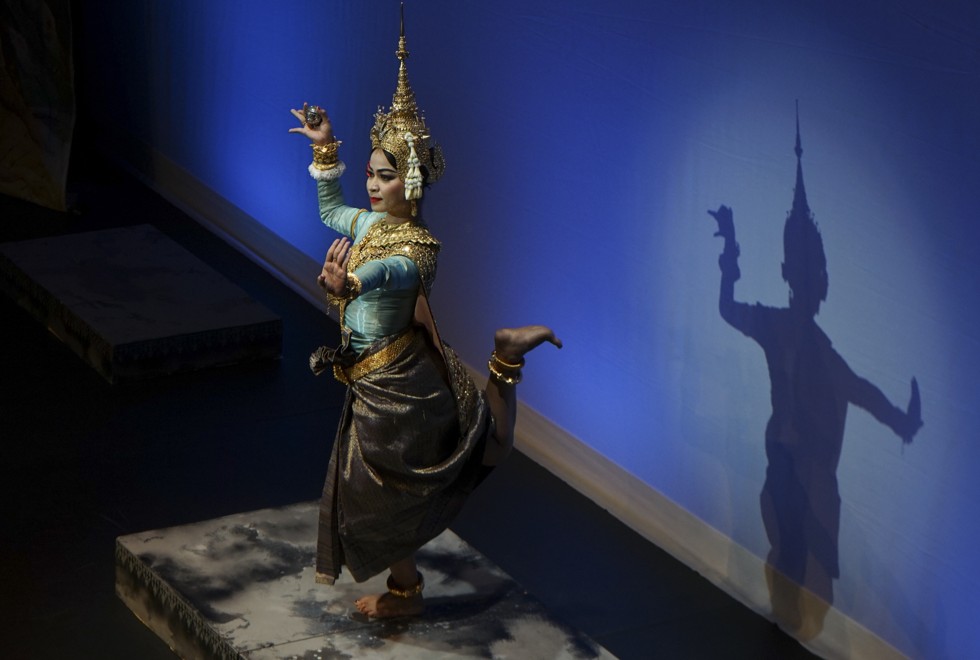
Princess Norodom Buppha Devi, half-sister of Cambodia’s King, has worked hard to reenergize the Royal Ballet of Cambodia, seen here at the Hong Kong Cultural Centre.
Cambodia went through dark years under Pol Pot, when like thousands of citizens, the arts were exterminated. Now a member of the royal family is putting her heart and soul into reviving the ballet. (“Cambodia is a constitutional monarchy, i.e. the King reigns but does not rule,” Wikipedia explains.)
In the process, Princess Norodom Buppha Devi is reliving memories of her own time in the Royal Ballet.
For Post Magazine, Kate Whitehead interviewed both the princess and the dancer pictured above.
“Chap Chamroeuntola is alone on stage. Dressed in a long pleated skirt and tight-fitting tunic, the 29-year-old stands on her left leg, eyes downcast. Her right foot is flexed, the sole facing the ceiling, and her wrists and ankles are strung with gold bangles. Despite the challenging pose and a towering gilt headdress, she is completely still. As the music rises to a crescendo she remains motionless. Then her eyes, heavily ringed in kohl, dart up and she looks directly at the 74-year-old woman wrapped in a pink shawl sitting in the third row.
“Princess Norodom Buppha Devi, half-sister of Cambodia’s King Norodom Sihamoni, does not take her eyes off the dancer. No one in the packed Studio Theatre does. Slowly, Chap Chamroeuntola lowers her leg and turns, her arms held high, her fingers flexed against the joints. She moves as if in a trance and when six dancers join her on stage they, too, move as though under a spell. [Thus the] Royal Ballet of Cambodia made its Hong Kong debut. …
“Chap Chamroeuntola disliked the early years of her training and the hour each morning spent bending her fingers back into the hyperextended position that is typical of classical Cambodian ballet. …
“It takes nine years to learn the movements and the dances, she says. During that time she studied the history of classical ballet and fell in love with the art.
“ ‘The more I learned about the history, the more I got into it,’ she says. ‘I want to keep doing this to help my country, I will do everything I can to protect the classical dance.’
“If the dancers’ costumes and poses seem familiar to those who have not seen a performance by the Royal Ballet of Cambodia, the stone carvings at Angkor Wat might be the reason why. Its bas-reliefs show apsaras – celestial dancers – in all their gilded finery, dancing for the gods. And it’s at the ancient temple complex that the Royal Ballet of Cambodia originated – dance, drama and music performed as ritual offerings for the gods. …
“This explains why Chap Chamroeuntola and the other dancers appear to move in a trance-like state; they are praying. …
“ ‘I started dancing when I was five,’ says the princess, speaking through an interpreter. ‘My grandmother, Queen Kossamak, trained me. She was a very good choreographer. When I was six I joined the ballet.’ …
” ‘Everything was destroyed by the Khmer Rouge, it was the hardest time for us,’ says the princess, who serves as choreographer, teacher and mentor for the dancers of the Royal Ballet of Cambodia. …
“ ‘When there was peace, I went looking for the dancers,’ says the princess. ‘Many of them had gone [into exile] in Thailand and came back. I found some and we made a troupe and I set up a school.’ ” More at the Post Magazine, here.

 Suzanne's Mom's Blog