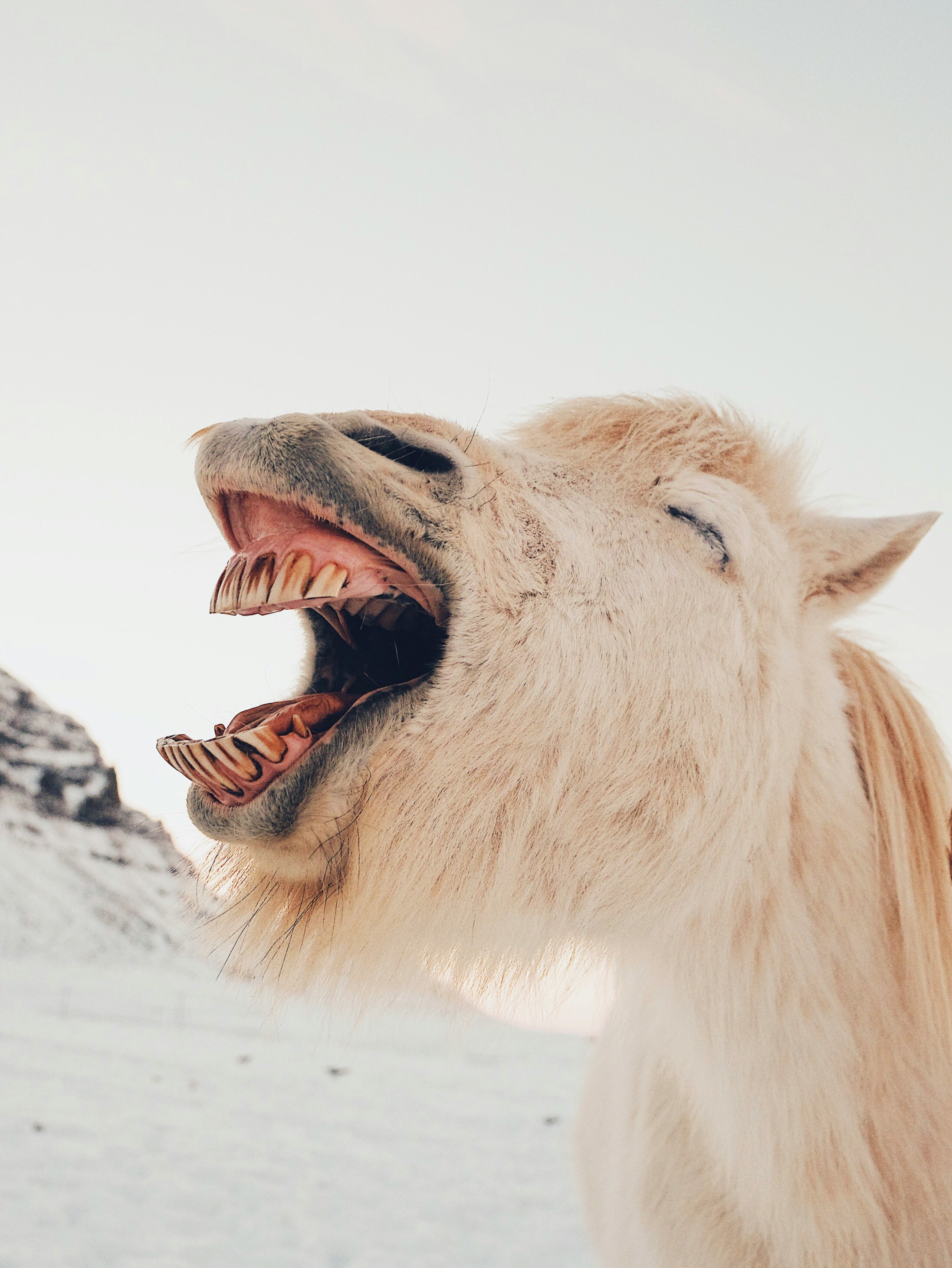
Photo: Dan Cook via Unsplash.
Is the horse really laughing or is something else going on?
I was visiting Suzanne’s family recently and at breakfast one morning, my younger granddaughter started reading The Week Junior stories out loud. She got me interested in an article about scientists researching animal joy. The information was originally reported in Science News.
It turns out that although we often ascribe our own emotions to animals, we may not be on the right track.
Amber Dance writes at Science News, “For decades, scientists have struggled to identify or measure true joy — or ‘positive affect,’ in sci-speak — in nonhuman animals, even though they’ve long assumed it exists. In the late 19th century, Charles Darwin wrote, ‘The lower animals, like man, manifestly feel pleasure and pain, happiness, and misery.’
“But in the 20th century, psychologists focused on strict behaviorism, which limited scientific study to actions that could be objectively tallied. Think Russian physiologist Ivan Pavlov and the dogs he conditioned to expect food when he rang a bell, giving him a measurable drooling response. Or American psychologist B.F. Skinner, who put rats and pigeons in Skinner boxes where they were trained to push levers and peck keys for rewards. That history left scientists wary of anthropomorphism and subjective topics like feelings.
“That’s true for positive feelings, at least — there has been loads of scientific attention on misery. In part, that’s because researchers aimed to understand and relieve suffering, not just in animals but in people experiencing pain, depression or other clinical problems. It’s also straightforward to measure a negative response, such as freezing in fear, compared to subtler signs of contentment.
“All this history made the study of animal feelings largely taboo, a trend bucked on occasion by researchers like the late Jaak Panksepp, an Estonian neuroscientist and early leader in the study of emotions in the brain. In the early 2000s, when Panksepp reported that rats make a laughter-like sound when tickled, scientists were doubtful; the ultrasonic calls are inaudible to human ears.
” ‘He had problems publishing it at all because people thought it was crazy,’ says Michael Brecht, a neurobiologist at Humboldt University of Berlin. Skeptical but curious, Brecht did research that found rats not just laughing, but also jumping for joy and playing hide-and-seek.
“If scientists had better tools to measure positive emotions they’d be equipped to more deeply investigate the causes of happiness and how animals communicate it, with major implications for mental health among captive animals.
“This need has inspired an audacious group effort to try to develop a ‘joy-o-meter’ — or more likely, a set of happiness metrics — that could be used to better understand many critters, whether they are wild or captive, whether they walk, fly or swim. …
” ‘Studying emotions is actually really hard,’ says Colin Allen, a project lead and philosopher at the University of California, Santa Barbara who collaborates with Cartmill.
“To keep it simple, Allen and his colleagues have focused on a strict definition of joy as an intense, brief, positive emotion triggered by some event, such as encountering a favorite food or a reunion with a friend. That kind of ‘woohoo!’ moment seemed easier to assess than, say, ongoing mild contentment. Even with a strict definition, the researchers are contending with variations in joy triggers and responses from one animal to the next, including within the same species or group.
“ ‘You want to make sure that what you’re putting out there is based on reality, as opposed to just guessing what is happening in the animal’s mind,’ says Heidi Lyn, a comparative psychologist at the University of South Alabama in Mobile who is a co-leader of the project and is in charge of the dolphin studies as well as some of the ape work.
“These efforts by Lyn and colleagues are important, says Gordon M. Burghardt, a biopsychologist and emeritus professor at the University of Tennessee, Knoxville. He is not involved in the joy project, but has studied animal play for more than 40 years. In that work, Burghardt says, coming up with a definition with five criteria in 2004 made it possible to identify play in diverse creatures including mammals, birds, lizards, turtles, fish, octopuses and bumblebees. …
“The team began the work in apes because its funder, the Templeton World Charity Foundation, thought the odds of success were best in humankind’s closest relatives. Bonobos are known for playful behavior, including frequent sex acts they use to create social bonds and resolve conflicts. Chimpanzees are considered more violent, though scientists have observed what are likely happy times in chimp troops. Cartmill’s and Lyn’s groups led the way, starting in 2022 with wild chimps at the Fongoli Savanna Chimpanzee Project in Senegal; zoo bonobos at ZOO Planckendael in Mechelen, Belgium; research bonobos at the Ape Initiative in Des Moines; and bonobos at the Jacksonville Zoo and Gardens in Florida.
“Wild chimps don’t have easy lives, says team primatologist Gal Badihi, who spent three months following a troop around Fongoli. They contend with dominance hierarchies, competitions and the ongoing search for food. Nonetheless, Badihi recorded potentially joyful moments. For example, chimps played with infants. A juvenile called Youssa proved to be quite the goofball, hanging upside down all the time. Other young chimps liked to drink from each other’s mouths or roll around giggling. When reuniting with their fellows, chimps would embrace and kiss. ‘The joyous moments kind of stick out because they are quite rare,’ says Badihi.
“She’s currently focusing her analysis on a panting sound like unvoiced laughter that chimps often made during those apparently positive or social behaviors, as well as during situations where they wanted to communicate positive intent or de-escalate conflict. ‘It’s really similar to how we use laughter and smiles across social context as people,’ Badhi says.”
Lots more at Science News, here.


 Suzanne's Mom's Blog