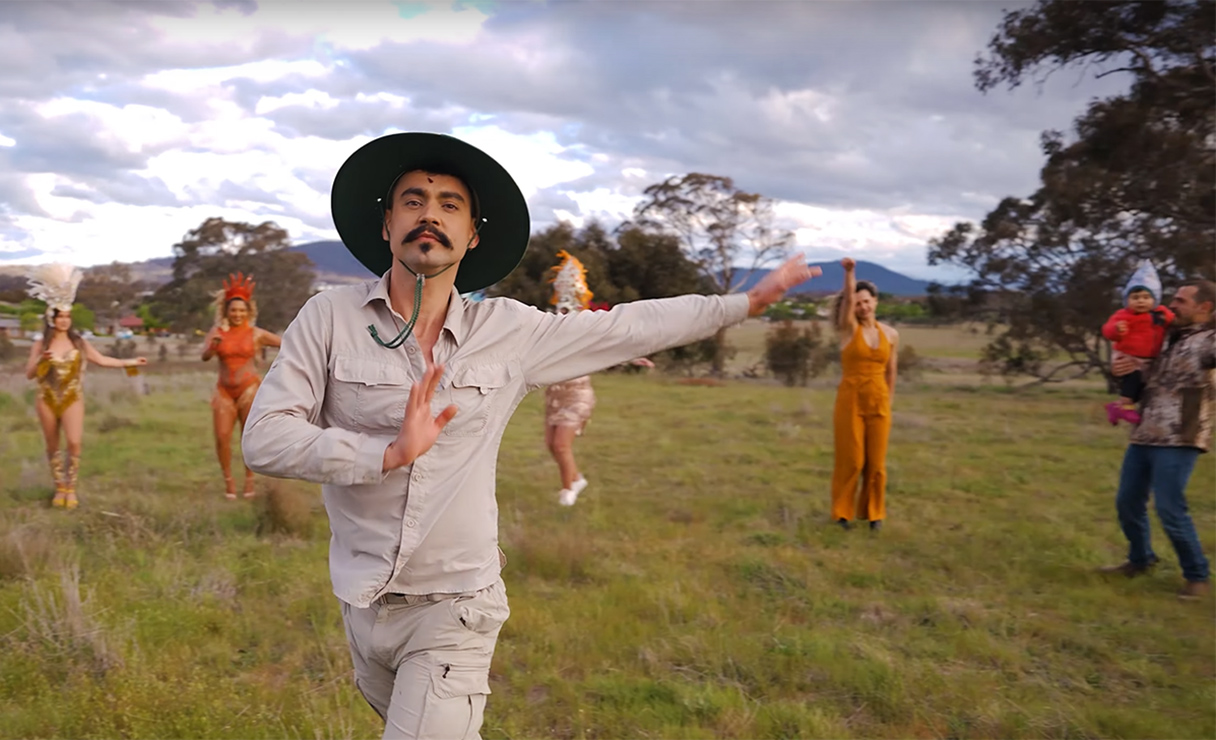
Photo: Weliton Menário Costa via Science.
Says Science magazine: “In his winning ‘Dance Your Ph.D.’ video, Weliton Menário Costa shifts his dance style to match other dancers, mimicking how kangaroos adapt their personalities to fit the group.”
This is a story about Science magazine’s annual “Dance Your PhD” competition. The winning video replicates something a researcher studied — kangaroo behavior. Runners up included dances about stream-bank erosion and moth mating.
Sean Cummings writes at Science, “In a broad grassland beneath an Australian sunset, dancers in everything from fishnets to field attire let loose an unchoreographed mishmash of steps, leaps, twirls, and twerks. There’s no unified style to the movement, but the resulting video — this year’s winner of Science’s annual ‘Dance Your Ph.D.’ contest — carries meaning nonetheless in its joyful madness. To Weliton Menário Costa, its creator, this dance mirrors the one between individuality and conformity in kangaroos — and celebrates the value of diversity in all species.
“Menário Costa, who was awarded $2750 in the annual contest now sponsored by the quantum technology-artificial intelligence (AI) company SandboxAQ, earned his ecology Ph.D. in 2021 at the Australian National University, studying eastern gray kangaroos (Macropus giganteus) living at Wilsons Promontory National Park. Even as joeys, he found, individual kangaroos seemed to have distinct personalities. Bolder animals, for instance, would approach a remote-controlled model car driven near them whereas others shied away. These personalities aren’t set in stone, however: The marsupials modify their behavior to conform with those around them, adjusting as they move between groups.
“Menário Costa, who has since transitioned from science into a career as a singer-songwriter under the name WELI, recorded an original song, Kangaroo Time, for the contest. He then recruited a score of dancer friends representing styles from urban to classical, ballet to Brazilian funk. ‘I wanted to showcase the diversity of kangaroo behavior, and the easiest way was to get the diversity of dance we already have. I didn’t choreograph them, they were just being themselves,’ Menário Costa says. The only instruction?
Do as the ’roos do. In other words, mingle with dancers of other styles and adjust your movements in response, gradually unifying into a group effort.
“The result resonated with a judging panel of artists, dancers, and scientists. ‘There was a sense of surprise and delight in it. You could tell they were having fun through the process’ … says judge Alexa Meade, a visual artist who uses optical illusions in her work. She also praised the video’s original songwriting and costumes, as well as the simplicity and accessibility with which it explained the science relating to kangaroo group dynamics.
“Besides finding a whimsical way to teach viewers about kangaroos, Menário Costa hopes to convey the message that diversity — in all its forms — should be celebrated. ‘Kangaroos are different, just like us,’ he says. ‘Differences happen in all species—.’ …
“The project also provided a way for Menário Costa to translate his academic experiences into an accessible form for friends and family in his small Brazilian hometown. Many of them didn’t fully understand what he was doing in Australia, he says — including his grandmother. ‘Once I released Kangaroo Time, she was like, “That’s my grandson! I get it now!” says Menário Costa, who [planned] to release his first EP, Yours Academically, Dr. WELI, at the beginning of March. …
“ ‘This year’s entries did a great job of incorporating art and science to [create something] greater than the sum of their parts,’ Meade says. In the past, she explains, ‘some entries have incredible research but the dance component feels like an afterthought, or we might get some incredible dance performance, but I’m not sure what it has to do with science. It has to be a blending that accentuates both.’ The entries were so strong, the judges noted, that the second-ranked dance in the social science category might have won the whole thing if not up against the kangaroos.” Click on that one: It’s pretty funny.
You can make a dance about anything — as I learned when I was 14 and had to choreograph a dance about oxygen in combustion. You couldn’t just show Antoine Lavoisier mixing chemicals but had to somehow replicate the chemicals themselves!
More at Science, here. Hat tip: ArtsJournal.com.

 Suzanne's Mom's Blog