Feeds:
Posts
Comments

Posts Tagged ‘argentina’

Photo: Robles Casas & Campos.
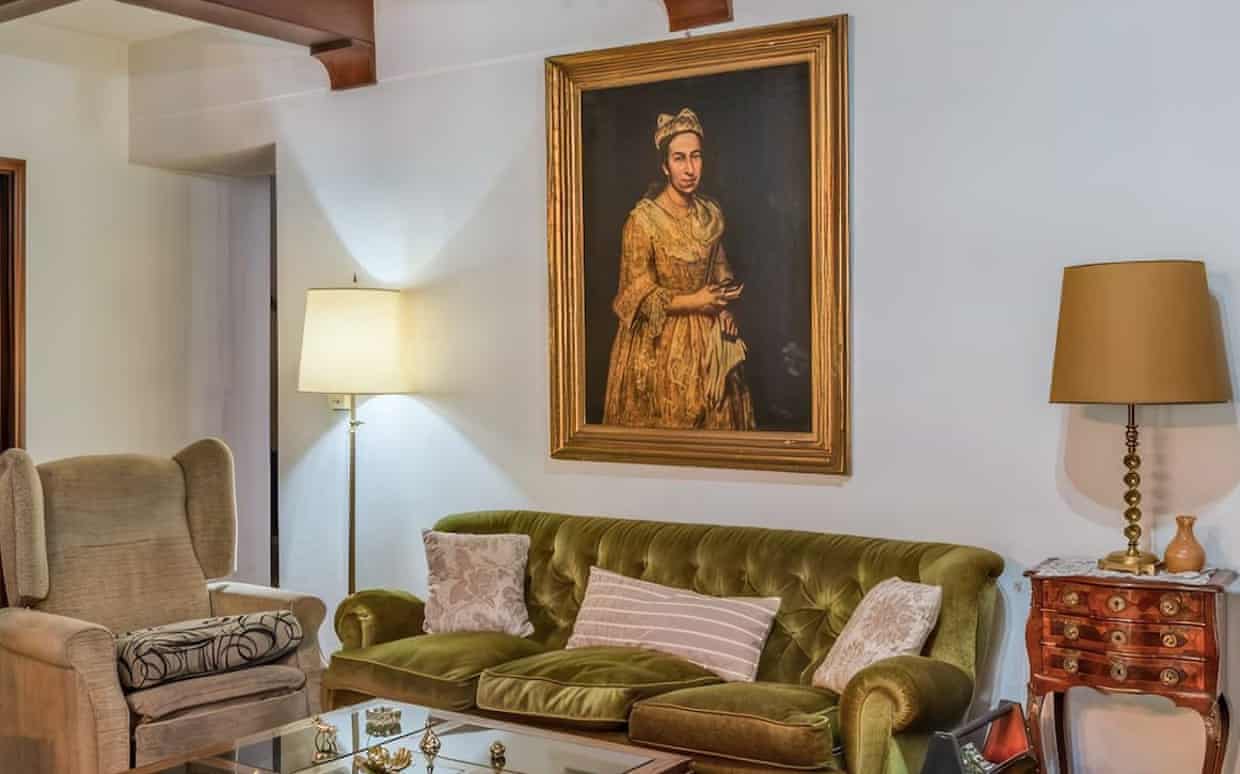
The painting by Italian artist Giuseppe Ghislandi in a living room in Mar del Plata. The 18th-century painting ‘Portrait of a Lady’ (Contessa Colleoni) was stolen by an SS officer and rediscovered this year in Argentina.

Guilty secrets don’t stay hidden forever. It may take a long time, as in today’s story about Nazi loot, but more often than not, truth eventually surfaces.

Facundo Iglesia  and Jon Henley write at the Guardian, “There was nothing very remarkable about the middle-aged couple who lived in the low, stone-clad villa on calle Padre Cardiel, a quiet residential street in the leafy Parque Luro district of Argentina’s best-known seaside town, Mar del Plata.

“Patricia Kadgien, 59, was born in Buenos Aires, five hours to the north. Her social media described her as a yoga teacher and practitioner of biodecoding, an obscure alternative therapy that claims to cure illness by resolving past traumas.

“Her husband, Juan Carlos Cortegoso, 61, built and raced go-karts. Like many in this neighborhood, the couple were comfortably off, and discreet. …

“Then, last month, they put their house up for sale. A photographer from a local estate agent, Robles Casas y Campos, came round to shoot the spacious, elegantly furnished interiors. The pictures went up. And their quiet existence came crashing down.

“The fifth photograph on the agency’s listing showed a general view of the villa’s living room. Hanging on the wall, above a buttoned sofa in plush green velvet and next to a polished antique commode, was a highly distinctive oil painting of a woman.

“More than [6,000 miles] away, the Dutch news outlet AD had, for several years, been quietly investigating the fate of old master paintings looted by the Nazis and still listed by the Dutch culture ministry as ‘unreturned‘ after the second world war.

“Journalists had made several attempts to speak to Patricia Kadgien, the owner of the property, and to her elder sister, Alicia, the daughters of a high-ranking Nazi official Friedrich Kadgien, who was known to have settled in Argentina after the war.

“Their calls and messages had consistently gone unanswered, or been rebuffed. But then a Dutch reporter based in Buenos Aires, Peter Schouten, went knocking on the door of the villa – and spotted a ‘for sale’ sign.

“What followed, after Schouten and his colleagues in Rotterdam clicked on the link to the property and instantly recognized the work, made headlines around the world as the story unfolded of the unlikely recovery of an 18th-century portrait missing for 80 years. …

“After the media reports of the work’s likely location, and before a police search, the couple had tried to obstruct the investigation, the prosecutor argued, by taking down the online property listing and for sale sign and replacing the portrait with a tapestry.

“Despite knowing they were under investigation, it was alleged that the defendants had also attempted a civil action claiming the painting was rightfully theirs, turning it over only after they were placed under house arrest and facing further police raids.

“Through their lawyer, Kadgien and Cortegoso have denied concealment, saying they had always been willing to hand over the painting, and obstruction, arguing that their civil action was aimed at establishing ownership and not at hiding the artwork. …

” ‘Portrait of a Lady’ belonged to Jacques Goudstikker, a Jewish-Dutch art dealer who fled Amsterdam in mid-May 1940 to escape the Nazis, but died after falling through an open hatch into the hold of the SS Bodegraven, the ship carrying him to the UK.

“Goudstikker carried with him a notebook detailing his collection of more than 1,100 artworks, including pieces by Rubens, Giotto, Titian, Rembrandt and Van Gogh, all of which were snapped up for a fraction of their value by Nazi officials.

“Some were later recovered and displayed as part of the Dutch national collection in the Rijksmuseum, before 202 works were restored to the dealer’s sole heir, his daughter-in-law, Marei von Saher, in 2006. ‘Portrait of a Lady’ was not among them. …

“Born in 1907, Kadgien joined the Nazi party in 1932 and the SS in 1935. By 1938, he was a special representative working for Göring on the four-year economic plan drawn up by Adolf Hitler to rearm Germany and prepare it for self-sufficiency by 1940. …

“Kadgien ‘confiscated a large amount of property from Jewish merchants, including jewelry and diamonds in Amsterdam, and oversaw the sale of expropriated shares and securities through banks and front companies in Switzerland’ [federal prosecutor Carlos Martínez] said.

“He fled to Zurich early in 1945, then to nearby Baden, where in 1948 he set up a successful finance and trading firm, Imhauka. With pressure growing after questioning by Swiss and US investigators, Kadgien left for South America in 1949. …

“Kadgien resurfaced in Rio de Janeiro in 1951, settling in the Santa Teresa district and establishing a Brazilian branch of Imhauka. … Imhauka secured valuable contracts with Juan Perón’s government, including acting as an intermediary for major German engineering firms such as Siemens. …

“The fate of ‘Portrait of a Lady,’ which will be registered with Argentina’s supreme court, is now uncertain. Prosecutors have requested it be held, but not displayed, at the Holocaust Museum in Buenos Aires while its ultimate ownership is determined. This week von Saher, Goudstikker’s heir, lodged a legal claim to the work with the FBI in New York.”

More at the Guardian, here. No firewall.
Read Full Post »

Photo: Erika Page.
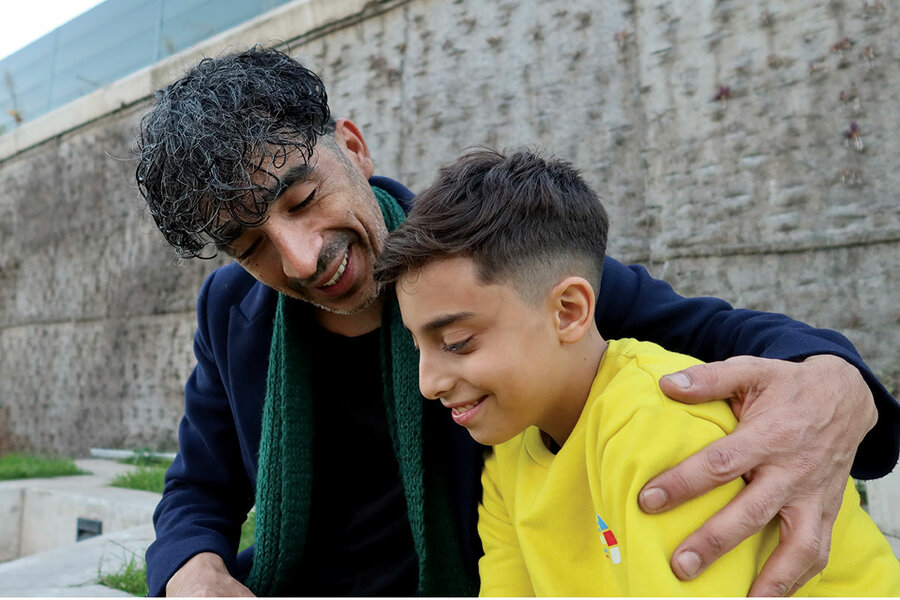
Julio Franchi and Ian Cháves in Buenos Aries, Argentina. The two met in a square four years ago and are now father and son.

Who can resist a story like this at this time of year? I had just finished reading Nothing to See Here, a fanciful novel about parenting someone else’s children, when I read today’s entry by Julio Franchi, written up by Christian Science Monitor staff writer Erika Page.

Fiction and reality are closer than you think.

“At the time,” Franchi reports, “my only thought was to help. I just followed my instinct. Only now am I realizing what it means to be a father. 

“It was 2019. I would meet up with a group of neighbors and our dogs at the square around 10 o’clock at night. We were always the same people. One night a little boy appeared. 

“He was just there, playing with a stick, and you could tell he was alone. He looked abandoned. It was 11 o’clock, 12 o’clock at night. That was late for a 7-year-old. I asked him what his name was, what he was doing there. We got along right away. The next day he came back. 

“From then on he was always there, with his broken sneakers and clothes that weren’t his size. 

“We asked, and he wasn’t going to school. The first thing that occurred to us was to buy him some sneakers. We pooled money between the 10 of us neighbors. 

“I kept trying to connect the dots. I asked where he lived, and he said, ‘that way.’ The next day I walked him to the corner. There were a few squatter houses left in the neighborhood – his was one of them. I went with him one day with the excuse of the new shoes. I didn’t want his mom to think I was meddling. When she came out I realized because of her state that she was dealing with an addiction. But she was receptive to help.

“We found him a local school. That was already a lot. He could eat there and not spend so much time on the street. He would come to my apartment for an afternoon snack, or he’d go to one of the neighbors’ homes. This continued into 2020. We saw each other several times a week. …

“Then the pandemic hit, and the pandemic was really strict here. You couldn’t go anywhere. Six months passed, and I didn’t hear anything from him. When the quarantine began to relax … his mom called to say she was going to be hospitalized. She couldn’t take care of Ian. 

“She wanted to know if I could. I obviously said yes. She never called to ask for Ian back. 

“She clearly loves her son. In her right mind, she’s great. Very fun, very cheerful. But the addiction leads her to lie endlessly. She can sleep for days. Later I learned that Ian had to get her out of places where he was forced to see really ugly situations. Within her chaos, though, she is always looking for the best for him. …

“I’m always thinking about myself, always caught up in my own world. I never thought I would be ready to be a father. When I realized she was handing him over to me, I didn’t think about my life. It’s never crossed my mind even a little bit to wonder what I’ve gotten myself into. I live alone in Buenos Aires; he is my family.

Ian came to pull me out of myself, out of my ego. 

“People who know me can’t believe I get up at 6 a.m. and take him to school. I used to go to bed at 7 in the morning or later. I’ve discovered the morning. I’ve discovered what it means to miss someone. The most important things in my life happen without me expecting them. 

“My relationship with my own father marked me. There are things that have been difficult for me to forgive, moments of violence from another generation. But he never threw in the towel. He always wanted to change. Now I see what it means to be a model for Ian. I can’t hit the brakes and say, ‘I’m not going to raise you for a while. I’m going to spend my time screwing everything up and doing things wrong, so don’t watch me.’ He’s going to watch anyway. 

“Fatherhood is like a giant mirror in which I see all my flaws. The virtues, too, although they aren’t as numerous. It forces me to try to be better, even if I don’t succeed all the time. When I get angry, and I realize five minutes later I’ve made a mistake, I apologize right then. No matter how much I feel like screaming like a madman, I say, ‘Look, what I just said was wrong. I’m sorry.’ …

“When I told Ian the whole truth about what was happening to his mom – what it’s like to be an addict – everything became clearer to him. He began to understand that his mom had a problem. It wasn’t that she didn’t love him. It was essential for him to understand that. …

“When I met him, knowing where he came from, the first thing I imagined was that I was going to bring him things, offer him experiences, buy him stuff. Not that I have any money. I’m a musician. I was better off than him, but just by a bit. But later I realized that in reality what I was going to give him were limits. That’s what he needed. That’s really being a parent. 

“At first we explained things to people about our relationship. Then at one point we said, ‘OK, that’s it, we’re father and son.’ I told him, ‘Just watch, now that we say it, we’re going to start hearing that we look alike.’ Two days later, a woman stopped us and said, ‘You’re identical!’ Ian just started to laugh.”

More at the Monitor, here. No firewall.

Read Full Post »

Photo: Natalie Alcoba.
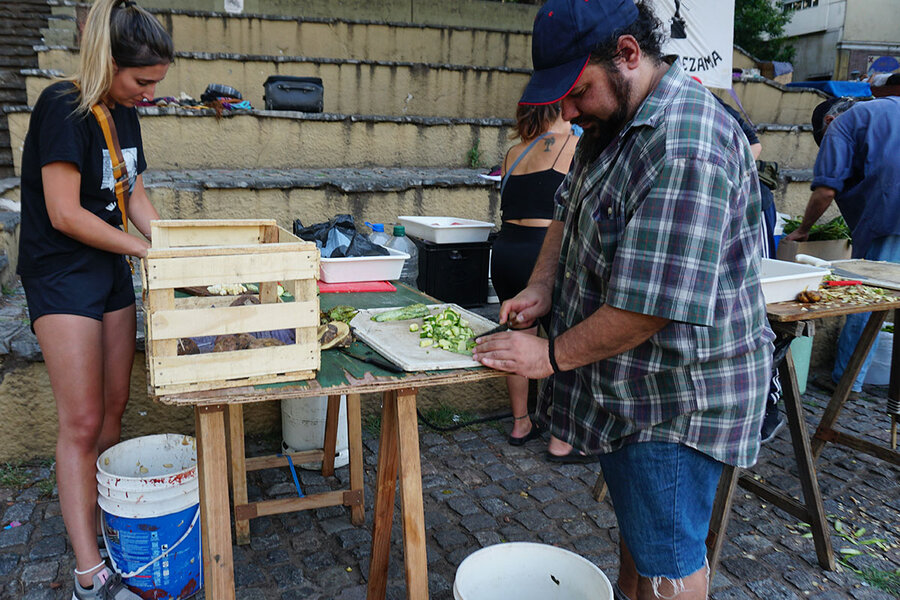
Gerardo Romero and Flor Yciz donate the gift of time to the nonprofit Parque Lezama Olla Popular, preparing
a meal they serve each week to those in need in Buenos Aires, Feb. 6, 2023.

One thing that struck my husband when he returned from over a year of working in China was that Americans do a lot of volunteering. His perception of China at that time was that the government did everything and that citizens didn’t often take it on themselves to help others less fortunate.

Christian Science Monitor reporter Erika Page notes that Argentinians, too, aren’t known for helping strangers, but that young people are leading the way in tough inflationary times.

“Every Tuesday evening,” she writes, “as streetlights flicker on in downtown Buenos Aires, a man named Charlie tidies a section of sidewalk, preparing for his visitors.

“Charlie lives on the street. The volunteers who regularly check in on him as part of their recorrida nocturna, or night route, are an emotional lifeline.

“The team of six sit with Charlie in a semi-circle on the pavement, offering juice, yerba mate, and conversation. They chat about the weather, current events, the neighbors, and when the laughter lulls, they ask Charlie about more immediate concerns, like his health, upcoming medical appointments, and how the police have been treating him.

“There are thousands of people like Charlie living on the streets across the capital, and 43% of the country’s population lives in poverty. It’s a reflection of the unrelenting economic crisis and sky-high inflation that’s enveloping this South American nation. Some 600 volunteers take part in these nightly visits organized by the nonprofit Fundación Sí, underscoring a growing movement of volunteers, fueled by young people, who are working to fill the void where government services and the labor market are falling short. 

“These volunteers may not be well off – or even interested in staying in Argentina long-term – but they offer whatever they can to lift their neighbors up: a hand, an ear, a meal, or simply some of their time. Argentina isn’t known for high rates of volunteerism, but recent data shows that’s changing.

A study published by Voices! Consultancy found that a record 36% of Argentines volunteered last year, including nearly 60% of people between 18 and 24 years old.

“Generosity of time and affection is generally reserved for family and close friends in Argentina, says Constanza Cilley, executive director of Voices! Consultancy. But, ‘there are significant increases [in volunteering] in times of greatest crisis,’ she says. …

“Last year, annual inflation reached 94.8%, sending food prices soaring, and making saving nearly impossible. Most young people no longer expect a higher standard of living than their parents in a country whose social mobility was once a point of national pride. That can cause internal conflict for those who want to do good here. …

“Emilia Maguire, a therapist, has considered emigrating for years, tired of the poverty she can no longer ignore – and which she sees as a reflection of distorted political and economic priorities. She recently joined Fundación Sí’s night routes.

“ ‘Sometimes I get home tired and distressed,’ says Ms. Maguire. ‘But when you connect with things like this that are gratifying, it’s easier to get by, because your focus shifts.’ …

“The Voices! study found a correlation between volunteering and general satisfaction. Some 23% of respondents who said they volunteered last year indicated Argentina as the best place for them to live, compared to only 14% of non-volunteers.

“The group got their start in 2018 with close to nothing, as the value of the Argentine peso began to plummet once again. They’ve since acquired a gas stove and donations from businesses and farmer’s collectives. They invite those who come to eat to help cook as part of the team. …

“ ‘The crisis itself pushes people together, uniting in empathy,’ says Carmela Pavesi, an organizer in her mid-20s. ‘You don’t need a lot of money or a lot of things,’ she says. ‘With the people you have nearby, wherever you are, you can do something with what you have.’ …

“ ‘Today there are more people living on the streets, more people in need, more people begging for money or help,’ says Eduardo Donza, a researcher with the Social Debt Observatory at the Universidad Católica de Argentina.

“The country’s poverty is structural and historic, says Mr. Donza, in large part due to a precarious labor market. Only 35% of the population works in the formal private sector, another 15% in the public sector, leaving half the population doing informal work. …

“ ‘If we don’t generate more wealth, if we can’t create more good jobs, we’re never going to come out of this,’ he says. Volunteering can’t solve these wider issues on its own. ‘But it seems to me like solidarity has increased. That willingness to help matters.’ “

More at the Monitor, here. No firewall.

Read Full Post »

Image: Norah Borges
The artist’s older brother, Jorge Luis Borges, wrote that Norah was the fearless one in the family and “I the slow, timid, submissive one. She climbed to the top of the roof, traipsed through the trees, and I followed along with more fear than enthusiasm.”

How many women in the arts have been overshadowed by the men in their families? Countless. Just the other day I was surprised to hear some work by Fanny Mendelssohn — composer of more than 480 pieces of music — that was pretty impressive.

Maria Popova at Brain Pickings wrote recently of another female artist who was new to me: “Few people know that literary titan Jorge Luis Borges had a sister, and even fewer that Leonor Fanny Borges Acevedo (1901–1998), better-known under the pseudonym Norah Borges, was an acclaimed artist in her own right, who emerged in the 1920s as one of the female pioneers of modern art. …

“During her lifetime, Borges illustrated close to eighty books, including some of her brother’s, in addition to editorial illustrations for a number of avant-garde magazines belonging to ultraísmo — the first major avant-garde movement in Spain, comprising an eclectic group of writers and artists influenced by Italian futurism.

“Her soulful paintings and drawings, the earliest of which is collected in the out-of-print Spanish-language volume Norah Borges: Obra Gráfica, … spans more than seven decades and is nothing short of breathtaking.” See examples of that oeuvre here, at Brain Pickings.

For details on the life of Norah Borges, go to Wikipedia, here.

Photo: Wikipedia
Norah Borges, Argentinian artist, 1901-1998

Read Full Post »

Do you ever check the website This Is Colossal? They have the best stuff.

Here is a cute bit about giant, playful robots in Argentina.

In a “clip from Fernando Livschitz of Black Sheep Films,” says the website, “we watch as tin windup toys overtake the streets of Buenos Aires, living amongst its inhabitants as if it was an everyday occurrence. Livschitz is known for his short films that blend live action footage with aspects of absurdity, most notably his New York and Buenos Aires theme parks. Music by the very fine Canned Heat circa 1972.” More.

We hear so much these days about robots in advanced manufacturing and medicine, but I like the idea of robots as toys. You could really warm up to some of these guys, as Frank Langella did with his robot in the futuristic movie Robot & Frank.

Photo: Fernando Livschitz at This Is Colossal

Read Full Post »

A busy holiday here in New England with both our kids, their spouses, and the two grandsons. Every time we thought we were nearly done opening presents, one or more of us needed a nap.

The distaff side produced a chicken masala (with rice, nuts, raisins, cilantro, coconut, and chutney from Swaziland via the Servv catalog), creamed spinach, salad, and pear crumble.

Meanwhile, here’s a Christmas-y story from South America …

“In 2001, when Argentina’s economy was near collapse and property prices plummeted, UCLA art prof Fabian Wagmister bought a 15,000-square-foot abandoned warehouse in Buenos Aires. When he finally set out to clear the remaining debris from the building last year, he uncovered more than 100,000 Christmas ornaments piled in one of the back rooms.

“What to do with a trove of metallic bulbs, plastic wreaths, and bags of fake snow for a sunny Argentine Christmas?

“Re-gift them, of course,” writes Elise Hennigan at Pacific Standard.

“ ‘As artists we were immediately taken by the powerful expressive potential of the materials,’ says Wagmister.

“Now the director of the University of California, Los Angeles’s Center for Research in Engineering, Media, and Performance (REMAP), Wagmister invited a team of ten artists, researchers, and programmers from Los Angeles to distribute the ornaments to the surrounding community …

“Starting on December 15, the team invited community groups to visit the warehouse, one among many lining a historically working-class district that has seen an influx of technology companies. There, the researchers have encouraged participants to develop projects that will use the ornaments to express their identities, struggles and aspirations. On December 23, the groups took to the streets and decked the halls accordingly.” More.

 Photograph: Pacific Standard
Some of the found ornaments going up around Argentina’s capital

Read Full Post »