Photo: Pawan Sharma/AFP via Getty Images.
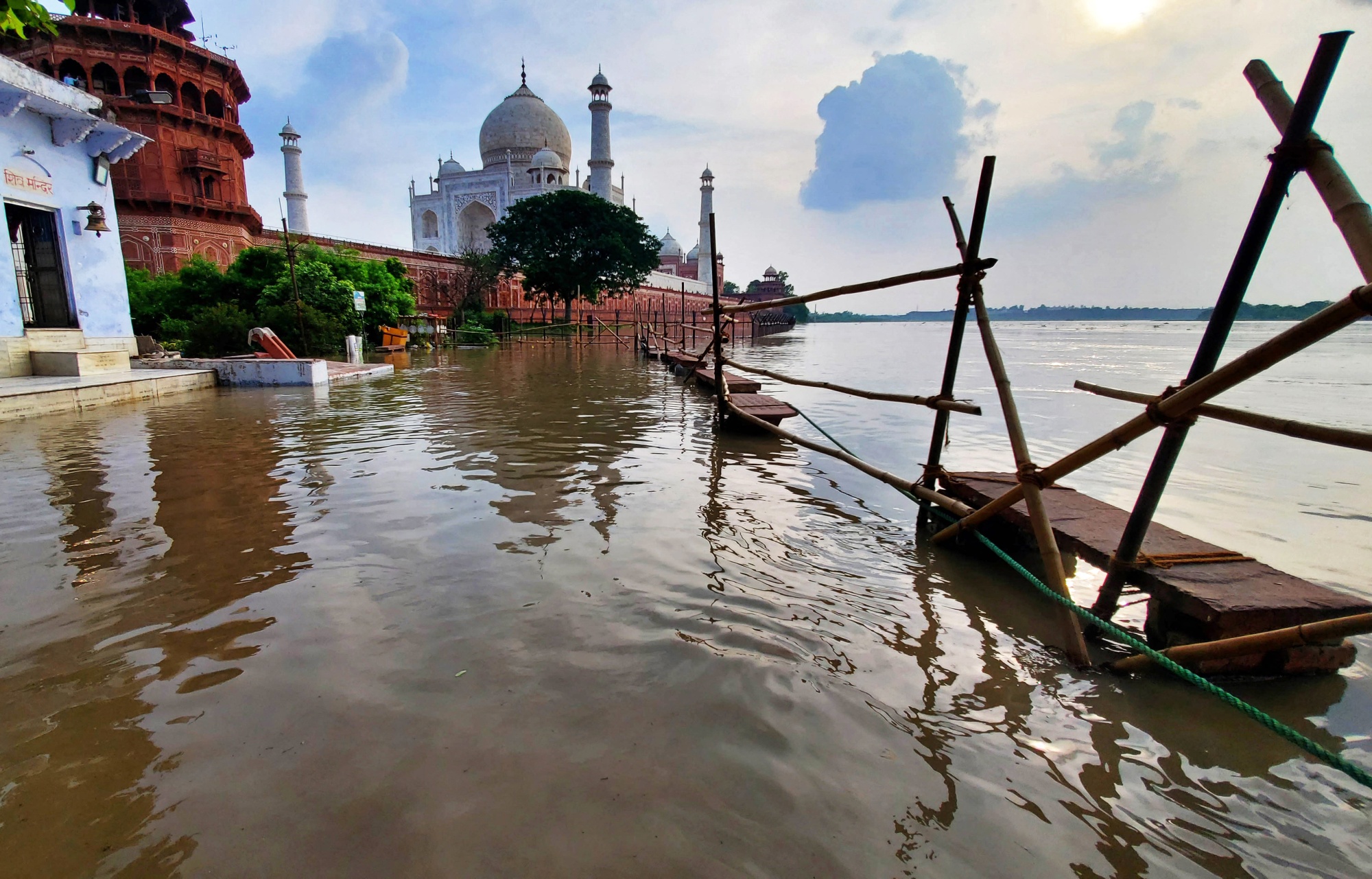
The flooded banks of the Yamuna river near the Taj Mahal in Agra, India.
“It’s an ill wind that blows nobody good.” Maybe so, but how can severe flooding ever benefit a landmark?
First, let’s look at the worries about flooding near the Taj Mahal. In a July 20 Nikkei Asia report, Neeta Lal wrote, “Indians watched with alarm this week as the surging Yamuna River reached the outer walls of the country’s most recognizable landmark — the white-marbled Taj Mahal — for the first time in 45 years, due to heavy monsoon rains that have wreaked havoc and killed scores in the north of the country.
“Apart from highlighting the vulnerability of the 17th-century mausoleum in Agra, into which officials on Wednesday assured media the water was unlikely to enter, flooding has disrupted life across several states in recent weeks. Tens of thousands of people have been displaced, roads have caved in, homes have collapsed, and schools have been forced to close. Waist-deep water at Kaziranga National Park sent rare one-horned rhinos, elephants and deer fleeing to nearby villages, authorities said.
“A State Bank of India report this week made an early estimate of economic damage at nearly $2 billion.
“The crisis comes in a year when many parts of the world are experiencing severe heat waves and other extreme conditions attributed to climate change. Although flooding is nothing new in India, experts warn that global warming means the country can expect more extreme weather and must plan accordingly.
“New Delhi has not been spared. In the capital, nearly 10,000 people were forced into 33 makeshift relief camps arranged by the local Aam Admi Party (AAP) government, according to an official statement last week. Some were still in the shelters this week.
“Residents holed up at a camp in Delhi’s Civil Lines area complained of a lack of amenities. ‘We’ve been here for three days after losing all our belongings in floods but are struggling to get basics like food and water. Mosquitoes are also posing a problem,’ said Rashida Bai, 48, a widow and mother of three. However, her neighbor, Amina Yusuf, praised the government ‘for providing rations and promising 10,000 rupees ($122) per family as financial support.’ “
Meanwhile at Bloomberg CityLab, Sreeja Biswas addresses the Taj Mahal angle. “Extreme weather is a threat to cultural sites all over the world, but northern India’s latest monsoon may turn out to be positive for the Taj Mahal.from the Yamuna river, a major tributary of the Ganges, reached the compound walls of the UNESCO World Heritage Site on July 18, following a period of heavy rain that left thousands displaced in the neighboring state of New Delhi and caused devastating floods around the region. It was the closest Yamuna waters had come to the Taj Mahal in 45 years, flooding the visitor viewing area, according to local media reports.
“The Taj Mahal’s white marble exterior may suffer minimal damage, but the heightened water level will likely raise the moisture content of the structure’s wooden foundation, increasing its life span, said Raj Kumar Patel, superintendent archaeologist for the Archaeological Survey of India, a government agency responsible for archaeological research and preservation of historical monuments.
“The Taj Mahal is supported in part by a base of deodar wood, which becomes stronger when it absorbs water, Patel said. Drainage pipes divert the river water, and deep wells filled with rock, wood and other solid material provide stability to the massive building above.
“A drying Yamuna river has previously been a concern for the Taj Mahal — built in the 17th century by Mughal Emperor Shah Jahan in memory of his queen Mumtaz Mahal — as a lack of moisture shrank the supporting rafters at its base. The building has also suffered years of extreme air pollution and acid rain that has turned the monument yellow-green. …
“The recent flooding in northern India has been far less fortunate for other sites. The Mehtab Bagh, or Moonlight Garden, near the Taj Mahal, was mostly submerged in the recent rains and will likely need new grass, according to Patel.”

 Suzanne's Mom's Blog