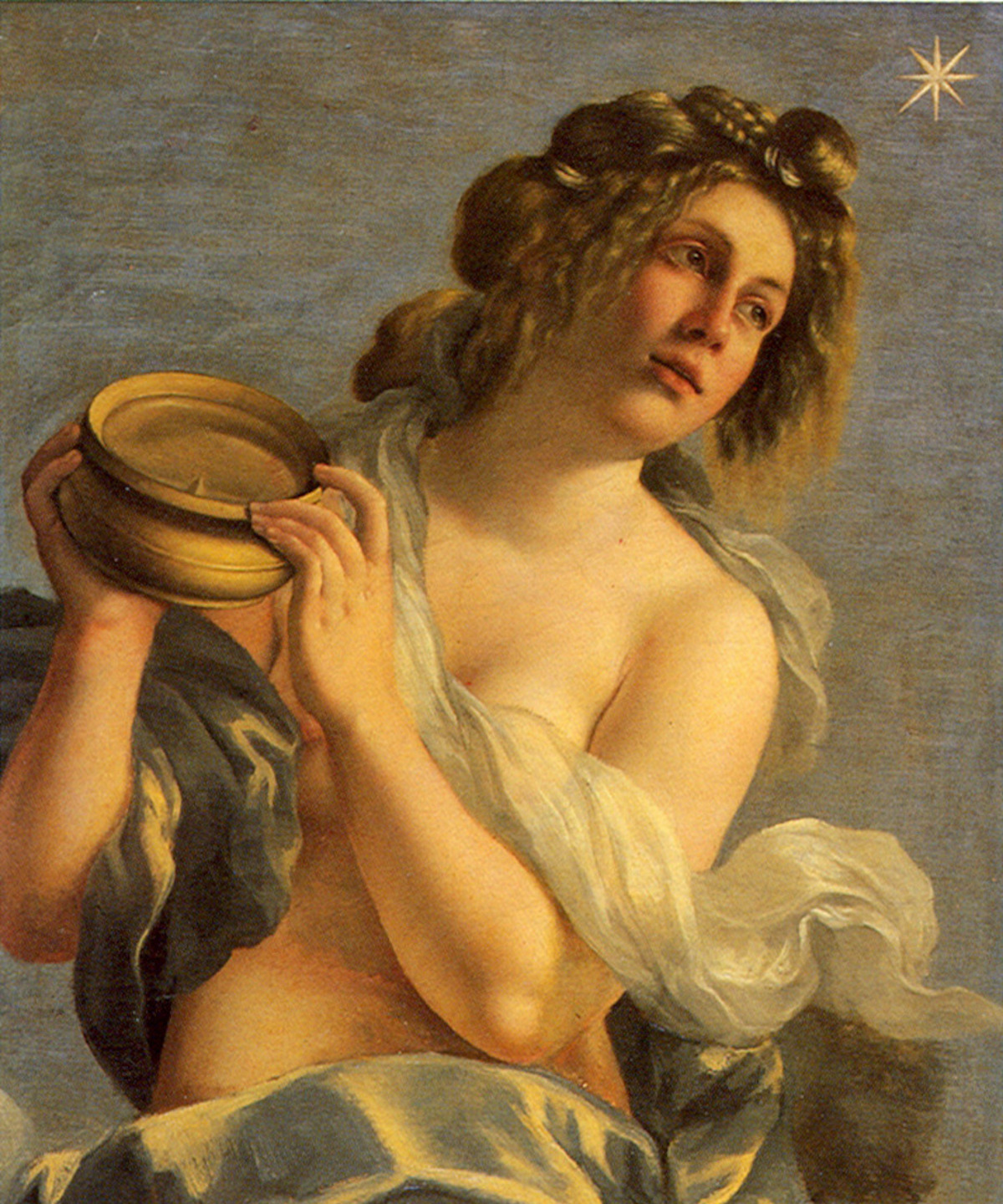
Art: Artemisia Gentileschi via Wikimedia Commons.
Artemisia Gentileschi, an an Italian Baroque painter, is considered one of the 17th century’s most accomplished artists. Shown here is her “Allegory of Inclination” (1616).
Have you been seeing the name of seventeenth-century painter Artemisia Gentileschi mentioned more these days? I have. Finally the world is coming to grips the astonishing proposition that some female artists are better than many male artists.
Elaine Velie has some thoughts on Gentileschi at Hyperallergic.
“In 1616, the 22-year-old artist Artemisia Gentileschi painted a nude woman perched in the clouds and holding a compass at the Florence home of Michelangelo Buonarroti the Younger, Michaelangelo’s great-nephew. The work was the first in the Buonarroti family’s home gallery dedicated to their famous ancestor, and the impasto ceiling painting, likely a self-portrait, was also one of Gentileschi’s first commissions. ‘Allegory of Inclination’ remained untouched for around 70 years until a descendant of Michelangelo Buonarroti commissioned the Late Baroque painter Baldassarre Franceschini (il Volterrano) to paint draping over the nude figure in the interest of modesty.
“Now, the former Buonarroti residence is the Casa Buonarroti museum, and a team of conservators there is working to ‘virtually restore the original appearance’ of the painting in a project called ‘Artemisia Unveiled.’ Using imaging techniques such as X-rays and raking light to examine the over 400-year-old brush strokes, the team will determine which additions were Gentileschi’s and which were Franceschini’s, and the final result will be an uncensored image.
“Elizabeth Wick, the restorer leading the project, told the Florentine that the team will not physically alter the existing painting for two reasons: Franceschini’s layer is considered a historic addition that contributes to the painting’s story, and since the two layers of paint were applied only 70 years apart, removing Franceschini’s draping would likely damage Gentileschi’s original coat of paint. …
“Gentileschi’s success in the male-dominated art world of 17th-century Italy, and the woman-focused subject matter of her work, have turned her into somewhat of a feminist icon. Although she earned recognition during her lifetime, Gentileschi’s work has been revisited in recent years through museum shows and other conservation projects.”
More at Hyperallergic, here. No firewall, but contributions are sought.
At Wikipedia, we learn that Gentileschi started out working in the style of Caravaggio and “was producing professional work by the age of 15. In an era when women had few opportunities to pursue artistic training or work as professional artists, Gentileschi was the first woman to become a member of the Accademia di Arte del Disegno in Florence, and she had an international clientele.
“Many of Gentileschi’s paintings feature women from myths, allegories, and the Bible, including victims, suicides, and warriors. Some of her best known subjects are Susanna and the Elders (particularly the 1610 version in Pommersfelden), Judith Slaying Holofernes (her 1614–1620 version is in the Uffizi gallery), and Judith and Her Maidservant (her version of 1625 is in the Detroit Institute of Arts).
“Gentileschi was known for being able to depict the female figure with great naturalism and for her skill in handling color to express dimension and drama. … For many years Gentileschi was regarded as a curiosity, but her life and art have been reexamined by scholars in the 20th and 21st centuries. She is now regarded as one of the most progressive and expressive painters of her generation.”
P.S. Check out SJ Bennett’s Queen Elizabeth II murder mystery, All the Queen’s Men, in which the Queen’s Gentileschi painting plays an important role.



 Suzanne's Mom's Blog