Feeds:
Posts
Comments

Posts Tagged ‘Assad’

Photo: Taylor Luck.
“The Fardous Bookstore, once under restrictions imposed by the former Assad regime,” says Taylor Luck of the Christian Science Monitor, “now sells previously banned books to eager readers.”

Books are stronger than tyrants. We hold onto that thought. We know from both history and the belief of poets that the time of tyrants has an end. I think Shelley says it best.

“My name is Ozymandias, King of Kings;
“Look on my Works, ye Mighty, and despair!
“Nothing beside remains.”

If you don’t see the downfall of the pedestal in your own country at the moment, look toward Syria. Syrians have reason to believe that new tyrants won’t be replacing the hated Assad anytime soon.

After all, books are not being banned by the revolutionary government.

“Post-revolution Syria is becoming a page-turner’s paradise,” wrote Taylor Luck at the Christian Science Monitor recently.

“After years of being banned by the former regime, dozens of long sought-after books are flooding stores across Syria, literally spilling onto the streets. An epicenter of this new literary freedom is the so-called ‘bookshop alley’ in the Halbouni neighborhood of Damascus, a leafy street lined by two dozen bookshops and printers, big and small.

“It is here that Radwan Sharqawi runs the Fardous Bookstore, a small corner shop that his family has owned since 1920. The contrast between today’s Syria and the long period of Assad family rule is like night and day, he says.

“ ‘Before, we had daily interrogations by the security services,’ Mr. Sharqawi says. ‘Now everything is permitted, nothing is banned. Now is a golden era for books!’

For decades, any book written by an intellectual or an artist who had expressed opposition to the Assad regime – or who simply did not vocally toe the official line – was banned.

“So, too, were books that touched on Syrian history from any perspective other than the ruling Baath Party’s revisionist version. Titles on the history of the Israeli-Arab conflict, or anything on the 2011 Arab Spring uprisings, were contraband.

“Islamic thinkers such as Ibn Taymiyya, the influential medieval Sunni jurist and scholar, were banned. So, too, were books by Brotherhood-aligned clerics. … Even a book as basic as a tafsīr, an annotated Quran with explanations and context, was banned, for fear it might contradict the Assad government’s tightly controlled Islamic authorities.

“ ‘These are texts about religion and God, not politics,’ says Abdulkader al-Sarooji, owner of the Ibn Al Qayem bookshop, as a customer browses shelves of leather-bound Islamic books, their titles engraved in decorative golden calligraphy. …

“As soon as the regime fell, Mr. Sarooji began importing books from Turkey and northern Syria to Damascus. Syrians are rushing to snatch up banned titles. …

“ ‘There is demand for banned books because people feel there is a gap in their knowledge, even in their religious knowledge,’ says Mr. Sarooji.

“The most dangerous texts during the Assad era – and the books in highest demand now – are works of literary fiction, titles that draw on the real experiences of Syrians who spent time in jail and suffered abuse at the hands of the regime. The most fiercely banned book was Bayt Khalti, by Ahmed al-Amri, which details the horrors faced by women in the notorious Sednaya prison.

“Now Bayt Khalti is prominently displayed on bookshelves and vendors’ roadside stands across Damascus – in both legitimate editions and blurry knockoffs that feed the high demand.

“ ‘This book was the most dangerous one,’ street-side book vendor Hussein Mohammed says as he waves a copy of Bayt Khalti. ‘If they caught you with this, you were a goner.’

“Another popular banned text, Al Qoqaa, or The Cochlea, details a Christian Syrian’s time in Mr. Assad’s prisons.

“Eyad, a young Damascene, purchased a book of fiction from Mr. Mohammed after spending an hour browsing in the bookshop alley. ‘There are a lot of books that I have wanted to read for years,’ he says.”

More at the Monitor, here.
Read Full Post »

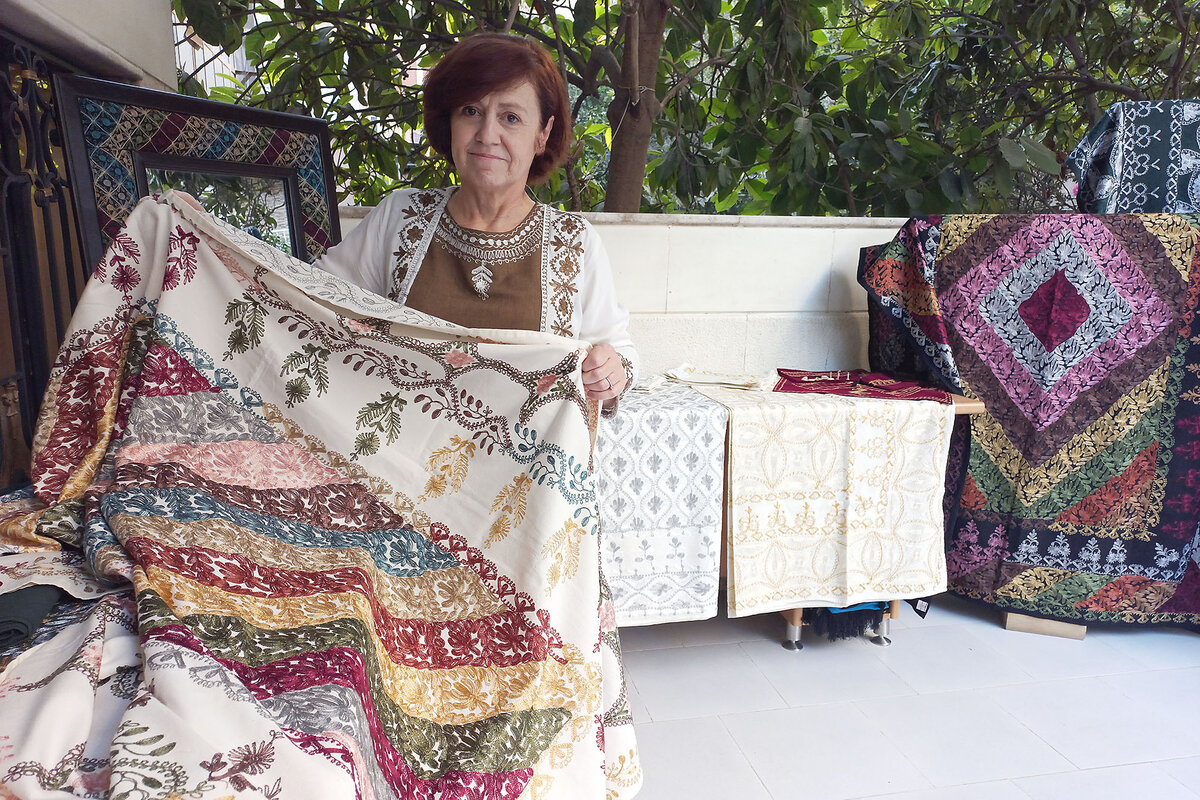
Photo: Walaa Buaidani.
Mona Araghili showcases aghabani embroidery at the Threads of Hope exhibition in Damascus, Syria. Post-Assad, she sees an opportunity for serious investment in traditional crafts.

“Threads of Hope” is a phrase that seems to cover a lot of what is going on in the world. Hopes may be hanging by threads, but every day they can strengthen. In today’s article from the Christian Science Monitor, the words are applied to the reemergence of traditional Syrian embroidery after the fall of the Assad regime.

Dominique Soguel writes, “By the time Ameera al-Hammouri was 10, her hands were dancing across the taut fabric beneath her grandmother’s aghabani embroidery machine. She was too short to sit, so she stood, working the foot pedal to coax floral patterns from metallic thread and her own memory.

“Decades later, in a rundown apartment building on the outskirts of Damascus, her machine now runs on an erratic supply of electricity. The building’s elevator no longer works and many of its windows are broken, but inside the sanctity of Ms. Hammouri’s spotless home, the artistry lives on. ‘Working on the embroidery machine for me is like drawing on paper,’ she says. … ‘Whatever I imagine, I bring to life with my hands.’

“Aghabani embroidery originated in Damascus more than 150 years ago, blending Ottoman, Arabic, and Persian design influences. Traditionally, patterns were hand-printed in Damascus onto fabrics that were then sent to Douma, about 8 miles from the capital, where women embroidered them at home. Their work, displayed on tablecloths and other household items, became a hallmark of Syrian hospitality.

“Today, the survival – indeed, the revival – of this craft tradition rests in the hands of women from Douma, a city synonymous with both resistance and ruin. The women behind these works are not only artisans. They are mothers, widows, and survivors of siege, displacement, and economic collapse.

“Ms. Hammouri herself endured all of it. Her husband and eldest son were arrested in 2012 and never returned. Douma was subjected to a five-year siege, when government forces surrounded the city, cutting it off from food, medicine, and fuel. Ms. Hammouri’s house was destroyed. As the bombs fell, she moved her children from house to house, basement to basement.

“The siege ended in 2018. With no income and no husband, Ms. Hammouri turned to the one thing that had always grounded her: her original aghabani machine, bought in 1988 with money she scraped together by selling her wedding gold and other treasures. It still stands in a corner of her bedroom, alongside a newer model.

“ ‘I talk to this machine,’ confides Ms. Hammouri, who is known in the community as Umm Meriee. ‘It holds my secrets. I’ve cried over it.’

“At first, she worked quietly from home, taking orders from traders who remembered her family’s reputation and bought pieces for export. Over time, she began training other women.

“If Syria’s current political opening brings more trade and tourism, she says, crafts like aghabani could once again become a source of stable income rather than just a means of survival.

“Now, twice a week, her apartment fills with the chatter and laughter of industrious women. … This gathering of women is not a formal enterprise. There is no signboard or registration, no website to market their work. But family reputations endure in a country where word of mouth is the norm.

“ ‘They know my name in the market,’ says Umm Meriee, recalling how she revived ties with shopkeepers in the Al-Hariqa market, in Damascus’ old city, because her aunts and grandmother had put the family name on the map. …

“For Mona al-Masri, a Tuesday regular, embroidery is her identity. … While her colorful pieces earn heartfelt ‘wows’ from her daughters, it is next to impossible to eke a living from this craft. In a good week, working three hours a day in between bouts of housework, Ms. Masri earns just over $6. … Despite the skill and time aghabani requires – a single detailed motif can take hours, and a full tablecloth might take a week or more to complete – handmade aghabani cannot compete with cheaper, machine-made imitations that dominate the local market, such as those imported from China.

“ ‘Right now, aghabani has no future,’ says Ms. Masri. But with government support, she feels that future could ‘be a very bright one.’

“Mona Araghili shares that optimism. … More than a decade ago, Ms. Araghili set up Threads of Hope – Aghabani with little more than a social media page and materials she borrowed from friends. With her college friend Basheera Baghdadi, who had grown up in Douma, she smuggled fabric and thread into the besieged city, using tunnels and roundabout routes through the countryside. …

“Ms. Araghili never shut down her group’s Facebook page, she says. ‘I always hoped that we could restart someday.’ ”

More at the Monitor, here.

Read Full Post »

Photo: Shirin Jaafari/The World.
Moayyed al-Kharrat, whose family has been performing the Sema in Syria for decades, described the dance as a sort of prayer.

As recently as June, when radio show The World filed this story about whirling dervishes, hope seemed to be the main emotion in Syria. The brutal Assad regime was gone, and victorious rebels were promising diversity and justice. Today sectarian violence has erupted.

But I think there are still reasons for hope — and for diverse groups to flourish. Like the Sufis.

This post shares what Shirin Jaafari wrote about the famous Sufi dance and the performers’ hopes.

“In the heart of Damascus, a group of men and boys dressed in long, white robes and tall headpieces stood in a semicircle. Their chants filled the courtyard of a traditional Damascene house that was turned into a hotel. …

“As the melody built up momentum, several of the men and boys began to twirl, their white skirts flaring out like blooming flowers. The dancers’ synchronized rotations make them trance-like, seemingly detached from everything around them.

“The al-Kharrats say they are the only family in Syria who have continuously performed the Sema, as the dance is known. It was introduced to the country in the 14th century and first popularized by the Persian poet Rumi in Turkey.

“Through years of war, repression and threats from extremist groups like ISIS, the family has still been able to pass the ritual on to younger generations.

Now, they say they are hopeful about new opportunities under the new Syrian government.

“Moayyed al-Kharrat, one of the two brothers who oversee the dancers, said their great-uncle learned the Sufi dance and taught it to others in the family. …

“ ‘The spinning represents pilgrims moving around the Kaaba in Mecca,’ Kharrat said, referring to the ritual performed by Muslims. ‘It’s also reminiscent of the planets moving around the sun.’

‘During the ritual, one hand is extended upward, palm facing the sky, he went on to explain, which symbolizes receiving divine blessing. The other one is turned downward, palm facing the earth, to pass the blessings to the world.

“Mahmoud al-Kharrat learned the Sema when he was 4 years old. He said that keeping the tradition alive in Syria hasn’t been easy.

“Sufism is a mystical branch of Islam focused on spiritual closeness to God. It has long faced suspicion from extremists, who consider Sufis to be non-believers. ISIS fighters have attacked their shrines and killed and imprisoned the descendants of the saints and personalities they represent.

“The regime of ousted President Bashar al-Assad didn’t prohibit the Kharrat family from performing, the brothers said. But it did make it difficult for them to get the right permissions. The Assad regime used the arts to paint a more positive image of itself to the world, they explained. For example, when foreign dignitaries visited, they asked the family to perform for them.

“As the civil war ravaged Syria, countries stopped issuing visas for Syrians to travel. The family found it almost impossible to take its performances to international audiences as it had done before. One time, they managed to go to the US, but upon returning, Mahmoud was questioned by a border guard about why he hadn’t yet completed Syria’s mandatory military service, which all men had to complete at the time.

“Mahmoud estimated that he ended up paying around $7,000 in bribes so he wouldn’t get sent to the frontlines. …

“At the Damascene home-turned-hotel, the first part of the performance wrapped up, and the two brothers discussed with the younger members what they could improve on. …

“After some discussion, they got ready for the next part of the performance — their long, white skirts sweeping the ground as they moved around.

“ ‘The best way to keep this tradition alive,’ Moayad al-Kharrat explained, ‘is to pass it on to the younger generation [making] sure they learn the chants, and the full meaning of what this dance represents.’ …

“ ‘When I dance, I feel like I’m flying,’ Mahmoud added. ‘I feel like a child who has just been given a birthday present.’ ”

More at The World, here.

Read Full Post »