Feeds:
Posts
Comments

Posts Tagged ‘audience’

Photo: Robert Ormerod for the New York Times.
Graham Maxwell performing “The Flying Bubble Show” during the Edinburgh Festival Fringe.

Nowadays, hearing or reading about something cool is generally good enough for me. As interested as I might be in a foreign country or a new play or a natural wonder, I don’t often think, “I wish I had been there.”

But today’s story on bubble art is different. I would have loved to see these performances and be in the midst of audience reactions. They took place at the Edinburgh Festival Fringe in August.

Alex Marshall wrote at the New York Times, “In McEwan Hall last week, the atmosphere was riotous. For about an hour, some 400 adults and children were gasping, screaming and laughing as Louis Pearl, the Amazing Bubble Man, encased girls and boys in huge soapy globules, made bubbles levitate and wobble, filled many of the fragile spheres with smoke, and karate-chopped others in half.

“For the show’s finale, Pearl, 68, grabbed a long plastic stick with a ring on one end, dipped it into a vat of soapy formula and waved it above his head so that thousands of bubbles drifted over the audience. Children throughout the theater leaped out of their seats to pop them. …

“This year, four bubbleologists, as they like to be called, have shows on the Fringe. … Ray Bubbles has a show for disabled children and an ‘Ultimate Bubble Show‘; an act called the Highland Joker has the simply titled ‘Bubble Show‘; and Maxwell the Bubbleologist has a ‘Flying Bubble Show,’ largely performed midair.

“After his gig last Monday, Pearl posed for photos with fans and sold bubble-making kits outside the venue. ‘Bubbles are like dreams,’ he said later in an interview: ‘When you blow one, you go out of normal reality and this magical thing captures your attention until — boom! — it pops.’ …

“Born in San Francisco, Pearl said his bubble fixation began in the 1970s at Dartmouth College in New Hampshire when a roommate showed him a bubble pipe and they tried out some tricks like filling the bubbles with marijuana smoke.

“While working odd jobs after college, Pearl sold toy bubble pipes on the streets of San Francisco, and sometimes sold pot, too. His life changed in 1983 when he saw Tom Noddy, a bubble artist who once appeared on The Tonight Show, perform at the Exploratorium, a San Francisco science museum. Noddy’s tricks included creating a cube-shaped bubble, making smoke spin tornado-like inside a bubble, and blowing piled-up bubbles to form the shape of a goblet.

“Pearl said he spent ‘hours and hours’ replicating Noddy’s tricks and developing his own. During that time, Pearl recalled, he also had to work out the ideal mixture for bubble blowing. (His current recipe, he said onstage, calls for dish soap, water — and lube to make the bubbles stretchy.)

“At this year’s Fringe, Pearl is performing versions of some of Noddy’s best stunts. ‘In the bubble community, if you present tricks in a new way, it’s cool, Pearl said. ‘If you steal, it’s not. …

“When Pearl first took his ‘Amazing Bubble Man’ act to the Fringe, in 2007, he played a 100-seat venue. Now, he’s in an over-1,000-capacity hall, although he said a full house could be disastrous, in part because the heat generated by larger crowds creates air currents that make it harder to control the bubbles. …

“Yet Pearl is up against an even bigger challenge this year. For the first time, the most hyped bubble act at the festival isn’t his, but ‘The Flying Bubble Show,’ in which Maxwell the Bubbleologist blows hundreds of the iridescent orbs while flying on a harness around a circus tent.

“The spectacle’s performer, Graham Maxwell, 32, said in an interview that he had been putting on traditional bubble shows around the world for about a decade when, in 2024, he had ‘a vision’: He pictured himself suspended midair while using tai chi movements to make bubbles levitate, bulge and spin. That inspired him to train in a circus tent in Goa, India, where he learned how to use a wired harness. …

” ‘There’s a whole, deep world to bubbles, he said: Seeing one pop could prompt adults to recall their youth or dwell on their mortality, he said. How bubbles form and move can be used to understand fundamental scientific properties, he added, and for him, the act of blowing bubbles can induce a meditative state. …

“Last week, Maxwell performed his flying show to an audience of about 500. … As graceful classical music played, Maxwell — wearing a top hat and billowing velvet shirt — swooped overhead as the audience sat around a circular stage. Trailing behind him were elongated bubbles that he created by blowing through his soapy fingers or using ropes he had dipped in bubble-making fluid. During the hourlong show, he juggled bubbles midair, tried to create ‘the biggest bubble ever’ and performed his bubble-levitating trick.

“ ‘Bubbles, it’s such a lovely word,’ he said at one point. ‘You can’t ever say it without smiling.’ “

More at the Times, here. Amazing pictures!

Read Full Post »

Photo: C. Stephen Hurst.
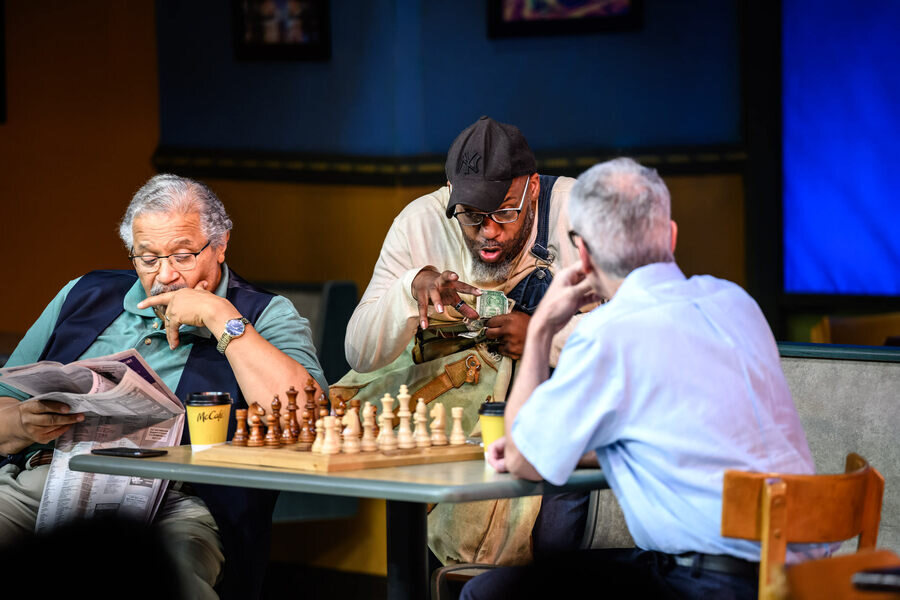
A production of the play Coconut Cake at the International Black Theatre Festival in July 2024.

One of the interesting things about theater targeted at a particular group is that people from many demographics may be curious to see it. The production may become a kind of meeting place, a place of shared laughter and emotion. Just for example, the plays of Black playwright August Wilson were often tried out in Boston, where a very diverse audience jumped at the chance to see them.

To encourage and support more Black playwrights, several theaters have decided to collaborate.

Dorothy Marcic and Kimberly LaMarque Orman report at American Theatre, “Chicagoan and English professor Melda Beaty started writing plays in 2011 and sent them out to readings, festivals, and theatres, with limited response. Then she submitted to a contest — and won.

“Her life changed when the International Black Theatre Festival (IBTF) awarded her play Coconut Cake the Sylvia Sprinkle-Hamlin Rolling Premiere (SSHRP) Award, presented at the IBTF July 29-Aug. 3 in Winston-Salem, N.C. Named after the co-founder of the IBTF, the SSHRP award includes ‘rolling premieres’ at several Black theatres. …

“The idea for the award came from IBTF artistic director Jackie Alexander, also North Carolina Black Rep’s producing artistic director. Recalling his experiences in New York seeing great plays that disappeared after a single run, Alexander wanted to try another model. As he put it to us, ‘We have these great Black theatre companies in major cities, and if we work together on a worthy play, we don’t need critics, we don’t need funding — we can create a hit of our own.’

“He’d been talking for a number of years with various artistic directors on how to collaborate, including at a dinner with the founder/executive director of Memphis’s Hattiloo Theatre, Ekundayo Bandele, and with the artistic director of Houston’s Ensemble Theatre, Eileen J. Morris, who recalled discussions about what their theatres could do to create art in the most efficient and economical way.

“When Alexander called and asked Morris if her theatre could be one stop for the rolling premiere of a new play about Maya Angelou called Phenomenal Woman, while its writer, Angelica Chéri, was still writing it, Morris noted, ‘For me, that was cool because I believed in the play. I believed in the experience. I believed in the opportunity. Despite not seeing the final script yet, I trusted in the process. The fact the first play was about Dr. Maya Angelou — that was a great selling point.’

Their goal for the first project was to share resources: designers, director, costumes.

“Though they wanted a female director, Morris was already booked to helm several plays in her own season, so Alexander stepped in and directed productions in both North Carolina and Houston; each theatre came up with its own funding. …

Phenomenal Woman played first in North Carolina, and by the time it opened in Houston it was selling out already because of the buzz from press in Winston-Salem. That success led to Phenomenal Woman to be picked up by producers with an eye on New York. …

“Hattiloo was recently able to produce Beaty’s Coconut Cake, [a] play about five senior men (four Black, one white), who meet every morning at the same McDonald’s to talk about marriages, health, and ambitions, while playing chess and learning important life lessons. This time around, each rolling premiere production of Coconut Cake is being produced on its own, without sharing designers or directors — a structure that allows both bigger-budget theatres like Houston’s Ensemble and theatres with fewer resources to each have their own vision. …

Coconut Cake has been in the oven for a while; it first appeared at IBTF in a reading in 2017. This was followed by a 2020 virtual reading through Houston’s Ensemble Theatre, in collaboration with St. Louis Black Rep. Ron Himes, St. Louis Black Rep’s producing artistic director, was initially skeptical.

” ‘I was one of those adamantly opposed to streaming theatre,’ he said, ‘and I had told everyone, no, we’re not doing it. Then Eileen called, and I was in. And you know, it worked. It was great!’ …

“Another Coconut Cake cast member was the indomitable Count Stovall, who had been in the original 2017 festival reading. An avid chess player, he had inspired Beaty with some moves she uses, particularly at the end of the play, when the audience sees that the king only can move a couple spaces at a time, while ‘the queen is everything.’ Stovall also told us even though memory loss was not explicitly written into the play, the fact that all actors were in their 60s and 70s meant, ‘It was there — you just didn’t see it.’

“Also joining for the Coconut Cake rolling premiere program was the Westcoast Black Theatre Troupe (WCBTT) of Sarasota, Fla. Founder/artistic director Nate Jacobs had been mentored for years by Sprinkle-Hamlin and her husband, Larry Leon Hamlin, the Festival’s co-founder and also the director of Jacobs’s first production at the IBTF.

“As Jacobs continued attending the festival, bringing other artists, he remembered what Sprinkle-Hamlin had told him about the festival: ‘We Black artists are competing with each other. But we ain’t got anything — no money. We need to unify and become stronger, because no other people are obligated to tell our stories.’

“So when Alexander asked if Westcoast would join the rolling world premiere program, Jacobs immediately agreed. ‘The show was a hit,’ he said of Westcoast’s production of Coconut Cake in June. ‘It popped. I was happy, again, to propel another artist.’ Beaty came and took notes, making changes as the show progressed through the various productions. ‘She’s a phenomenal writer,’ Jacobs told us. ‘And we need quality. [Audiences] such as ours, love Black culture, but they don’t want mediocrity, which means we have to be better than the best.’ “

More at American Theatre here.

Read Full Post »

Photo: Stephan Rumpf/Süddeutsche Zeitung Photo/Alamy.
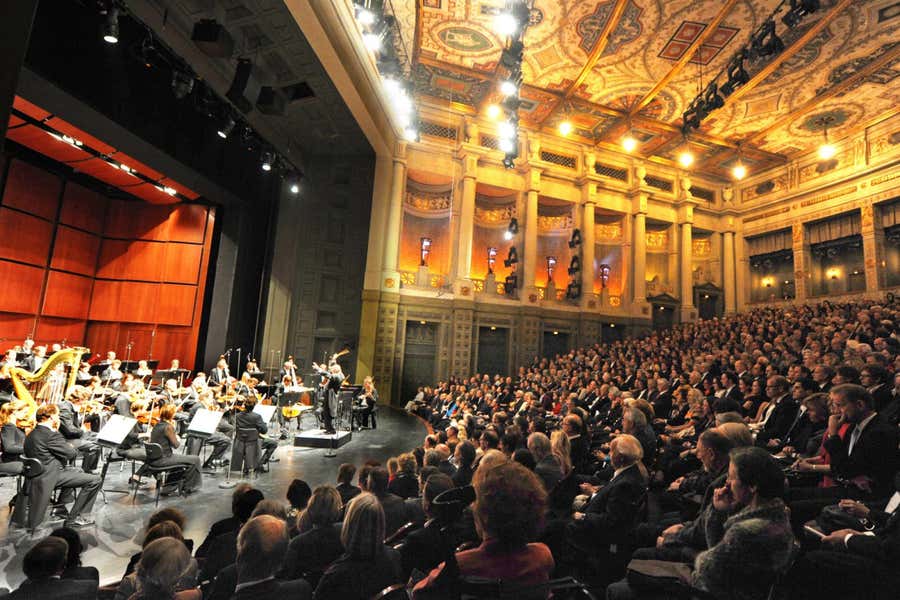
Research involving self-reported personality traits shows that music can synchronize the heartbeats of some members of an audience.

For about a year or so, I have been learning to breathe. Ha. I always made fun of that sort of thing, but noticing your breathing is supposed to be good for your health, and I have found it often does lower my blood pressure.

So, what was my delight to read this related research! It’s about how classical music often synchronizes the heartbeats of an audience.

Jason Arunn Murugesu wrote at New Scientist, “Audience members’ heartbeats, breathing speeds and even degree of sweating synchronize when they watch a classical music concert together.

Wolfgang Tschacher at the University of Bern in Switzerland and his colleagues monitored 132 people who were separated into three groups to watch different concerts of the same pieces of music – Ludwig van Beethoven’s Op. 104 in C minor, Brett Dean’s Epitaphs and Johannes Brahms’s Op. 111 in G major – while wearing body sensors.

“Various measurements became more synchronized during the concerts, such as the participants’ heart rates, breathing speeds and their skin conductance, which measures how much someone is sweating based on their skin’s varying electrical properties.

“Prior to the concerts, the researchers asked the participants to complete a personality test. They found that this synchronization was more likely to occur among people who considered themselves to be agreeable or open. …

“Tschacher expects that this synchronization would also apply to non-classical music genres and would probably be stronger still outside a trial setting. Due to covid-19 restrictions at the time of the experiment, the audience members were socially distanced. In a normal music concert, where audience members often engage with one another, the synchrony may be more pronounced, he says.

“The timing of the participants’ breathing, such as when they inhaled and exhaled, didn’t synchronize, however. Otherwise, you might think that a synchronized heart rate somehow leads to a synchronized breathing pattern, says Daniel Richardson at University College London. Instead, perhaps a person’s heart rate is influenced by their enjoyment of the music, he says.” More at New Scientist, here.

Aristos Georgiou at Newsweek adds, “Synchronization between humans is usually observed in physical bodily responses, such as breathing. Most frequently, this synchronization is the result of direct social interaction with another person. But it can also be induced by other external factors that are not related to such social interactions.

” ‘Synchrony is an important part of social interaction, and psychology has started to measure how much people become synchronized in different settings,’ such as in psychotherapy, discussions between spouses, and other conversations, Wolfgang Tschacher, an author of the study from the University of Bern’s Hospital of Psychiatry and Psychotherapy in Switzerland, told Newsweek. …

“While the researchers found that the audience members shared the same heart rate during the concerts, the heartbeats themselves were likely not all occurring at the same time, Tschacher said. The same applied to their breathing. The rate at which the audience members breathed was synchronized, but the individual ‘in’ and ‘out’ breaths of each attendee did not necessarily all occur at the same time.

“In addition, the researchers found that the [self-reported] personality traits of a listener were associated with the likelihood of their physical responses being synchronized with other audience members. Those participants who rated more highly for personality traits such as agreeableness or openness were more likely to become synchronized. On the other hand, those with neurotic or extraverted traits were less likely to become synchronized. …

“Alexander Khalil, a researcher in the Department of Music at University College Cork in Ireland, who was not involved in the study, told Newsweek that the scale and scope of the latest research is notable.

” ‘Typically, musical synchrony studies only address a small number of parameters at a time and in a relatively small group of people,’ he said. ‘Here, we have data on interpersonal synchrony amongst audience members attending a concert recorded from a large group of people.’ …

“The study is ‘particularly interesting and useful’ because individual variation across these different parameters has been compared with the subjective experience and personality traits of audience members, Khalil said. …

” ‘It tells us that that urge to tap your foot, nod your head, or sway from side to side is just the tip of the iceberg: from head to toe, body and mind are in motion with those of other listeners.’ ” More at Newsweek, here.

Read Full Post »