Feeds:
Posts
Comments

Posts Tagged ‘barefoot’

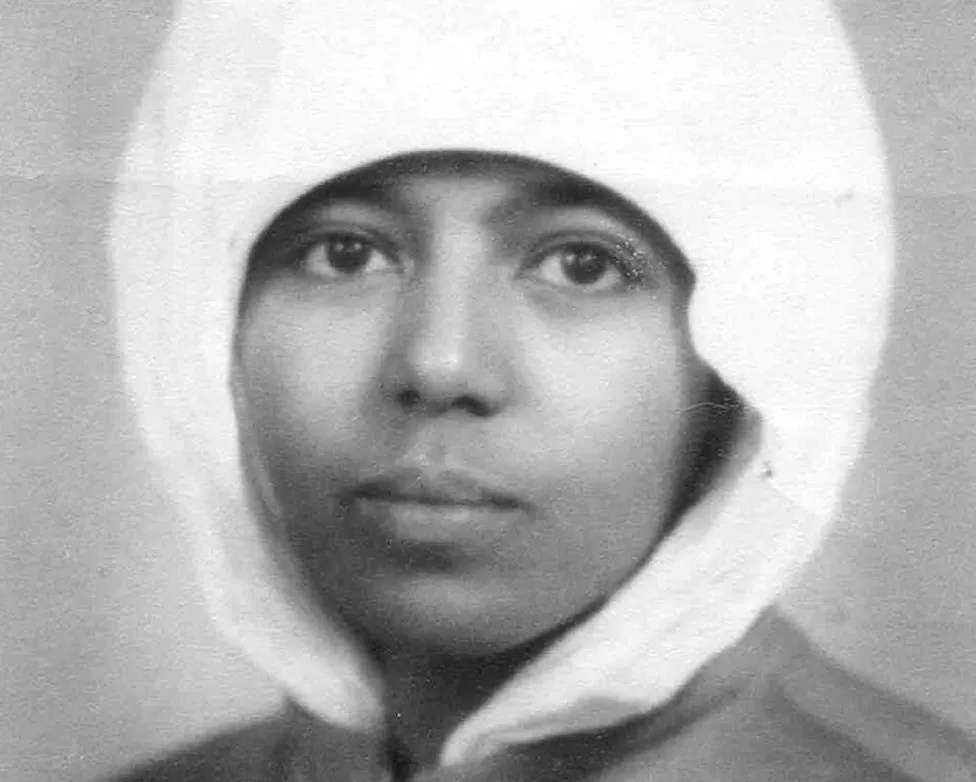
Photo: Buda Musique via the BBC.
Emahoy Tsegué-Maryam Guèbrou, the composer and piano-playing nun who died March 26 at age 99. The BBC reports she led an “extraordinary life, which included being a trailblazer for women’s equality and walking barefoot for a decade in the isolated mountains of northern Ethiopia.”

Here’s a woman who had a long and fruitful life, dying at 99 after making her mark as a nun, a musician, and a proponent of women’s equality. You may be surprised to learn of the advantages a girl could have back in the day if her family was connected to Ethiopian royalty.

Brian Murphy reports at the Washington Post, “Emahoy Tsegué-Maryam Guèbrou, a classically trained musician who once abandoned music for a hermit-like life as a nun in her native Ethiopia and later returned to the piano with a genre-defying blend of Western and Ethiopian influences, died March 26 at her convent in Jerusalem. She was 99. …

“The styles explored by Sister Guèbrou (the title Emahoy is equivalent to ‘Sister’ for a nun) were so singular in sound and structure that music scholars often puzzled over the main source of her inspiration — seamlessly mixing forms such as jazz, chamber music and rhythms from her homeland. …

“Her work was brought to a larger audience in recent years on the soundtrack for the Oscar-nominated documentary Time (2020) about a two-decade saga for an inmate and his family; and as music on the Netflix race-and-prejudice drama Passing (2021).

“Sister Guèbrou, meanwhile, spent long stretches in solitude inside the Ethiopian Monastery of Debre Genet, or Sanctuary of Paradise, in Jerusalem, where she lived since 1984 in a single room adorned with her artwork of icons and angels. …

“In her few specific comments on her musical influences, she expressed admiration for the European classical canon including Frédéric Chopin and Johann Strauss. Yet she stayed rooted in the five-note melodic runs common in Ethiopian music, while also exploring the flowing richness of Eastern Orthodox chants or the distinctly American sounds such as jazz or the old-timey snap of ragtime. …

” ‘Just within the first five or 10 seconds of the song, we have invocations of European modernism, of Ethiopian traditional music and of the links between Ethiopian Orthodoxy and a broader Judeo-Christian tradition,’ said Ilana Webster-Kogen, an ethnomusicologist at the University of London’s School of Oriental and African Studies.

“ ‘Getting all of that musical information within about five seconds of listening means that comparing her to anyone else wouldn’t make sense,’ she added.

“There was a decade, however, when Sister Guèbrou played nothing at all.

“She was a rising young talent as a teen, studying for two years under Polish violinist Alexander Kontorowicz in Cairo and then was offered a scholarship to London’s Royal Academy of Music. Sister Guèbrou never made clear what happened next. For some reason, she was blocked by Selassie’s government from traveling to London.

“She was devastated. For nearly two weeks, she refused to eat. She ended up in a hospital in Ethiopia’s capital, Addis Ababa. Her family feared she was near death. Weak and ailing, Sister Guèbrou said she slept for an entire day.

“ ‘When I wake up, I had a peaceful mind,’ she told the BBC in 2017. ‘I was changed. And I didn’t care for anything.’

“She left music behind. At 19, she joined the Gishen Mariam monastery in Ethiopia’s northern highlands. For the next decade, she barely left the monastery grounds, where she slept in a hut on a dried-mud bed. She noticed many of the nuns and monks were barefoot. She gave up shoes as well.

“She had already experienced huge swings in her life. She was raised in privilege in a family that had deep connections in the Ethiopian royal court, including her father’s work in diplomatic and liaison roles. She and her sister, Senedu, attended a Swiss boarding school and soaked in Western music and art.

“After Italian forces under Benito Mussolini invaded Ethiopia in 1935, Sister Guèbrou and her family were placed under house arrest and later sent to POW camps in Italy for two years. Three of her brothers were killed in the fighting. (She composed the 1963 piece, ‘The Ballad of the Spirit,’ in their memory.) …

“At nearly 30 years old, she decided to see how her fingers felt back on the piano keys. The music flowed. Now, however, it was more infused with the meditative sounds and chants from the monastery.

“ ‘I said to myself, “I have nothing. I have music,” ‘ she recalled. ‘I will try to do something with this music.’ …

“In 1974, a coup toppled Selassie and ended Ethiopia’s monarchy. Anyone favored by the ousted royal regime, including Sister Guèbrou and her family, was now under suspicion and closely monitored. When Sister Guèbrou’s mother died in 1984, she moved permanently to the monastery in Jerusalem, always seen in public in the flowing religious garb that covered her head. …

“ ‘We can’t always choose what life brings,’ she told the BBC. ‘But we can choose how to respond.’ ”

More at the Post, here.
Read Full Post »

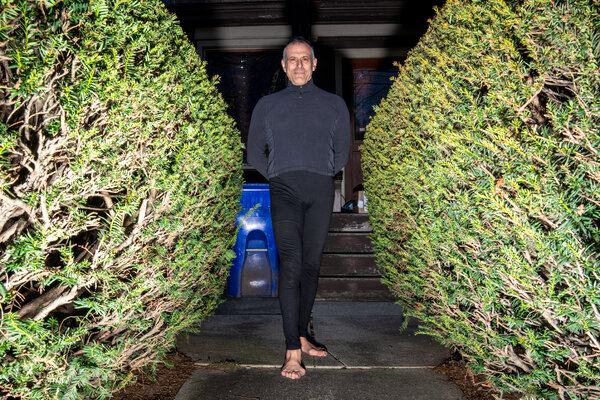
Photo: Joe Buglewicz for the New York Times via OddityCentral.
Joseph DeRuvo has gone barefoot for years. He says going barefoot means being mindful of how you move through the world. (And washing well at night!)

Here’s an unusual guy worth writing about. We can always learn something interesting from the outliers in our society. Let me know what you think. In my case, this guy makes me wince just thinking about all the stubbed toes I had as a barefoot child on Fire Island.

Katherine Rosman reports at the New York Times, “A few years back, Joseph DeRuvo Jr. made a quick stop at an upscale supermarket to buy eggs and was stopped in the dairy aisle by a store manager. ‘You’re not wearing shoes,’ he recalled the manager saying to him.

“He was right. Mr. DeRuvo wasn’t wearing shoes. He almost never does. The employee cited health codes; Mr. DeRuvo disputed that he was in violation. The employee made vague references to insurance policies; Mr. DeRuvo replied, ‘More people break their necks with high heels than they ever do going barefoot.’ …

“Mr. DeRuvo initially decided to forgo shoes because of agonizing bunions, but he has stayed barefoot for reasons that transcend physical comfort. …

“There are questions he is asked frequently that he is always happy to answer. How does he manage snow and ice? Doesn’t he get sharp objects stuck in his thick calluses? But that’s the simple stuff. ‘Navigating the terrain is easy,’ Mr. DeRuvo said. ‘Navigating people is tricky.’

“When asked to leave a shop or a restaurant, he normally does so without protest, said Mr. DeRuvo’s wife, Lini Ecker, a shoe-wearer who serves as a bridge between her husband and a world that generally asks for conformity. …

“For two decades, Mr. DeRuvo, 59, has lived an almost entirely barefooted life, one he has constructed, with Ms. Ecker’s help, to limit or avoid such confrontations. After years spent as a photographer and a photography teacher, he is still self-employed, now as a Pilates instructor, a particularly barefoot-friendly profession. And the couple stays close to home. When they go out, they gravitate toward mom-and-pop stores and restaurants where they can forge personal connections with owners and managers, and he can be seen as more than the guy with the feet.

“Still, said Ms. Ecker, 61, ‘we get thrown out of a lot of places.’ … Ms. Ecker, a preschool teacher, prepared lunch, lightly grilling bagels in a cast iron pan, slicing avocados, tossing a salad. Mr. DeRuvo grabbed a pair of chop sticks, his preferred cutlery. This is among his ‘quirks,’ as he calls them. He needs reggae music to play in the background at almost all times; the only numbers he can remember are of radio stations, which he uses for internet passwords.

“ ‘I clearly have one foot on the spectrum,’ he said earlier (though he clarified that he has never undergone an autism evaluation).

“Mr. DeRuvo’s lifestyle has given him reason to think a lot about bare feet, assessing their safety and hygiene and whether they threaten polite society. He can come up with no health risk. What germs can his feet carry that the bottom of someone’s shoes do not? …

“Mr. DeRuvo assumes all risk of stubbed toes, or worse. He has performed a number of jobs all in his bare feet and all safely. He is a tinkerer and a maker, including of his own Pilates equipment that he fabricates in the elaborate workshop he built out of the garage behind his house, sometimes wearing safety goggles but rarely shoes. (He will wear moccasins while welding.)

“In case he steps on something sharp, he carries a sunglasses case filled with tweezers to remove detritus, pulling his feet close to his face to spy metal splinters and shards of glass. He showers at night, scrubbing his feet clean before getting into bed with his wife.

“And he knows when to capitulate, he said, keeping a pair of loosefitting sandals in the car in case there is an event where others would be inconvenienced by him getting refused entry, like when they go to dinner with friends.

“But generally Mr. DeRuvo chooses the comfort of his feet over doing anything or going anywhere that forces him to force them into a pair of shoes.

“Bare feet outside of the beach, the yoga studio or the pedicure chair tend to attract attention. … ‘People have a thing about feet,’ Mr. DeRuvo conceded. ‘People get skeeved.’

“Mr. DeRuvo’s look like they would hurt inside a pair of shoes: His big toes, with a protruding large bump at their bases, jut aggressively toward the pinkie toes on a diagonal.

“The bumps are bunions. About 20 years ago, they had become painful — throbbing during long runs in tight sneakers and interfering with his life. Mr. DeRuvo saw a doctor who recommended surgery. As he awaited the scheduled procedure, he went without shoes because the pain was so intense. In the intervening days he learned that the screws that were to be implanted in his feet contained a metal he was allergic to. He also realized that he felt better since he quit shoes.

“It did not take long before he came to see that going barefoot was enriching his life in ways he did not anticipate. There were physical benefits in addition to the relief for the bunions: He found comfort from the ground beneath him. ‘The tactile feedback just kind of makes everything else going on feel a little bit smoother,’ he said.

“There are spiritual benefits too, said Mr. DeRuvo, a religious man. ‘God says to Moses, “Take off your sandals,” you know, “this ground is holy,” ‘ he said. ‘Well, I kind of like to take that as far as it can go.’ ”

More at the Times, here.

Read Full Post »